The Compliance Cliff: prohibited practices and governance controls that actually ship
Prohibited practices aren’t a legal footnote — they’re product constraints. This month is about turning “don’t do this” into guardrails you can deploy: policy gates, capability limits, audit trails, and incident-ready governance.

Axel Domingues
February taught us how to test agents.
March teaches the harder lesson:
You can have perfect evals and still ship something you’re not allowed to ship.
This is the “compliance cliff” every team hits the first time an agent leaves the lab:
- the product works
- the metrics look good
- stakeholders are excited
…and then someone asks:
“Are we allowed to do this?”
The uncomfortable truth is that compliance is not a document.
Compliance is runtime behavior + evidence.
So this month I’m going to treat regulation the way an engineer should treat it:
as a set of constraints that must be designed into the system.
Always validate your interpretation with counsel for your specific product, jurisdiction, and use case.Think of this as an engineering translation layer: how to turn “prohibited practices” and “governance requirements” into controls you can actually ship.
The real goal
Turn legal “must not” statements into invariants enforced by architecture.
The real output
Not a policy PDF — an evidence trail: logs, evals, approvals, and kill switches.
The real risk
Agents blur UX + decisions + persuasion. That’s where prohibited behavior hides.
The real win
Ship faster by making compliance repeatable (like CI), not heroic (like audits).
What “prohibited practices” means to an engineer
Most compliance regimes have two kinds of rules:
- Do these things (disclosure, logging, oversight, incident handling)
- Never do these things (the “prohibited” bucket)
Engineers naturally gravitate to (1) because it sounds like features.
But (2) is where teams get surprised — because prohibited behavior often emerges from composition:
- a model that can persuade
- plus user profiling
- plus high-leverage UI actions
- plus weak oversight
None of those parts are “illegal” in isolation.
Together, they can become a prohibited system behavior.
So the right mental move is this:
Treat “prohibited practices” as system-level failure modes.
You don’t “comply” with them by adding a checkbox.
You comply by preventing the system from entering those states.
The four prohibited-practice traps agents fall into
Prohibited practices are written in legal language, but the operational meaning is usually one of these traps.
Manipulation at scale
When the agent’s “helpfulness” becomes behavior steering (nudges, dark patterns, coercive copy, pressure).
Exploiting vulnerability
When the agent targets people who can’t reasonably defend themselves (children, impaired users, dependency contexts).
Automated judgment
When the system assigns “worthiness” and uses it to gate outcomes (ranking people, eligibility, reputational scoring).
Biometric + emotion shortcuts
When “efficiency” leads to facial scraping, biometric categorization, or emotion detection in sensitive settings.
These show up in agent systems in very practical ways:
- A sales agent that learns which phrasing maximizes conversion can become a dark-pattern machine without anyone intending it.
- A support agent that profiles sentiment can drift into “emotion recognition” territory if you’re not strict about what signals you ingest and how you use them.
- A “helpful assistant” that suggests actions can become manipulative when paired with tight loops (notifications, “urgent” messaging, fear-based copy).
- A productivity agent deployed in the workplace can cross lines fast if it starts inferring traits or monitoring behavior “for optimization.”
That means your system needs explicit “persuasion boundaries,” not just good intentions.Even if you don’t ask them to persuade, their job is to produce language that moves the user toward actions.
The compliance control plane
If you only learn one pattern from this post, make it this:
Put compliance controls in a separate plane from product code.
Because compliance isn’t one feature.
It’s a cross-cutting set of guarantees:
- who can do what
- under what conditions
- with what disclosures
- with what oversight
- with what evidence
That’s not “an agent prompt.”
That’s a platform layer.
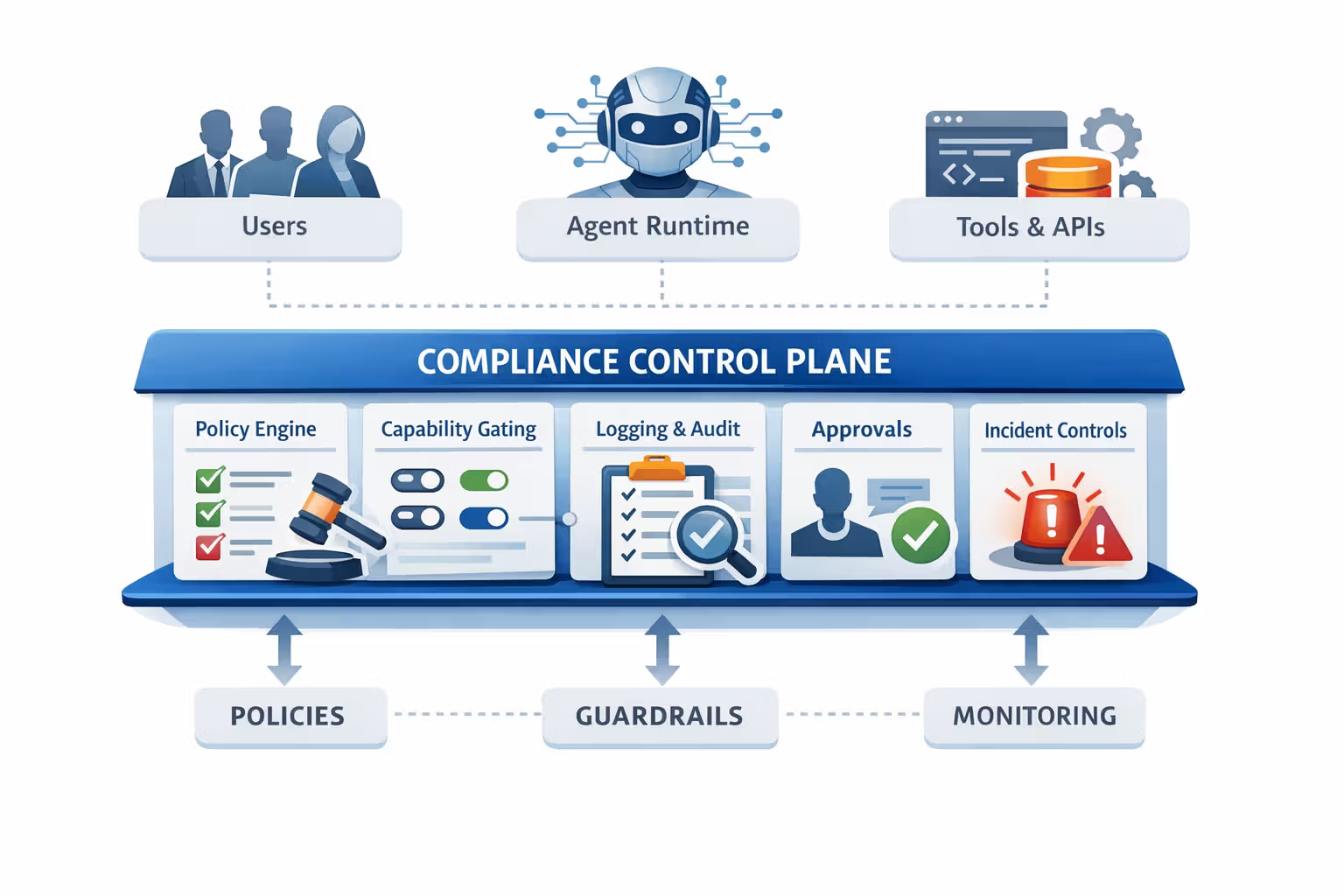
A practical control plane usually has these building blocks:
- Policy-as-code gate (feature flags + rules + jurisdiction + customer tier)
- Capability sandboxing (tool allowlists, scopes, quotas, safe-mode)
- Auditability (structured traces, immutable logs, replay handles)
- Oversight hooks (human approval, escalation, refusal paths)
- Monitoring + kill switches (rate limits, anomaly detection, instant disable)
The goal is not bureaucracy.
The goal is making “what we are allowed to do” enforceable at runtime.
From “rule” to “control”: the translation method
When compliance hands you a rule, you need to translate it into four artifacts:
- Scope: What features, users, and contexts does it apply to?
- Invariants: What must never happen?
- Controls: What prevents or detects invariant violation?
- Evidence: What proves the controls exist and worked?
This is the same move we used in 2023 for hallucinations:
Define truth boundaries. Enforce them. Measure them.
Now we’re doing it for governance.
If you can’t test it, you can’t ship it.
The governance controls that actually ship
Below is a minimum viable governance stack that teams can implement without turning product development into molasses.
It’s structured like production architecture: layered defenses, clear owners, and evidence by default.
Goal: prevent “we built it, now legal says no.”
- a short intake form that captures:
- user group (consumer, employee, child, vulnerable group)
- domain (health, finance, education, HR, public services)
- data types (personal, sensitive, biometric)
- actions (read-only, write actions, money movement, account changes)
- a fast classification outcome:
- green / yellow / red
- with required controls per class
Evidence: intake record + assigned risk class + reviewer identity + timestamp.
Goal: enforce boundaries even when the model improvises.
- tool allowlists by feature and environment
- scoped credentials (least privilege) per tool
- “safe mode” variants of tools (read-only, dry-run, preview)
- jurisdiction + age + role based restrictions
- quotas and rate limits for high-risk actions
Evidence: policy rules + tool scope configs + denied-action logs.
Goal: oversight at decision points with real harm.
Use human approval for:
- irreversible actions (money movement, account deletion)
- high-impact decisions (eligibility, sanctions, HR outcomes)
- uncertain classifications (model confidence low, policy match ambiguous)
Design the UX so the human can:
- see the proposed action + rationale + inputs
- approve / edit / reject
- request more context
Evidence: approval records + diffs + final action traceability.
Goal: answer “what happened?” without archaeology.
Log structured events for:
- user request
- context sources used (IDs, versions)
- model + tool versions
- policy decisions (allow/deny/require approval)
- tool calls (inputs redacted, outputs hashed)
- final user-visible outputs
Evidence: immutable log store + retention policy + replay handles.
Goal: prevent prohibited behavior regression the same way we prevent test regressions.
Add eval suites for:
- manipulation / dark pattern tendencies
- vulnerability exploitation prompts
- sensitive trait inference attempts
- “policy bypass” and jailbreak variants
- tool misuse (unsafe clicks, risky UI flows)
Evidence: CI run history + thresholds + red-team findings + fixes.
Goal: make failures survivable.
- kill switch (feature + tenant + capability-level)
- rollback plan for model/prompt/tool changes
- incident playbooks (severity, owners, communication)
- post-incident review templates
Evidence: tested runbooks + incident drills + change history.
Designing for “prohibited practices” without guessing the law
Here’s the pragmatic stance:
You don’t need to memorize every line of regulation to build safer systems.
You need a design posture that makes prohibited outcomes difficult.
That posture is:
- don’t build persuasion loops without oversight
- don’t infer sensitive traits unless you absolutely must (and can justify it)
- don’t automate high-impact judgment without human review
- don’t pull in biometric/emotion signals “because it’s easy”
So what should you do on Monday morning?
Build controls around the four traps.
Control patterns for each trap
1) Manipulation at scale → “No persuasion” boundaries
The mistake is treating manipulation as “bad prompts.”
Manipulation is usually an optimization target hidden inside product metrics: conversion, retention, “resolution rate.”
Controls that ship:
- Copy + UX review: treat agent copy like growth copy (red-team it)
- No urgency / scarcity patterns for high-stakes flows
- Persuasion-limiter policies: enforce safe language in certain contexts
- Metrics firewall: never optimize on outcomes that reward coercion (e.g., “close rate” in debt collection)
That’s fine — but it must be governed like one.
2) Exploiting vulnerability → context-aware restrictions
The failure mode here is subtle:
A model adapts tone based on signals. Those signals correlate with vulnerability. Now the agent “helps” by applying pressure in the exact places it shouldn’t.
Controls that ship:
- Age / role gating (and don’t pretend you can infer age safely)
- Dependency detection flags (e.g., medical/mental health keywords) → shift to safe-mode
- Hard refusal boundaries (no financial coercion, no self-harm escalation, no medical instructions beyond policy)
- Escalation to humans when vulnerability triggers are hit
3) Automated judgment → separate “assist” from “decide”
Agents are great at summarizing.
They’re dangerous at adjudicating.
Controls that ship:
- Decision separation: the agent can recommend, but a deterministic service decides
- Feature flags: “assist mode” vs “autopilot mode”
- Explanations: the agent must cite reasons and limits, not just outcomes
- Appeals: users can contest and get a human review path
4) Biometric + emotion shortcuts → strict data contracts
The fastest way into a compliance cliff is “we added webcam analysis.”
Controls that ship:
- Data contracts: explicitly ban certain data types at ingestion
- Tool restrictions: no webcam/screenshot OCR unless justified and sandboxed
- Privacy review gates: anything biometric requires a separate approval path
- Model training boundaries: no “we kept the images for later” surprises
Shipping playbook: compliance as a delivery pipeline
Here’s a lightweight process that works in real teams.
It doesn’t require an army of lawyers.
It requires discipline and automation.
Define the use-case envelope (the “what are we building?” doc)
Write a one-pager that answers:
- who uses it
- where it runs
- what data it touches
- what actions it can take
- what harm looks like
Classify risk and attach required controls
Produce one of:
- allowed with standard controls
- allowed with extra controls
- blocked pending redesign
Encode policy as code (so it can’t be bypassed)
Turn the decision into:
- feature flags
- allowlists
- approval rules
- safe-mode fallbacks
Add governance evals to CI
Ship tests that fail when:
- the agent persuades in restricted contexts
- the agent attempts sensitive inference
- the agent uses forbidden tools
- the agent ignores “require approval” policies
Ship with audit + kill switches
Assume failure. Make it reversible.
Governance that doesn’t collapse under scale
The real reason governance fails is that it’s “someone’s job” instead of “how the system works.”
When you run fleets of agents, you need governance like you need DevOps:
- standardized
- automated
- observable
- owned
A practical operating model looks like this:
- Product owns the use-case envelope and user-impact decisions
- Platform owns capability gating, logging, and runtime controls
- Security/Privacy/Legal own policy requirements and review thresholds
- Everyone owns evidence (because it’s baked into CI and telemetry)
A governance rule worth stealing
If a control isn’t enforceable by the platform, it doesn’t exist.
If it isn’t measurable, it isn’t reliable.
If it isn’t repeatable, it won’t survive scale.
Resources
EU AI Act — official text (Regulation (EU) 2024/1689)
The source of truth for what’s prohibited, what’s required, and how obligations are scoped — use this to anchor every “invariant” you encode.
AI Act Service Desk — Article 5 (Prohibited AI practices)
A practical, navigable view of the prohibited-practices bucket — useful when translating legal language into product-level failure modes (manipulation, vulnerability, social scoring, etc.).
FAQ
No. The point is to stage risk.
Start with low-risk use cases:
- internal productivity with no high-impact decisions
- read-only assistance
- “drafting” workflows with human approval
Build the control plane once, then reuse it.
No.
Models are probabilistic. They drift with prompts, context, and tool availability.
You need hard boundaries:
- capability gating
- policy checks
- deterministic enforcement
- auditability
No.
The same engineering controls show up everywhere:
- privacy regimes
- consumer protection
- workplace monitoring rules
- sector regulation (finance/health)
Treat this as a general “governance architecture” playbook.
What’s Next
March was about turning “prohibited practices” into controls that can be enforced and audited.
April is where agent platforms start to look real:
Agent runtimes emerge — SDKs, orchestration primitives, and the observability stack you need to run agents as a product, not a demo.
Agent Runtimes Emerge: SDKs, orchestration primitives, and observability
In 2025, “agents” stop being demos and start being products. This is the month you realize you don’t need a smarter model — you need a runtime: durable execution, safety gates, and traces you can debug.
Agent Evals as CI - From Prompt Tests to Scenario Harnesses and Red Teams
If your agent ships without tests, it’s not an agent — it’s a production incident with good marketing. This month is about turning “it seems fine” into eval gates you can run in CI.