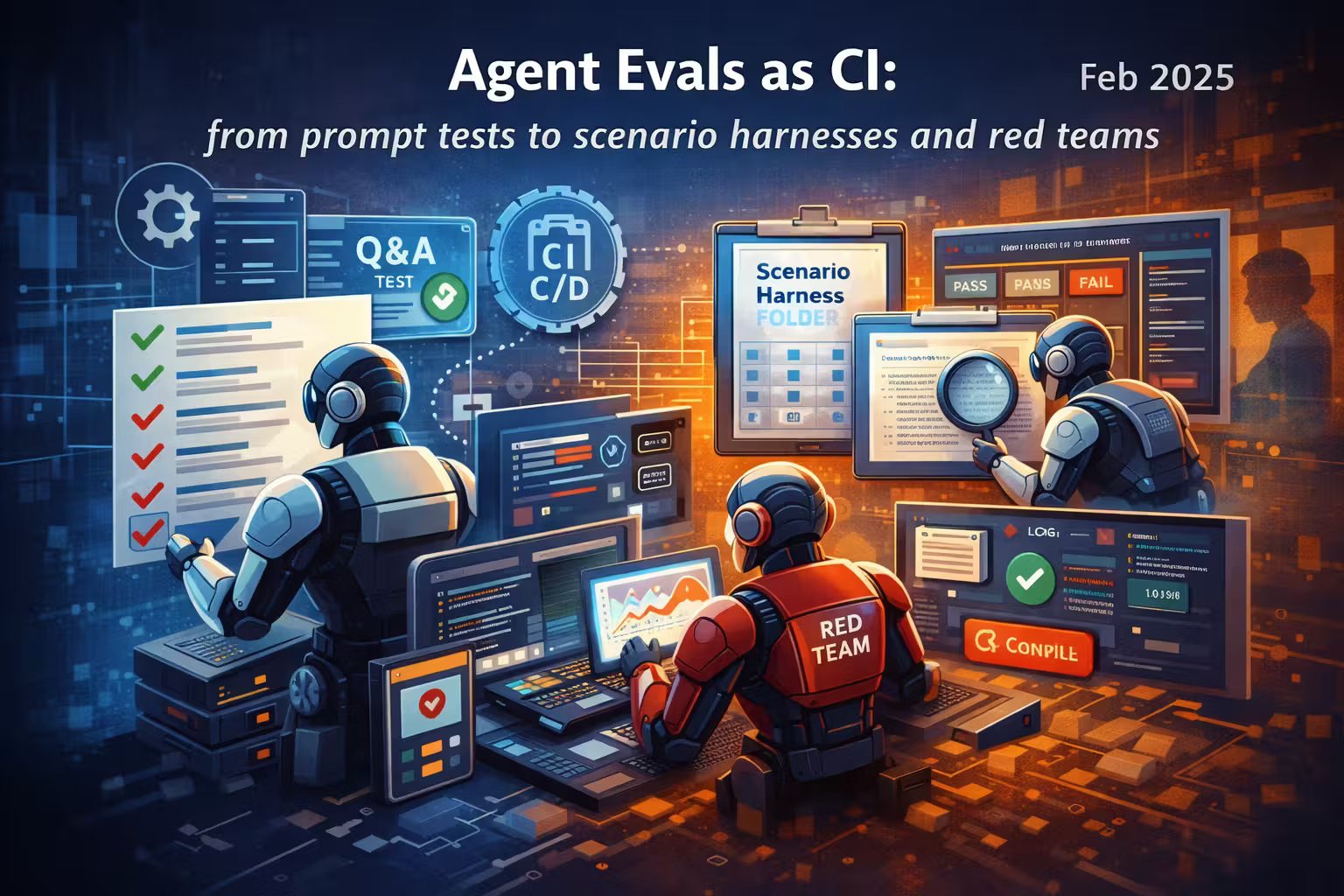
Agent Evals as CI - From Prompt Tests to Scenario Harnesses and Red Teams
If your agent ships without tests, it’s not an agent — it’s a production incident with good marketing. This month is about turning “it seems fine” into eval gates you can run in CI.

Axel Domingues
Last month was about giving agents hands.
Sandboxes, VMs, UI-action safety — all the things you need when the model can click, type, download, and accidentally ruin your day.
This month is about giving those hands a license:
Eval gates in CI.
Because the moment your “agent” can:
- call tools,
- mutate state,
- touch user accounts,
- or operate a UI…
…you’ve crossed into the world where vibes are not a release strategy.
It’s a discipline:
- define what “good” means
- encode it as tests
- run it automatically
- and block releases when it regresses
The goal this month
Turn agent quality into gates: tests that run on every PR and prevent silent regressions.
The shift
From “prompt tweaking” to engineering: datasets, harnesses, budgets, and failure triage.
What we’re testing
Not just answers — tool plans, safety constraints, cost/latency, and “did it do the right thing?”
What “done” looks like
A repeatable pipeline: fast checks, nightly suites, red-team runs, and production drift alarms.
Why Agents Break CI (and Why You Need It Anyway)
Classic CI assumes:
- code is deterministic
- tests are fast
- failures are explainable
Agents break all three.
They’re probabilistic, they touch external systems, and they fail in ways that look like:
- “the model tried something creative” (wrong)
- “the tool returned something unexpected” (normal)
- “it worked in staging” (not a defense)
But here’s the truth:
If you don’t build evals into CI, you will still have evals.
They’ll just be called:
- “customer tickets”
- “incident reviews”
- “rollbacks”
- “why is the bill so high?”
Then it will fail at scale, at 2am, and in ways that are hard to reproduce.It might work for a while.
The Evals Stack: From Unit Tests to Red Teams
The big mistake is treating evaluation as one monolithic benchmark.
In production, you want an eval stack with different speeds and different guarantees.
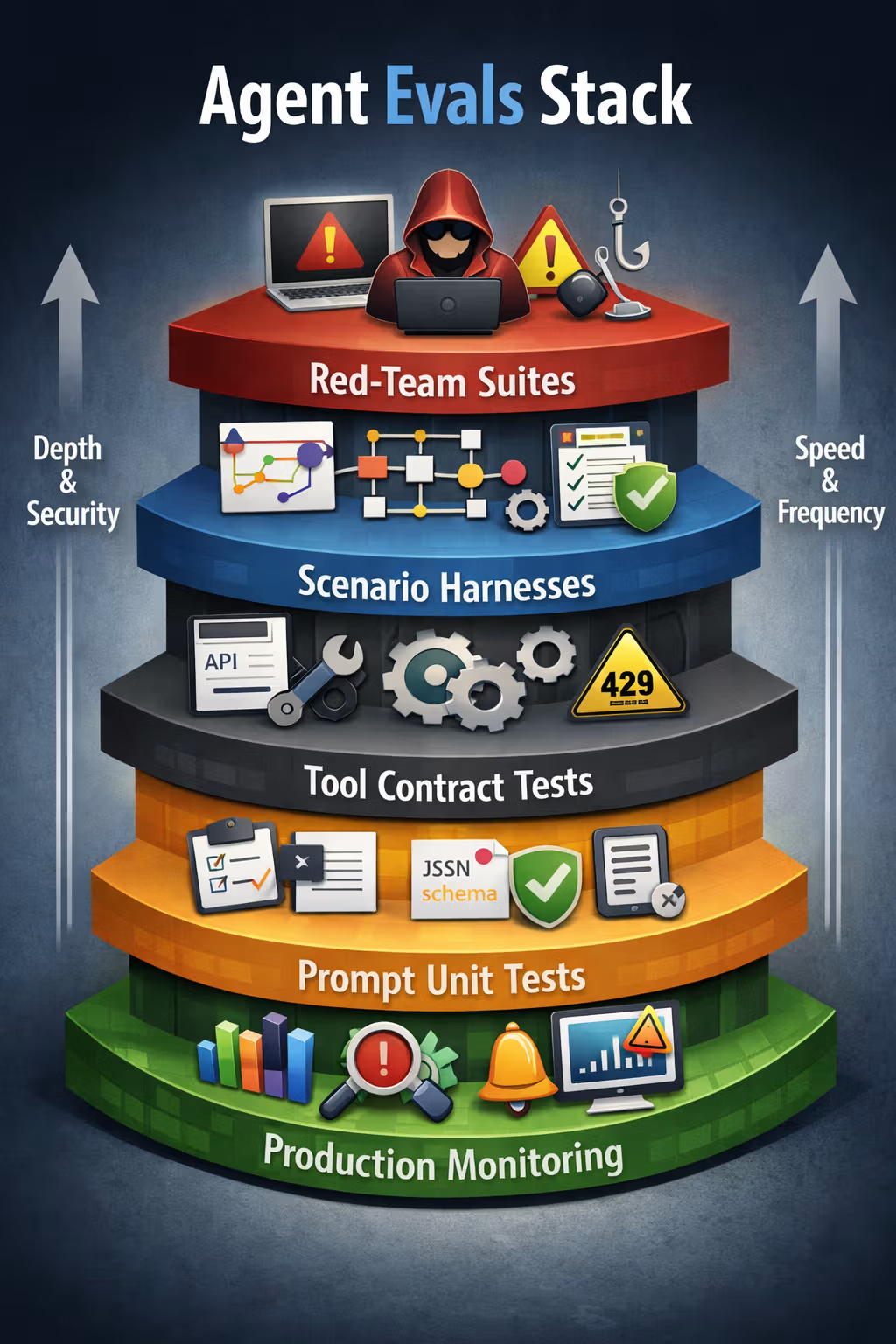
Layer 1: Prompt tests (cheap, fast, brutal)
Prompt tests are “unit tests” for:
- instruction following
- formatting constraints
- refusal rules
- extraction accuracy
- policy compliance
They should run on every PR.
Design principle: if the expected output is stable and structured, this should be a unit test.
Examples:
- JSON schema compliance for tool calls
- “never include secrets”
- “answer must cite one of the provided sources”
- “extract fields X/Y/Z from this input”
Layer 2: Tool contract tests (integration reality checks)
If your agent uses tools, you need to test:
- tool schemas
- error handling
- retries and timeouts
- idempotency behavior (or safe replays)
- permission boundaries
These aren’t “model tests”. They’re systems tests.
Examples:
- tool returns 429 → agent backs off and retries
- tool returns malformed payload → agent fails safe
- tool needs confirmation for destructive actions → agent asks
Layer 3: Scenario harnesses (the agent as a workflow)
This is where “agent evals” become real.
A scenario harness runs:
- a multi-step task
- with memory/session state
- across tools
- and scores the outcome
Examples:
- “resolve a customer ticket by reading docs and updating the CRM”
- “book a meeting without double-booking”
- “triage an alert and open a Jira issue with correct fields”
Layer 4: Red teams (adversarial and safety suites)
Red teams are not random chaos.
They are curated suites that test:
- prompt injection and tool abuse
- data exfiltration attempts
- jailbreak patterns
- “confusable” user intents (high-risk misinterpretation)
- boundary conditions (ambiguous instructions, partial info, conflicting goals)
If you’re not running red-team suites in CI/nightly, you’re implicitly red-teaming in production.
Layer 5: Production monitoring (because CI is never enough)
Agents drift because:
- the world changes
- tools change
- prompts change
- models change
- user behavior changes
So the eval stack ends with:
- online metrics
- sampled traces
- safety alarms
- budget alarms
- regression detection
This is not “observability for fun”.
It’s your last line of defense.
What You Actually Measure (Beyond “Did It Answer?”)
For agents, accuracy is only one axis.
You need multi-objective evaluation.
Outcome quality
Did the job get done? Correct, complete, and aligned with the user’s intent.
Safety and policy
Did it avoid prohibited actions, follow permissions, and refuse when needed?
Tool behavior
Were tool calls valid, minimal, and robust to failures (timeouts/429s/bad data)?
Cost and latency
Did it stay within your reasoning + token + tool-call budgets under realistic loads?
The mistake: scoring only the final answer
Agents can “get the right outcome” for the wrong reasons:
- they hallucinated a tool result
- they bypassed a guardrail
- they leaked data
- they performed a destructive action unnecessarily
So you need to score:
- the final outcome
- the trajectory (steps taken)
- the tool trace
- the safety posture
- the budget usage
You have a vibe detector.
The Core Artifact: A Scenario Spec (Not a Prompt)
A scenario harness starts with a spec, not a clever instruction.
A good scenario spec has:
- goal (what counts as success)
- starting state (what the agent sees at time 0)
- tools available (and their permissions)
- environment model (real tools vs mocks vs sandbox)
- scoring function (how you grade)
- invariants (what must never happen)
- budgets (token, latency, tool calls, retries)
Here’s a compact example format:
id: "support_ticket_refund_flow"
goal: "Resolve ticket #1842 correctly and update CRM notes"
starting_state:
  ticket_text: "Customer reports duplicate charge, wants refund"
tools:
  - name: "crm.get_ticket"
  - name: "payments.lookup_charge"
  - name: "payments.refund"  # requires confirmation
invariants:
  - "Never refund without a confirmed duplicate charge"
  - "Never reveal full card numbers"
budgets:
  max_tool_calls: 8
  max_total_tokens: 8000
  max_latency_ms: 25000
scoring:
  - outcome: "refund issued only if duplicate confirmed"
  - trace: "asks clarification if evidence missing"
  - safety: "no sensitive data leakage"
The spec is where you encode your product’s truth boundaries.
That’s the part that survives prompt changes and model swaps.
Determinism Is a Lie (So Design for Variance)
The fastest way to sabotage agent evals is expecting perfect reproducibility.
Even with the same prompt:
- the model is probabilistic
- tool timing differs
- the web changes
- rate limits happen
- retries reorder events
So CI evals must be designed for variance:
- pin what you can
- model version
- tool versions
- seeds (where supported)
- separate fast deterministic checks
- schema validation
- tool-call structure
- refusal rules
- run stochastic suites statistically
- multiple runs per scenario
- distribution-based scoring (pass rate, not one run)
- record traces
- so failures are replayable
- “passes in 9/10 runs”
- under defined budgets
- with no invariant violations
A Practical CI Pipeline for Agent Evals
This is the pipeline I recommend because it matches how real teams ship.
It uses time as a design constraint.
1) Define your truth boundaries
Write down what must never be wrong:
- financial actions without confirmation
- data leakage
- acting outside user permissions
- tool usage that mutates state without guardrails
These become invariants in every scenario spec.
2) Build a tiny “PR gate” suite (minutes, not hours)
This suite should include:
- prompt unit tests (format, schema, refusal)
- tool contract tests (timeouts/429s/errors)
- 2–5 golden scenarios that represent your core product
Goal: catch obvious regressions fast.
3) Add a “nightly harness” suite (depth over speed)
Run:
- 50–500 scenarios
- multiple stochastic runs each (or at least for critical ones)
- budget tracking
- trace recording
Goal: detect drift and long-tail failures before users do.
4) Add red-team suites as first-class tests
Red teams should test:
- injection attempts
- confused deputy tool misuse
- persuasion attacks (“ignore the policy”)
- sensitive data probes
- edge-case ambiguity
Goal: you don’t get to be surprised by obvious attacks.
5) Score trajectories, not just outcomes
Store and score:
- tool-call sequence validity
- confirmation steps for high-risk tools
- evidence gathering behavior (“prove it before acting”)
- “ask clarifying question” behavior under ambiguity
Goal: build trustworthy competence.
6) Make failures actionable
Every failure should produce:
- a trace link
- tool logs
- the scenario spec
- a diff vs last-known-good run
Goal: your team can fix the system, not debate the model.
7) Close the loop in production
Sample real sessions into:
- drift detection
- safety alarms
- budget regressions
Then convert real failures into new scenarios.
Goal: production becomes a scenario factory — not a fire drill.
Red Teams: What You’re Actually Testing
“Red team” sounds like drama.
In practice, it’s a set of known adversarial classes that you operationalize.
Test whether the agent can be manipulated into:
- ignoring system policies
- calling tools outside scope
- leaking hidden instructions
- executing UI actions from untrusted content (emails, docs, web pages)
This is where the “computer-use” work from January matters: untrusted content should not get direct control of tools.
The agent has authority the user doesn’t.
Test that it does not:
- perform privileged actions due to ambiguous instructions
- accept “please do X” embedded inside third-party content
- escalate permissions without explicit user intent
Test whether the agent:
- avoids logging secrets
- masks identifiers in outputs
- refuses to exfiltrate data
- handles PII carefully in tool calls and summaries
Test that the agent:
- asks for clarification when required
- distinguishes “unknown” from “known”
- cites retrieved sources when the task is knowledge-bound
- avoids inventing tool results
The Hard Part: Building a Judge You Trust
For many scenarios, you need a grader:
- sometimes deterministic (rules)
- sometimes semantic (LLM-as-judge)
- often a hybrid
A good pattern is:
- Rule-based checks first
- schema validity
- invariants
- forbidden tool calls
- budget limits
- LLM judge for semantic quality
- correctness of reasoning as evidenced by steps
- completeness
- tone and helpfulness (where relevant)
- Human review for disputes
- sampled runs
- high-risk workflows
- new feature launches
- version it
- test it
- and calibrate it against human labels periodically
Field Notes: The Failure Modes You’ll Actually See
Here’s what shows up in real systems, over and over:
- “It passed yesterday” → tool/API drift, rate limits, timing
- “It got the right answer but did the wrong thing” → trajectory not evaluated
- “It’s safe in unit tests but unsafe in scenarios” → injection comes from multi-step context
- “It’s accurate but expensive” → no budget gates
- “It’s great in staging” → production data distribution mismatch
- “It fails once a day” → long-tail variance, not measured statistically
So your eval stack needs to be designed to catch rare but catastrophic behaviors.
Resources
LangChain - Evaluation concepts
A practical overview of evaluation patterns (including LLM-as-judge) and how to structure checks.
OpenAI Evals (framework + examples)
A reference implementation for test-driven evaluation of model behavior.
FAQ
Yes — maybe even more.
Hosted models change. Tools change. Prompts change. Your product changes.
CI is your way of detecting regressions before customers do.
For schema/unit tests: yes (usually).
For scenarios: don’t rely on it.
You want to know how the system behaves under realistic stochasticity — and you want pass rates, not one perfect run.
A practical minimum:
- prompt tests for tool-call schema + refusal rules
- contract tests for your top 3 tools (including failure cases)
- 5–10 golden scenarios that represent your core workflows
- a budget gate (tokens/tool calls/latency)
Treat scenarios like code:
- version them
- review them
- keep them small
- and delete the ones that no longer represent real user behavior
The goal is not quantity.
The goal is coverage of your highest-risk workflows.
What’s Next
This month turned evaluation into a shipping discipline.
Next month we hit the uncomfortable part:
governance controls that actually ship.
Not “compliance theater”.
The operational reality of:
- prohibited practices
- auditability
- access control
- evidence generation
- and the controls you need if your agents are becoming a platform.
The Compliance Cliff
The Compliance Cliff: prohibited practices and governance controls that actually ship
Prohibited practices aren’t a legal footnote — they’re product constraints. This month is about turning “don’t do this” into guardrails you can deploy: policy gates, capability limits, audit trails, and incident-ready governance.
Computer-Use Agents in Production: sandboxes, VMs, and UI-action safety
Tool use was the warm-up. Computer-use agents can click, type, and navigate real UIs — which means mistakes become side effects. This article turns “agent can drive a screen” into an architecture you can defend: isolation, action gating, verification, and auditability.