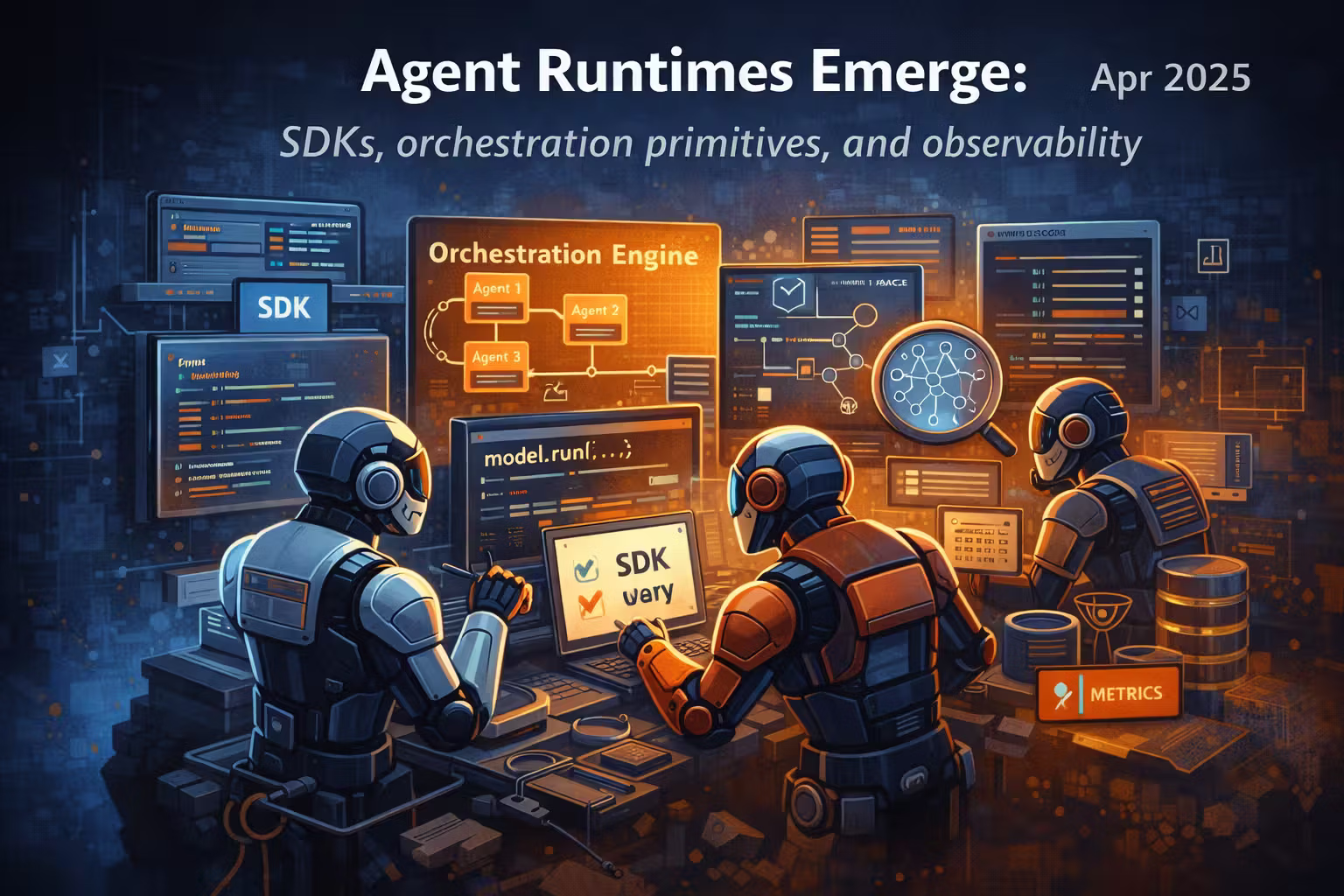
Agent Runtimes Emerge: SDKs, orchestration primitives, and observability
In 2025, “agents” stop being demos and start being products. This is the month you realize you don’t need a smarter model — you need a runtime: durable execution, safety gates, and traces you can debug.

Axel Domingues
March was the compliance wake-up call.
April is the engineering one.
Because once you decide an agent is allowed to act (call tools, click buttons, run workflows, touch data), the hard problem stops being “prompting” and becomes:
How do we run this thing reliably, safely, and debuggably?
That’s what agent runtimes are for.
Not a framework. Not a prompt library.
A runtime — the execution substrate that turns probabilistic reasoning into repeatable operations.
And every platform eventually needs the same three things:
- orchestration primitives (state, retries, timeouts)
- security boundaries (permissions, isolation, approvals)
- observability (traces, not vibes)
What changed in 2025
Agent capabilities improved — but the bigger shift is how we package execution: SDKs now ship with state, policies, and tracing.
The new unit of work
Not “a prompt”.
A run: multi-step, tool-heavy, budgeted, auditable.
The runtime job
Turn plans into operations: manage state, control tool access, handle retries, and surface traces humans can debug.
The failure mode
Without a runtime, “agent reliability” becomes folklore: invisible loops, silent tool errors, and zero accountability.
What Is an Agent Runtime (Really)?
Think of it like the JVM or the browser runtime — not the language model, but the thing that executes safely.
An agent runtime owns these responsibilities:
- Session & state: what the agent knows right now (and what it must forget)
- Tool I/O: calling tools with permissions, schemas, and sandboxes
- Durable execution: retries, timeouts, idempotency, checkpointing
- Policy enforcement: what actions are allowed (and under which conditions)
- Budgeting: token + time + tool cost caps per run
- Human-in-the-loop gates: approvals, escalations, review queues
- Observability: traces that let you answer “what happened?” in minutes, not days
If your system lacks any of these, you don’t have a runtime — you have a demo.
If your agent does more than one external side effect (emails, tickets, payments, deploys, UI clicks), you need durable execution + traceability.
SDKs Are Becoming Runtimes (Whether They Say So or Not)
In 2023–2024 we talked about tool use.
In 2025, the real product surface is execution.
So “agent SDKs” are evolving into something bigger:
- from prompt utilities → to run orchestration
- from one-shot tool calls → to multi-step plans
- from logging text → to tracing runs
- from best-effort → to budgeted + gated + replayable
This isn’t hype.
It’s a convergent architecture.
Every team that ships agents ends up reinventing the same primitives — until they standardize them.
The Orchestration Primitives That Actually Matter
Let’s name the primitives explicitly.
Because “agent orchestration” sounds mystical until you reduce it to runtime contracts.
Runs + checkpoints
A run has an ID, a current step, and a resumable checkpoint. If the worker dies, the run continues.
Deterministic state transitions
Treat run state as a state machine: explicit transitions, explicit failure states, no invisible “thinking”.
Tool contracts
Tools are APIs with schemas, auth scopes, and error contracts — not “functions the model can magically call”.
Budgets + timeouts
Cap tokens, wall time, and tool spend per run. Timeouts are not edge cases — they’re the default.
Retries + idempotency
Retries must be safe. Side effects need idempotency keys and “already done” handling.
Human gates
Approvals are first-class transitions. Humans are not “exceptions” — they’re part of the runtime.
If you’ve built distributed systems, none of this is new.
The only novelty is that the “business logic” is partly probabilistic — so you must compensate with stronger operational constraints.
If the agent can click “Confirm purchase” twice, you need idempotency and approvals — not a better prompt.
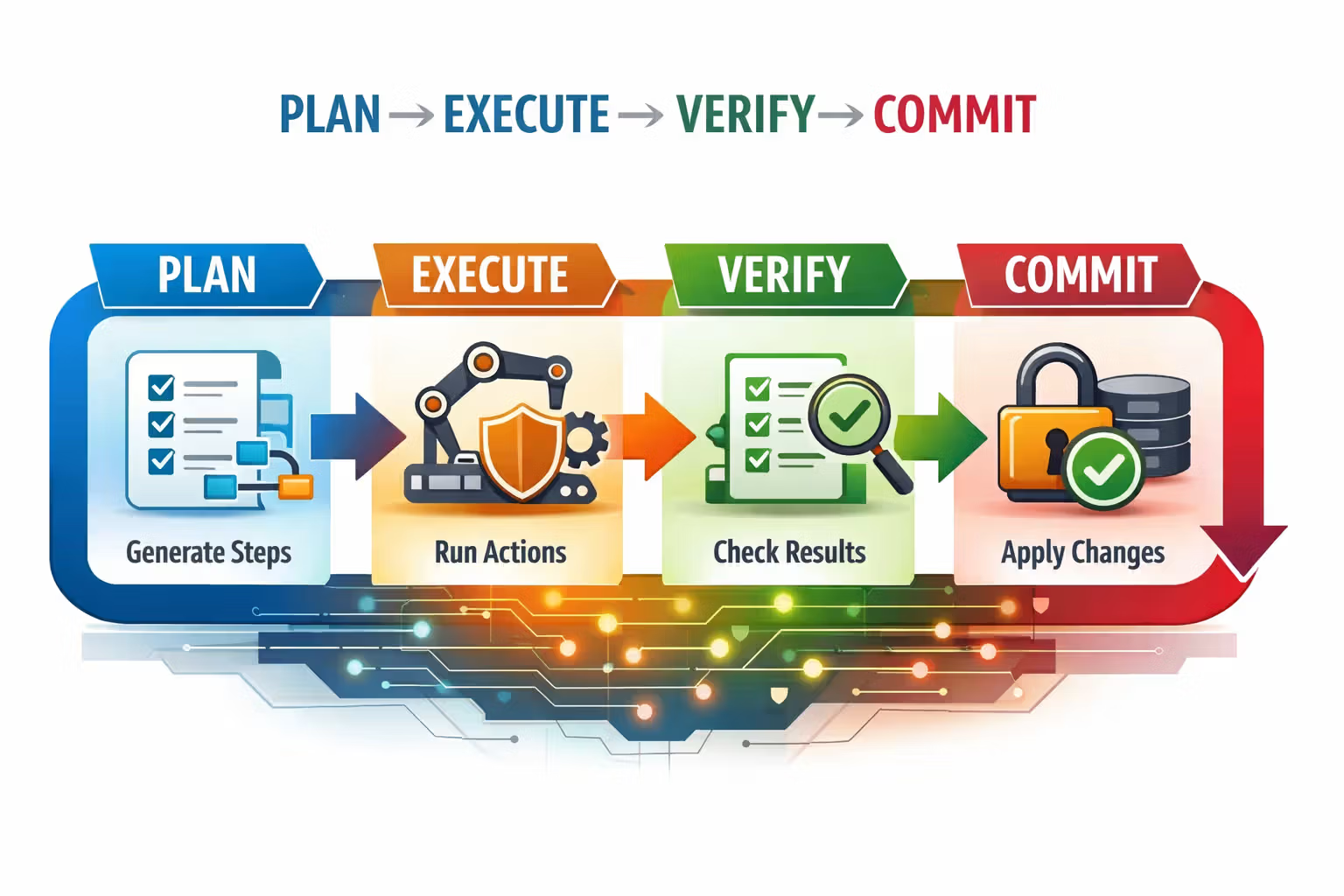
A Practical Runtime Model: Plan, Execute, Verify
A healthy runtime doesn’t let the model directly perform irreversible actions.
It wraps action in structure:
- Plan: decide steps (and produce a machine-readable plan)
- Execute: run tool calls with policies, budgets, and retries
- Verify: validate outcomes (with checks, not vibes)
- Commit: only then perform irreversible side effects
This is how you make “agentic” feel like engineering again.
Observability: The Runtime’s Superpower
Agents fail in ways that are qualitatively different from normal services:
- the “logic” is not fully deterministic
- the agent may try multiple strategies
- tool errors can be misinterpreted (or ignored)
- loops can be rational-sounding until you check the trace
So you need tracing, not just logs.
What a good run trace lets you answer
- Which tools were called, with which parameters (redacted where needed)?
- Why did the agent choose that action?
- Where did time go (model vs tools vs waiting vs retries)?
- Did we violate a policy gate?
- What changed in state between step N and N+1?
- If we replay this run, do we get the same operations?
A minimal “span taxonomy” for agent runs
You don’t need perfection. You need consistency.
agent.run
  agent.step (plan | tool | verify | summarize)
    llm.call
    tool.call (tool_name)
    retrieval.query (optional)
    policy.check (optional)
    approval.wait (optional)
And you need consistent attributes:
{
  "run_id": "run_123",
  "step_id": "step_07",
  "model": "gpt-4.1",
  "tool": "crm.create_ticket",
  "budget_tokens_remaining": 1200,
  "timeout_ms": 15000,
  "retry_count": 1,
  "policy_decision": "allow",
  "human_gate": "required:false"
}
Logs and traces have a habit of turning into a shadow data lake. Redaction, retention, and access control are runtime features — not compliance paperwork.
A Reference Architecture for Agent Runtimes
Here’s a blueprint that survives contact with production.
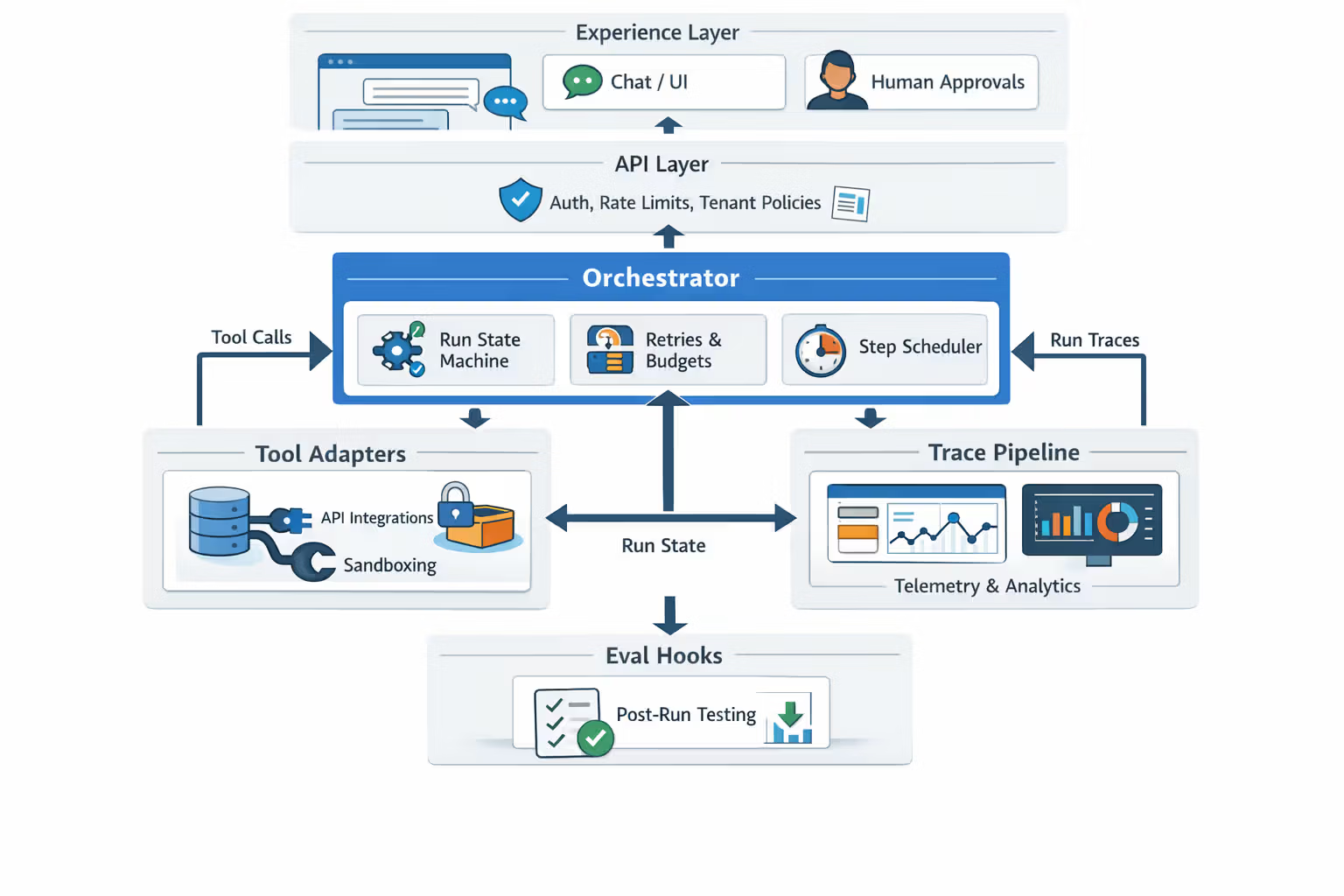
The layers
- Experience layer: chat/UI + human approval surfaces
- API layer: authentication, rate limits, tenant policy
- Orchestrator: run state machine, step scheduling, retries, budgets
- Tool adapters: typed connectors with scoped auth + sandboxing
- State store: run state, checkpoints, memory pointers, artifacts
- Trace pipeline: OpenTelemetry-compatible traces + run analytics
- Eval hooks: post-run scoring + regression gates (from February)
This is also why “runtimes” are emerging as products: every serious team ends up building this stack anyway.
How to Adopt This Without Boiling the Ocean
A runtime is not a rewrite. It’s a set of constraints you add until the system becomes operable.
Start with a single run schema
Define what a “run” is:
- run_id, status, step pointer, budgets
- inputs, outputs, artifacts
- audit metadata (who/what triggered it)
Add checkpoints before you add cleverness
If a worker dies, can you resume? If the answer is “no”, you’re still in demo territory.
Wrap every side effect with an idempotency key
Email, ticket, payment, deploy, UI click: every action must be safely repeatable.
Make policy checks explicit steps
“Allowed?” is a state transition, not a comment in code.
Instrument traces early
If you can’t debug it, you can’t ship it.
Teams that do it backwards end up with a smart agent they’re afraid to run.durability → safety → observability → intelligence
Resources
OpenTelemetry Traces
The baseline for distributed tracing — and the lingua franca for agent run observability.
OpenTelemetry Semantic Conventions
How to standardize span names and attributes so traces stay queryable at scale.
Temporal (Durable Execution)
A practical reference for retries, timeouts, and crash-proof workflows — the core of production orchestration.
FAQ
A workflow engine is a big part of it — durable state, retries, timeouts.
But a runtime also includes:
- model execution + tool mediation
- policy enforcement
- budgeting
- sandboxing / permissioning
- traces that stitch model and tools together
If it has no side effects, you can often get away with a simpler “LLM app” architecture.
The moment it:
- writes data,
- triggers actions,
- or runs multi-step tasks…
…you want runtime primitives, or you’ll reinvent them under pressure.
Buy the primitives you can standardize:
- tracing
- workflow durability
- sandboxing / secrets
Build the parts that encode your domain:
- tool adapters
- policies
- run semantics
- approval flows
The best strategy is usually: compose a runtime from strong building blocks.
What’s Next
April is where “agents” start looking like a platform layer.
Next month, we hit the economic reality shift that changes system design again:
The 1M-Token Era
When context becomes cheap enough (or big enough), the architecture of memory, retrieval, and caching gets rewritten.
The 1M-Token Era: how long context changes retrieval economics and system design
Long context doesn’t kill RAG — it changes what’s cheap, what’s risky, and what needs architecture. This month is a practical guide to building “context-first” systems without shipping a cost bomb (or a data leak).
The Compliance Cliff: prohibited practices and governance controls that actually ship
Prohibited practices aren’t a legal footnote — they’re product constraints. This month is about turning “don’t do this” into guardrails you can deploy: policy gates, capability limits, audit trails, and incident-ready governance.