
The 1M-Token Era: how long context changes retrieval economics and system design
Long context doesn’t kill RAG — it changes what’s cheap, what’s risky, and what needs architecture. This month is a practical guide to building “context-first” systems without shipping a cost bomb (or a data leak).

Axel Domingues
When long context crossed into “absurd,” a bunch of teams celebrated for the wrong reason.
They treated it like a feature that replaces architecture:
“We can just shove everything into the prompt.”
That works… right up until:
- latency doubles,
- cost triples,
- the model ignores the paragraph you care about,
- and your legal team asks why production logs are in the context window.
Long context is real leverage — but it doesn’t remove engineering. It moves the boundary of what’s worth retrieving, what’s worth caching, and what’s worth curating.
This month is about that boundary shift.
I’m saying the option changes system design the way “cheap storage” changed databases: you start designing around what’s cheap enough, not what’s theoretically minimal.
The new reality
Your context window can fit whole manuals, large codebases, or multi-day threads.
The new constraint
Cost + latency scale with “how much you stuff,” and attention doesn’t scale linearly.
The new risk
More context means more secrets, injections, and compliance surface area.
The new opportunity
Context becomes a tiered memory system: hot, warm, cold — not “prompt vs RAG”.
Long context didn’t kill RAG — it changed the economics
Before long context, the default plan was:
- retrieve a handful of chunks,
- keep prompts tight,
- optimize for “just enough grounding.”
With long context, you can load an entire knowledge slice and let the model navigate.
So what changes?
1) Retrieval is no longer the only way to get “coverage”
If you can fit the full product spec, you can stop playing “top‑k roulette” for many tasks:
- summarizing a multi-section doc
- answering within one manual
- extracting structured requirements from a repo of ADRs
But…
2) Retrieval still wins on precision and cost
Long context is “coverage.” RAG is “precision.”
If the task is needle‑finding (one clause, one config key, one exception case), retrieval + tight context is still cheaper and often more accurate.
3) You now have three costs, not one
Long context forces you to budget across:
- token cost: you pay to send it
- latency cost: you wait to process it
- attention cost: the model may not actually use it
That last one is the trap: you can buy tokens and still get shallow answers.
You gave the model everything… and it treated the most important page like background noise.
The “context pyramid”: think tiers, not a single prompt
I’ve started treating context as a pyramid with explicit tiers.
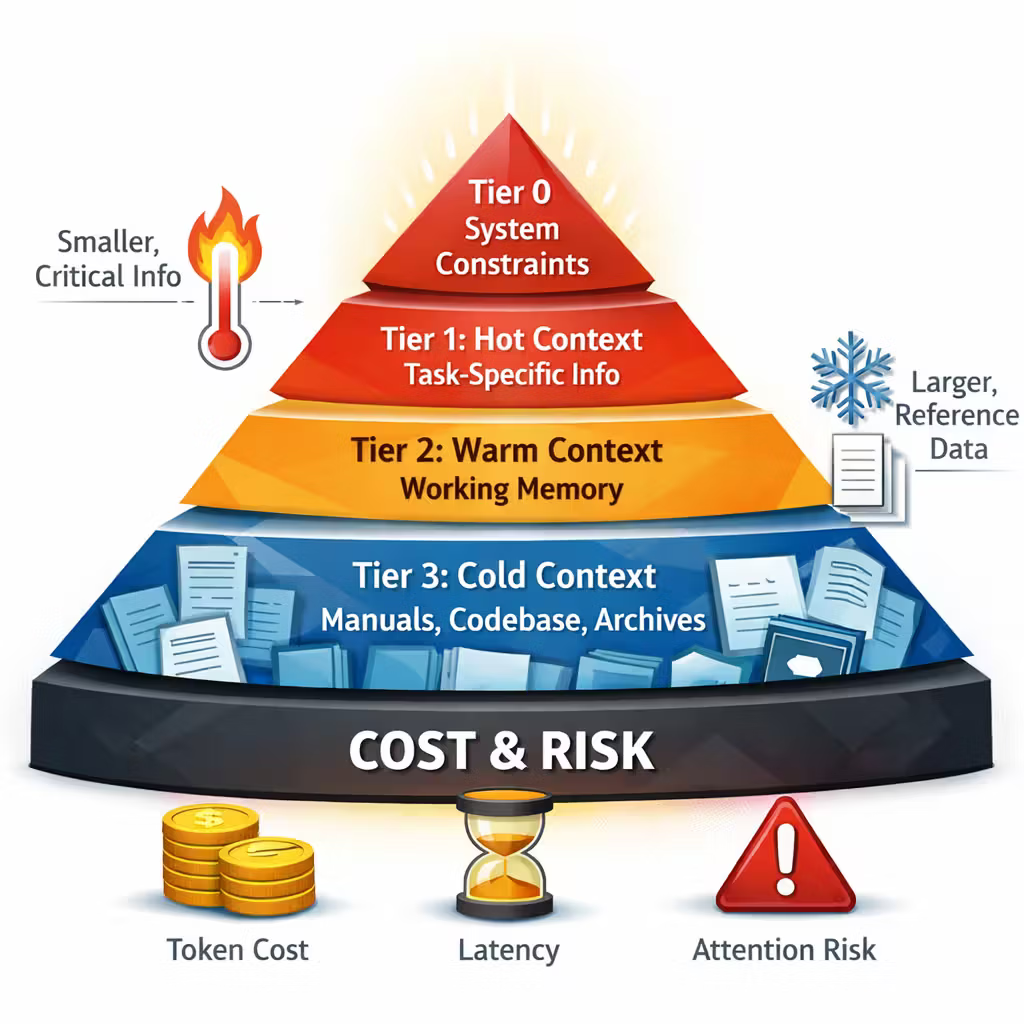
Tier 0: System constraints (hot, tiny, non-negotiable)
This is the part you never let be ambiguous:
- “what must never happen” (truth boundaries)
- tool rules and safety policies
- output format contracts
Tier 1: Task-specific facts (hot)
- the user’s request
- current inputs (files, records, UI state)
- the smallest grounding you can justify
Tier 2: Working memory (warm)
- conversation summary
- last decisions
- a running plan / checklist
- a short “known constraints” block
Tier 3: Reference memory (cold, large)
- manuals
- runbooks
- policies
- codebase slices
- incident timelines
Long context mostly expands Tier 3 — and that’s where your architecture needs to show up.
They’re better packers:
- dedupe
- prioritize
- compress
- and only expand cold memory when the task demands it
What “context-first” system design looks like
If you want long context to be an advantage, you need a pipeline. Not a prompt.
Here’s the minimal architecture I’ve found that holds up in production.
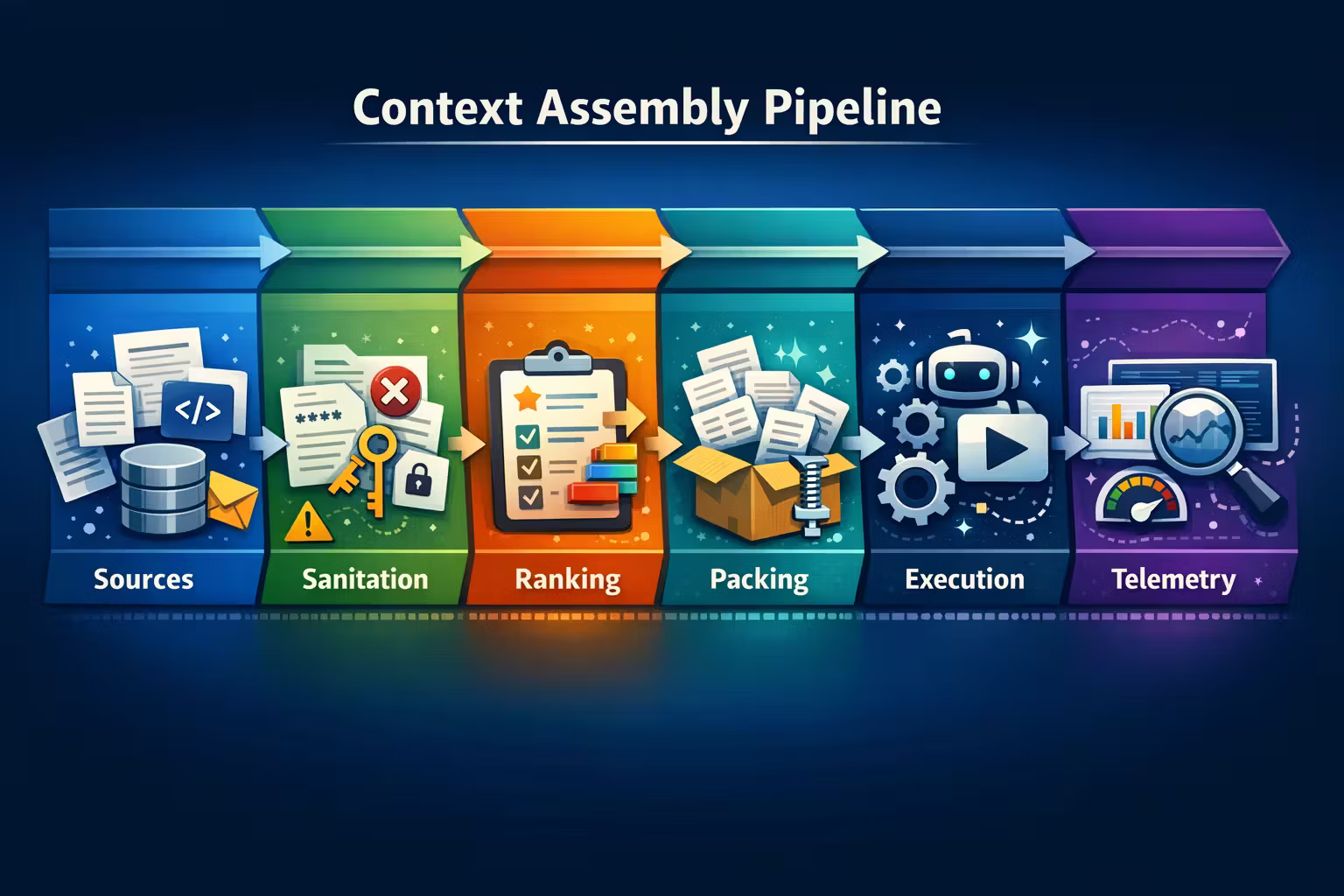
Define a context budget (explicitly)
Pick hard limits per request class:
- max cold tokens
- max tool output tokens
- max conversation memory tokens
Then build enforcement into the system (not “developer discipline”).
Sanitize before you summarize
Do redaction and classification before anything else:
- strip secrets (keys, tokens, credentials)
- mark PII and regulated data
- block disallowed sources
Summarization after leakage is still leakage.
Rank, dedupe, compress
Long context dies from redundancy:
- repeated headers
- quoted email chains
- boilerplate legal text
- duplicated logs
Dedupe aggressively, then compress:
- structural summaries (section outlines + key claims)
- extract only the clauses that matter
- collapse repeated tables to references
Pack with intention (order matters)
Models have positional biases. You want:
- constraints early
- task facts early
- references grouped by topic, with headings
- the “answer-critical” bits duplicated into Tier 1 as a “golden snippet”
Measure what you ship
Log a context manifest:
- token counts per tier
- top included sources (IDs)
- compression ratio
- retrieval hit rate (if you use RAG)
If you can’t see it, you can’t tune it.
When should I use long context vs RAG?
I use this decision matrix in architecture reviews.
| Task type | Long context is great when… | RAG is great when… | Typical hybrid |
|---|---|---|---|
| Summarization | You need coherent coverage of an entire artifact | You only need one section | Retrieve key sections + load the whole doc only if needed |
| Q&A | The question is broad and multi-part | The question is needle-like | RAG to locate needles + long context for surrounding reasoning |
| Code assistance | You need cross-file reasoning in one repo slice | You only need exact symbol usage | Retrieve call graph + load the relevant modules |
| Compliance/policy | You must interpret a full policy document | You need one clause fast | Load policy index + retrieve clause + include policy definitions |
| Support/incident | You need timeline + multi-source coherence | You need one error signature | RAG for signatures + long context for the incident narrative |
The pattern to notice: hybrid wins, but with a new default:
- start tight,
- expand cold memory on demand,
- and stop expanding when confidence stabilizes.
Observability for long context: what to log or you will suffer
Long context changes what “debugging” looks like.
In classic RAG debugging, you ask:
- did retrieval fetch the right chunks?
In long-context debugging, you ask:
- did the model use the right chunks?
Here’s what I recommend logging as a baseline.
Context manifest
Token counts per tier, source IDs, compression ratio, dedupe ratio.
Attention proxies
Citations/quotes mapped to sources, plus “unused context” estimates.
Outcome quality
Task success metrics + reviewer feedback + auto-checkers where possible.
Cost & latency
p50/p95 latency, tokens in/out, cache hit rate, tool time.
If the task is high-risk (policy, finance, legal, production ops), don’t ask for “citations” as a vibe.
Make grounding a contract:
- require the answer to include source IDs for key claims
- reject outputs that cannot map claims to sources
- store the mapping for audit (and future regressions)
You’ll be shocked how many “confident” answers collapse when you require traceable sources.
If your system includes 600k tokens and the output only references one 2k chunk, you probably paid for noise.
You can approximate “unused context” by:
- tracking which sources are quoted/cited
- tracking which retrieved items become answer anchors
- running a cheap post-check: “Which sources were actually necessary?”
Security and compliance: long context expands your blast radius
Long context makes two old problems worse:
1) Data exfiltration is easier
If you stuff:
- logs,
- internal tickets,
- customer records,
- or secrets,
…you increased your chance of exposing them in output, telemetry, or tool calls.
2) Prompt injection becomes a document property
An injection string inside a doc is no longer “some weird chunk.” It can be embedded anywhere in the cold tier.
So you need controls that are built for scale.
Practical controls that actually ship:
- source allowlists by request class (support vs ops vs compliance)
- automatic redaction (secrets + PII) before the LLM sees anything
- tool call gating (the model can propose actions, but execution is policy-checked)
- output filters for regulated strings (keys, IDs, credential patterns)
- context hashing for audit (“what exactly did we send?”)
The new design pattern: “expand-on-demand” context
The winning pattern I’ve seen is a two-pass flow:
- tight pass: minimal task facts + a small retrieval set
- expansion pass (conditional): load large cold memory only if needed
Why it works:
- you keep default cost low
- you avoid attention dilution for simple tasks
- you still have an escape hatch for complex tasks
Long context is a capability. “Expand-on-demand” is a strategy.
A concrete checklist you can use in a design review
If I’m reviewing a “let’s use long context” proposal, I ask:
- Do we have max tokens per tier?
- What happens when we exceed them (truncate, summarize, refuse, or degrade)?
- Are budgets enforced in code, or in “guidelines”?
- Secrets redaction (credentials, keys, tokens)
- PII classification + removal policy
- Allowlist of sources by request class
- Are we deduping repeated headers/quotes/logs?
- Do we compress cold memory to outlines and key clauses?
- Do we promote “golden snippets” to Tier 1?
- Do we store a context manifest?
- Do we track token cost by tier and by feature?
- Do we have evals that catch “worse answers with bigger context”?
- Are tool calls gated by policy?
- Do we sandbox tool outputs?
- Do we treat doc instructions as untrusted data?
Resources
Lost in the Middle - How Language Models Use Long Context (2023)
A clear look at why “more tokens” doesn’t automatically mean “better use of information”.
Retrieval-Augmented Generation for Knowledge-Intensive NLP Tasks (2020)
The modern baseline for grounding generation with retrieval — still relevant in the long-context era.
What’s Next
May was about context economics:
- what long context makes cheap,
- what it makes risky,
- and what needs architecture to keep costs and safety under control.
Next month we zoom out again.
If agents are doing work in the background — with retries, tools, and side effects — they start behaving like distributed systems.
Agents as Distributed Systems
Agents as Distributed Systems: outbox, sagas, and “eventually correct” workflows
Agents don’t “run in a loop” — they run across networks, vendors, and failures. This month is about the three patterns that make agent workflows survivable: durable intent (outbox), long-running transactions (sagas), and reconciliation (“eventually correct”).
Agent Runtimes Emerge: SDKs, orchestration primitives, and observability
In 2025, “agents” stop being demos and start being products. This is the month you realize you don’t need a smarter model — you need a runtime: durable execution, safety gates, and traces you can debug.