Standards for the Agent Ecosystem: connectors, protocols, and MCP
Agents are becoming the new integration surface. This is how you go from bespoke tool wiring to an ecosystem: portable connectors, common protocols, and a practical standard called MCP.

Axel Domingues
2024 was the year I stopped treating LLMs as “an API” and started treating them as a runtime.
- In July, I argued RAG is only “done” when you can evaluate it.
- In August, I treated tool use as a security problem: capability boundaries and sandboxes.
- In September, regulation became architecture: controls and evidence.
- In October, we budgeted reasoning: fast/slow paths + verification.
- In November, we made agents real-time: streaming + barge‑in + session state that doesn’t collapse.
By December, one thing is obvious:
Agents are becoming the new integration surface.
And integration surfaces always converge on standards—because the alternative is every team reinventing the same adapters, the same auth flows, and the same safety mistakes.
This article is about the “standards layer” that makes an agent ecosystem possible:
- Connectors: packaged integrations with real services
- Protocols: a common way for clients and connectors to talk
- MCP: an emerging protocol that tries to make tool ecosystems composable
It’s an architecture post:
- what needs to be standardized (and why)
- how to design for portability without losing control
- and how MCP fits into a pragmatic production stack
The core problem
Tool integrations don’t scale as one-off code.
The core risk
A tool call is a privilege escalation unless you design a boundary.
The core goal
Portable connectors + common protocols = an ecosystem you can operate.
The 2025 setup
Once tools are standard, workflows become the next reliability battle.
Why “agent integration” is different from classic integrations
Classic software integrations have a stable shape:
- API calls
- explicit parameters
- deterministic outputs
- known failure modes
Agent integrations are messier because they include a probabilistic component that chooses when to call tools and how to interpret results.
So the integration surface shifts:
- from “call endpoint X”
- to “give the runtime safe access to capabilities A, B, C”
That’s why I keep repeating capability boundaries.
Tool use is not “a feature.”
Tool use is delegation.
And delegation always needs:
- permissions
- auditing
- constraints
- rollback / containment when things go wrong
The layer cake: connector, protocol, runtime
Here’s the mental model I use.
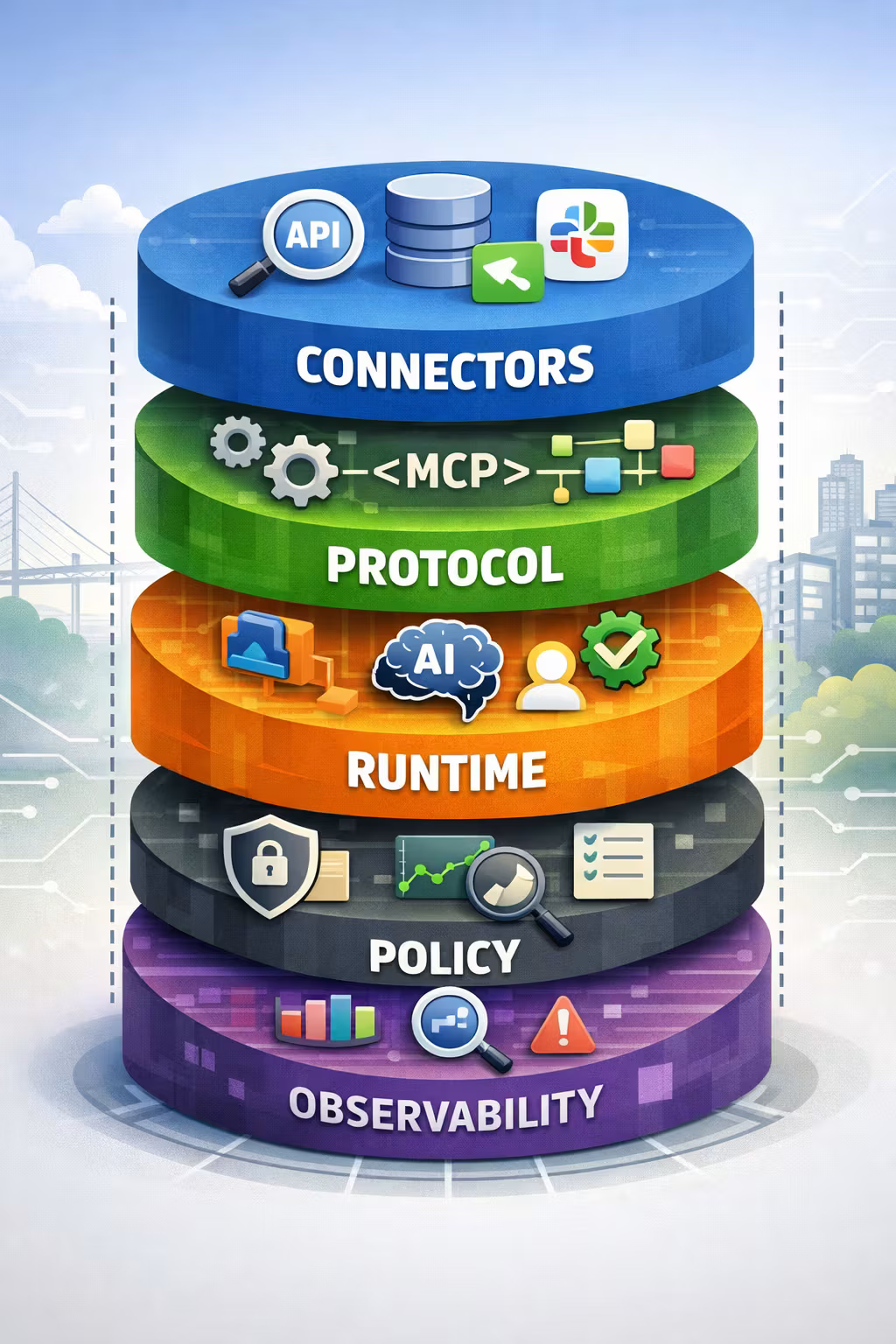
1) Connectors (the integration code)
A connector is a packaged bridge to an external capability:
- “Search tickets in Jira”
- “Create a Salesforce lead”
- “Query a Postgres DB (read-only)”
- “Send an email (with constraints)”
A connector owns the ugly parts:
- auth flows
- retries/backoff
- pagination
- rate limiting
- service-specific edge cases
2) A protocol (the interoperability contract)
A protocol standardizes how a client discovers and calls capabilities:
- discovery: what tools exist?
- schemas: what inputs/outputs are expected?
- transport: how are messages exchanged?
- errors: how are failures represented?
- state: what is session-scoped vs tool-scoped?
- security hooks: where consent / policy decisions plug in
3) The runtime (your product)
Your runtime is where product truth lives:
- policy
- telemetry
- user intent
- “truth boundaries”
- budget decisions (latency/cost/risk)
The runtime decides:
- what connectors are allowed
- what tools can run in this context
- how results are verified
- what gets written to audit logs
If you treat them as “just APIs”, you will miss the security boundary.
What standards actually need to standardize
Most discussions jump straight to “tool schemas.”
Schemas matter, but they’re only one layer.
The ecosystem needs agreement on a few boring but load-bearing things.
Capability discovery
Clients need to discover tools/resources dynamically, not hardcode lists.
Identity + consent
Who is calling? Who approved? What scopes? For how long?
Error + retry semantics
Retries without idempotency create duplicate money.
Observability
Trace IDs, audit logs, tool timing, cost, and outcomes must be first-class.
The “tool contract” I wish everyone shipped
If you want portability and safety, your tool contract needs more than a name and JSON schema.
It needs operational intent.
Here’s a compact contract shape that’s practical in real systems:
{
  "name": "create_invoice",
  "description": "Create an invoice for an existing customer",
  "inputsSchema": "JSON Schema here",
  "outputsSchema": "JSON Schema here",
  "sideEffects": "writes",
  "idempotency": { "supported": true, "keyField": "idempotencyKey" },
  "riskClass": "high",
  "auth": { "type": "oauth", "scopes": ["invoices.write"] },
  "rateLimit": { "burst": 10, "perMinute": 60 },
  "costHint": { "unit": "requests", "maxPerCall": 1 }
}
That looks like “extra bureaucracy”… until you’ve operated a tool ecosystem.
Then you realize:
- idempotency is how you avoid double‑charges
- riskClass is how you decide when to require explicit confirmation
- auth scopes are how you keep connectors from becoming skeleton keys
- rateLimit + costHint are how you keep agents from melting your platform
A contract tells you what the tool does.
Connectors: the unit of distribution (and the unit of risk)
Let’s be blunt: most “tool integrations” today are copied snippets.
That doesn’t scale, and it’s not governable.
A connector should be a real artifact:
- versioned
- testable
- releasable
- revocable
- runnable in a sandbox
- observable (structured logs + traces)
What “good connector DX” looks like
Local runs (developer laptop, desktop app) are great for:
- fast iteration
- private credentials
- tight user consent loops
Remote runs (hosted) are great for:
- centralized governance
- uniform observability
- shared caching / rate limits
The runtime should be able to answer:
- what can this connector read?
- what can it write?
- what are the dangerous operations?
If the connector can’t declare this, you can’t safely automate it.
Every connector should ship:
- schema validation tests
- contract tests against a sandbox environment (or mocks)
- replayable fixtures for “golden” tool calls
In production, “uninstall” means:
- revoke credentials
- disable tool routing
- quarantine the connector binary/container
- keep evidence for incident review
Protocols: the interoperability multiplier
If connectors are the unit of distribution, protocols are the multiplier.
Without a protocol, every client needs a bespoke adapter per connector.
With a protocol:
- many clients can talk to many connectors
- tool discovery becomes dynamic
- governance can be centralized
- vendors stop inventing incompatible function-call formats
That brings us to MCP.
MCP: Model Context Protocol (what it is, and why it matters)
MCP is an attempt to standardize how AI clients connect to external context and tools.
The key idea is simple:
A model shouldn’t be hardwired to every integration.
A client should connect to servers that expose tools and context in a standard way.
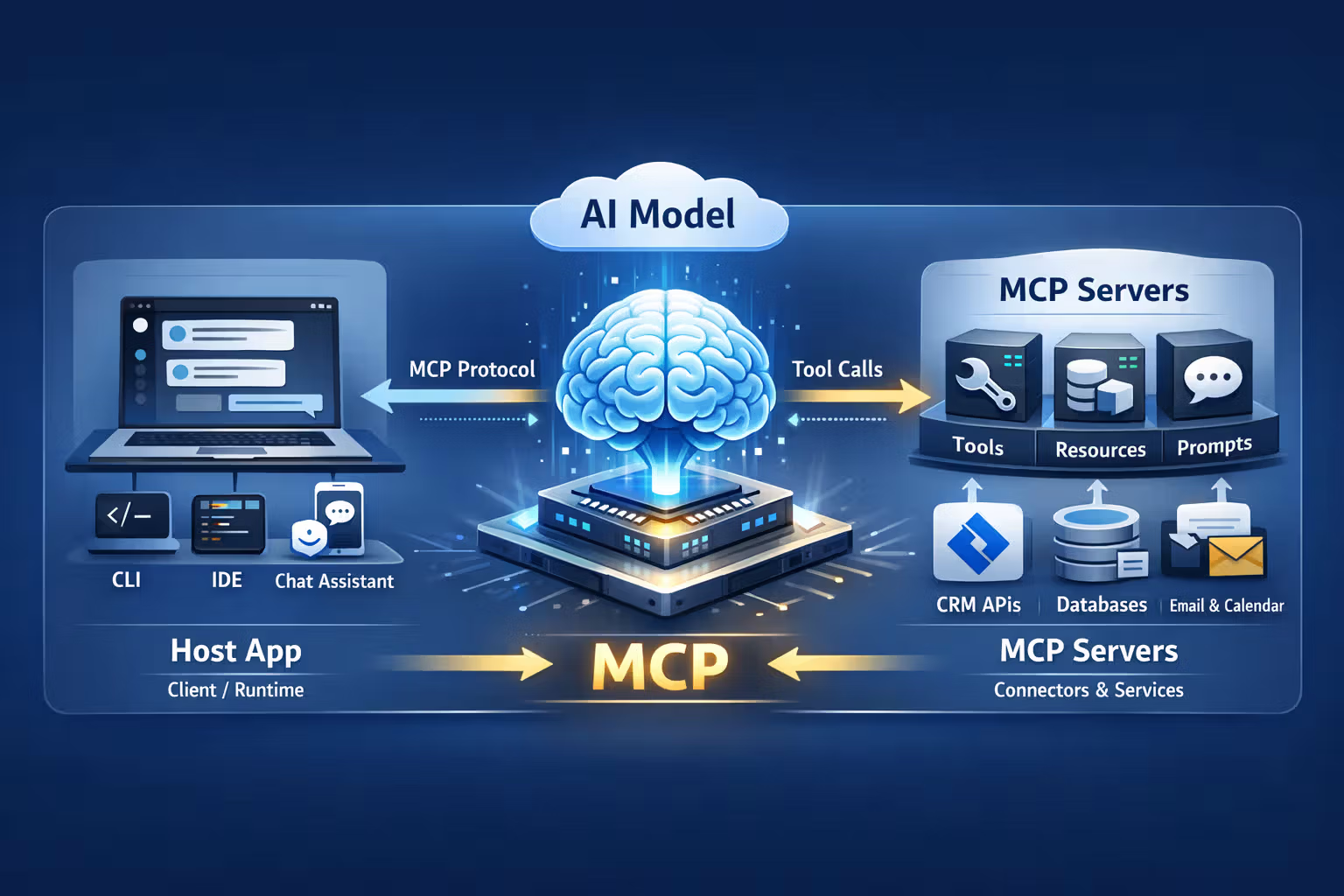
MCP introduces a few primitives that map cleanly to real product needs:
- Tools: actions you can execute (with schemas)
- Resources: data you can fetch/reference (think “read-only context”)
- Prompts: reusable prompt templates exposed by a server
It also standardizes discovery and interaction patterns so clients can enumerate capabilities and call them consistently.
Where MCP fits in your stack
Think of MCP as the “connector protocol” between:
- AI hosts/clients (chat apps, IDEs, desktop assistants)
- and MCP servers (connectors exposing tools/resources/prompts)
What MCP solves (and what it doesn’t)
What it solves
Portability
Build a connector once; let multiple clients consume it.
Discovery
Clients can list tools/resources instead of hardcoding them.
Separation of concerns
Tool wiring lives in servers; product policy lives in the runtime.
A real ecosystem shape
Registries, SDKs, and shared conventions become possible.
What it doesn’t solve (by itself)
MCP is not a security boundary.
You still need:
- sandboxing (process/container isolation)
- capability gating (confirmations, scopes, risk tiers)
- audit logging and evidence
- rate limiting and budgets
- safe retries and idempotency policies
You still have to design reliability and safety.
Designing MCP-style systems safely: the “capability boundary” checklist
Here’s a practical checklist I use for any tool ecosystem—MCP or not.
Classify tools by side-effect and blast radius
Start with three buckets:
- Read-only (low risk): search, fetch, query
- Write (medium/high): create/update/delete
- Irreversible / money-moving (high): payments, refunds, user deletion
Make this classification part of the tool contract (riskClass).
Require explicit confirmation for high-risk actions
For high-risk tools:
- show a confirmation UI
- summarize intended action + parameters
- require user approval (or a policy engine approval)
This is “capability boundary” in product form.
Make idempotency non-negotiable for writes
If a tool can write, it should support idempotency keys, or your runtime must provide a safe wrapper:
- dedupe requests
- store tool call intent
- retry safely
Run connectors in a sandbox by default
Treat connector execution like untrusted code:
- least privilege filesystem
- network egress allow-lists
- secret access via scoped tokens
- CPU/memory/time limits
Emit structured evidence for every tool call
Minimum evidence bundle:
- user/session ID (or pseudonymous identifier)
- tool name + version
- input hash + output hash
- timestamps + latency
- authorization decision (what allowed it)
- downstream request IDs (provider correlation IDs)
That evidence is what makes incidents debuggable—and compliance defensible.
“Connectors, protocols, registries”: the ecosystem flywheel
Standards only matter if distribution is solved.
In practice, ecosystems converge on three things:
- A protocol (how things talk)
- SDKs (how things get built)
- A registry/package manager (how things get discovered and installed)
You’ve seen this pattern before:
- HTTP + client libraries + package registries
- OAuth + SDKs + app stores
- OpenAPI + generators + API gateways
If agents are the new integration surface, the same pattern is inevitable.
MCP is interesting because it arrives with:
- a clear server/client split
- primitives that map to product reality (tools/resources/prompts)
- a shape that encourages third-party connector ecosystems
Resources
Model Context Protocol (MCP) docs
Core concepts and specs: tools, resources, prompts, and transport details.
Resources
Model Context Protocol (MCP) — Specification
The authoritative protocol spec: discovery, tools/resources/prompts, message formats, and the interoperability surface MCP is trying to standardize.
MCP Servers — reference implementations
Real, runnable examples of connector-style servers — useful for understanding the “unit of distribution” and what operational contracts look like in practice.
FAQ
Not exactly.
Function calling is how a model expresses “I want to call a tool.”
MCP is a way for the host/client to discover and route tool calls to external servers in a standard way.
In a mature stack, you often use both:
- model chooses a tool call (function calling)
- runtime executes it via MCP (or an MCP-like connector layer)
OpenAPI is great for describing HTTP APIs.
But an agent ecosystem needs more:
- dynamic discovery of tools/resources/prompts
- session context semantics
- consent and capability gating hooks
- uniform error/retry semantics across heterogeneous backends
OpenAPI can be part of a connector implementation; it’s not the whole interoperability layer.
No.
Safety comes from:
- sandboxing
- permissions/scopes
- product UX (confirmations)
- policy enforcement
- auditing
Protocols mostly give you portability and shared semantics. You still have to operate the system.
Treating tool execution as “just another API call.”
Tool execution is a delegated action chosen by a probabilistic system. If you don’t design for:
- misfires
- retries
- partial failures
- prompt injection
- “wrong tool, right-looking output”
…you will ship a system that looks magical in demos and collapses in production.
What’s Next
This is the end of the 2024 sequence.
If 2023 was:
“LLMs are probabilistic components—design reliability.”
Then 2024 became:
“LLMs are runtimes—design tool ecosystems.”
And that sets up the 2025 turn perfectly.
Because once you have tools… the next problem is coordination.
- state machines
- retries
- idempotency
- compensations
- human-in-the-loop checkpoints
- and workflows that survive outages and model mistakes
Next month: Computer-Use Agents in Production
Computer-Use Agents in Production: sandboxes, VMs, and UI-action safety
Tool use was the warm-up. Computer-use agents can click, type, and navigate real UIs — which means mistakes become side effects. This article turns “agent can drive a screen” into an architecture you can defend: isolation, action gating, verification, and auditability.
Real-Time Agents: streaming, barge-in, and session state that doesn’t collapse
Real-time agents aren’t “LLMs with voice.” They’re distributed systems with hard latency budgets. This month is about streaming UX, safe interruption (barge-in), and session state you can actually operate.