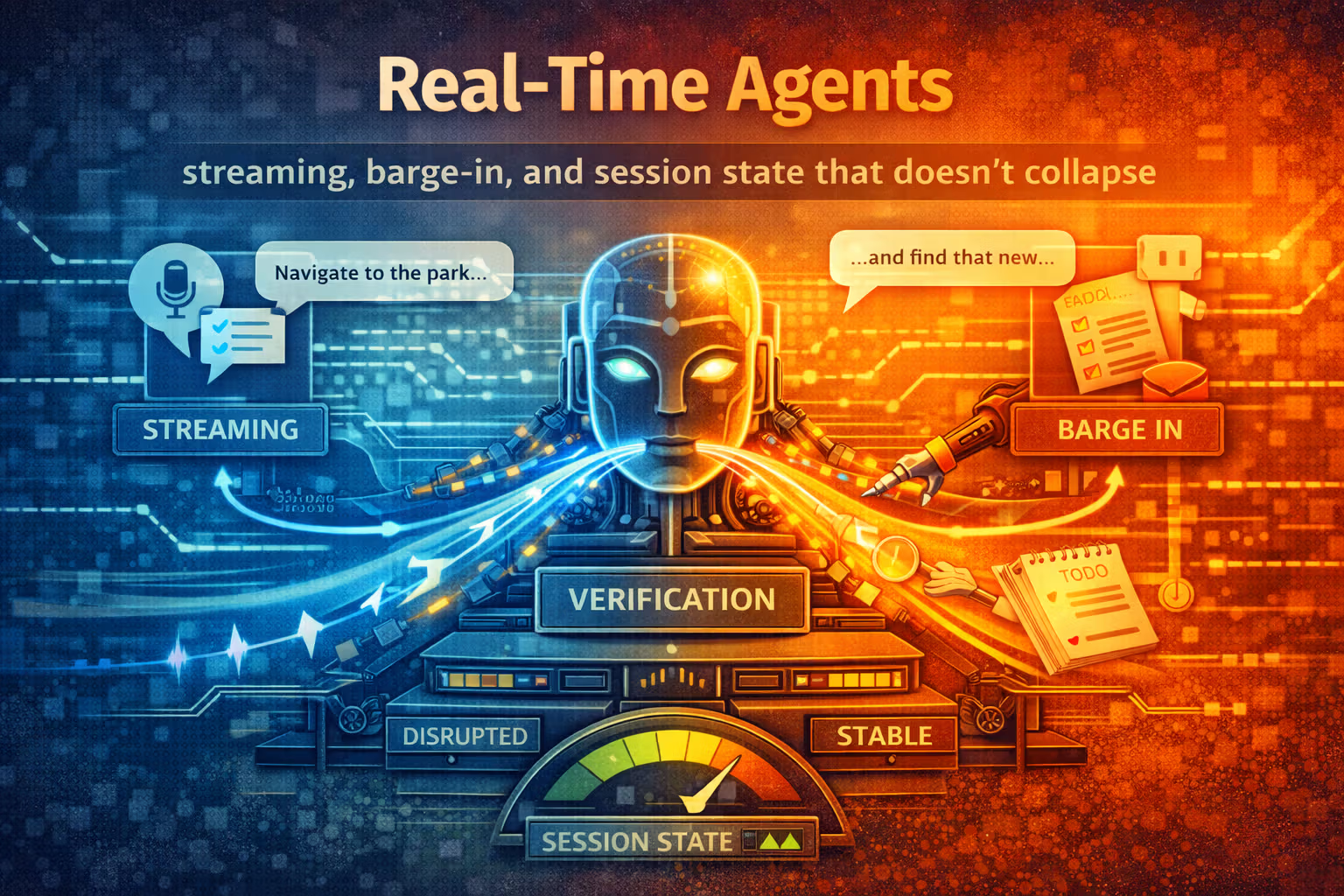
Real-Time Agents: streaming, barge-in, and session state that doesn’t collapse
Real-time agents aren’t “LLMs with voice.” They’re distributed systems with hard latency budgets. This month is about streaming UX, safe interruption (barge-in), and session state you can actually operate.

Axel Domingues
Tool use gave agents hands.
RAG gave them memory (the grounded kind).
But in November, the hard truth shows up:
Real-time agents are not a model problem.
They’re a latency + state + cancellation problem.
The moment you add streaming audio and allow the user to interrupt mid-sentence, you’re no longer “calling an LLM”.
You’re operating a conversation machine whose parts run at different speeds, fail independently, and must remain coherent anyway.
I mean:
- the UX stays responsive while the system is thinking
- the user can change their mind mid-output
- and the session doesn’t desync into nonsense when that happens
The new constraint
Latency becomes a product contract, not an optimization ticket.
The new UI primitive
Streaming is the UI.
“Answer at the end” feels broken.
The new safety mechanism
Barge-in (interrupt) is required.
But it’s also a cancellation minefield.
The new failure mode
Session state can split: transcript, tools, audio, UI.
Your job is to force convergence.
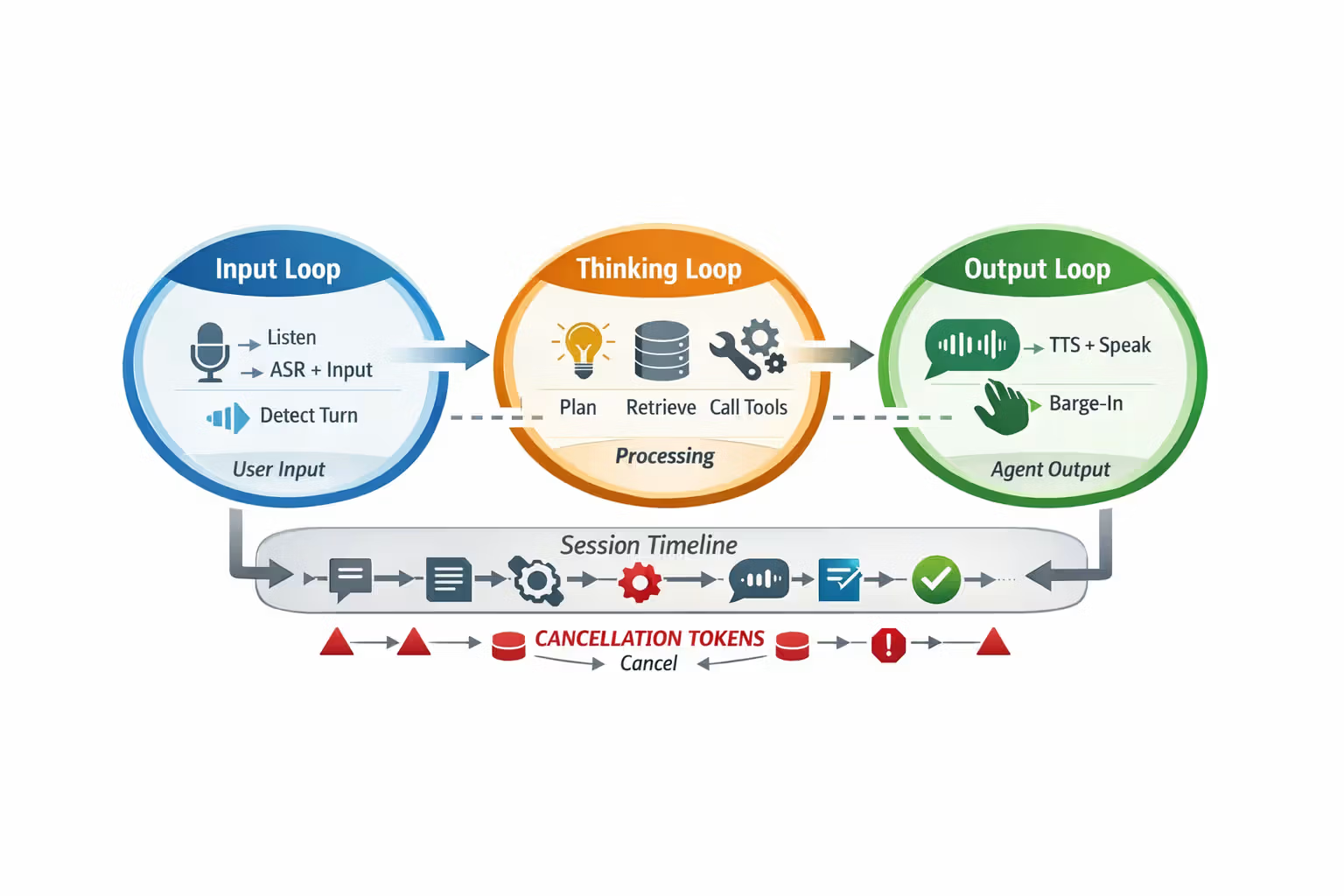
The real architecture: three concurrent loops
A real-time agent is three loops running concurrently:
- Input loop — capture user intent (audio/text), detect turn boundaries, stream partials.
- Thinking loop — plan, retrieve, call tools, generate response (often streaming).
- Output loop — speak/render tokens, allow interruption, reconcile partial outputs into a final trace.
If you treat this as a single “request/response”, you’ll ship a demo.
If you treat it as a set of coordinated loops with shared state and cancellation, you can ship a product.
Streaming UX is not “nice to have” — it’s how you buy time
In non-real-time systems, latency is hidden behind a spinner.
In real-time conversation, a spinner is social death.
Streaming buys you time in three ways:
- Perceived responsiveness: the user sees progress immediately.
- Progressive commitment: you can emit “I’m doing X…” before you finish doing X.
- Early error surfacing: tool failures and missing permissions can be shown before the user waits 10 seconds.
- confidence channel (“I’m doing something meaningful”)
- content channel (the actual answer)
Barge-in is a product requirement (and a cancellation contract)
Voice agents feel magical… until the user can’t interrupt.
In real conversation, interruption is normal:
- “Wait—no, not that…”
- “Actually, use my work email.”
- “Stop, I already know.”
If your agent can’t stop speaking and adapt, it feels less intelligent than a phone menu.
The architectural rule
Every output must be cancellable, and cancellation must be observable.
That means:
- cancel TTS playback immediately
- cancel any in-flight model generation
- cancel in-flight tool calls when possible
- and record what happened in the session timeline
Barge-in forces you to design capability boundaries and commit points.If you cancel the model but a tool call completes and commits side effects (sent email, booked meeting, charged card), you’ve created a trust-killer.
Session state that doesn’t collapse: build a timeline, not a blob
Most agent demos treat “conversation state” as a blob of messages.
Real-time agents can’t.
Because streaming and barge-in create partial, overlapping reality:
- partial transcript updates (ASR (Automatic Speech Recognition) revisions)
- partial model output (tokens)
- partial tool results
- partial audio playback
- cancellations and restarts
So instead of a blob, you need a session timeline: an append-only sequence of events with strong ordering guarantees.
The mental model
A session is a timeline of facts.
UI views are projections of that timeline.
That’s the only way to keep audio, text, tools, and UI aligned.
The session timeline pattern
Model everything as events: input chunks, transcript revisions, tool calls, tool results, output tokens, cancellations, commits. Then derive:
- the visible transcript
- the “current intent”
- the last committed actions
- the playback state
A practical event model (what I actually ship)
Your event model doesn’t need to be perfect.
It needs to be:
- append-only
- idempotent
- causally linked (what caused what)
- and replayable (for debugging + evaluation)
Here’s a minimal event envelope:
{
  "session_id": "sess_123",
  "event_id": "evt_456",
  "ts": "2024-11-24T10:12:33.120Z",
  "type": "asr.partial",
  "turn_id": "turn_7",
  "parent_event_id": "evt_455",
  "payload": {}
}
And here are the event types that matter most in real-time agents:
Transcript evolution
audio.chunk, asr.partial, asr.final, turn.end
Agent work
plan.start, retrieve.start, tool.call, tool.result, model.token
Output control
tts.chunk, playback.start, playback.stop, cancel.requested, cancel.ack
Commit points
action.proposed, action.confirmed, action.committed, action.reverted
Notice what’s missing:
There is no “final answer” field.
There is only a timeline that allows you to reconstruct what happened.
Turn detection: your VAD is part of the product
Turn detection is not an implementation detail.
It decides:
- when to stop listening
- when to start thinking
- when to start speaking
- and when to yield to the user
For voice agents, you typically mix:
- VAD (voice activity detection) to detect speech/silence boundaries
- ASR stability heuristics (how often the partial transcript is changing)
- explicit user controls (tap-to-talk, push-to-talk, “stop” button)
Turn detection is where perceived intelligence begins.If you rely only on “final ASR”, you’ll feel sluggish.
Streaming output: how to avoid talking yourself into a corner
Streaming text is easy. Streaming speech is where mistakes become audible.
Because once you speak, you commit socially — even if you later “correct” yourself.
So you need a simple discipline:
The two-phase response
- Low-commitment preface (safe, reversible)
- High-commitment content (only after you’re confident)
Example:
- “Okay — I’m checking your last invoice…” (safe)
- “Your October invoice is 82.50€” (committed, must be correct)
This is the same “truth boundary” idea from 2023, now applied to realtime.
The cancellation ladder: what to cancel first (and what to never auto-cancel)
When barge-in happens, you need a deterministic order of operations.
Here’s the cancellation ladder I use:
Stop playback immediately
Cut audio output now. Don’t wait for network.
Freeze UI projections
Stop appending “assistant text” to the visible transcript until you reconcile what was actually spoken.
Signal cancellation to the model stream
Cancel generation on the server and expect a cancel.ack.
Cancel tool calls only if safe
If the tool is read-only, cancel aggressively.
If the tool has side effects, cancel only if it supports idempotent cancellation.
Record the interruption
Append an event: who interrupted, what was playing, what was in-flight.
- % of turns interrupted
- cancellation latency (request → ack)
- “ghost speech” incidents (audio continues after cancel)
- “ghost actions” incidents (tool commits after cancel)
Side effects: design commit points like you’re processing payments
If tools can do real work (send, buy, delete, book), real-time makes safety harder.
Your agent needs explicit commit points.
A practical pattern:
- LLM proposes an action (structured)
- UI confirms (or policy auto-confirms only for low-risk scopes)
- only then do you commit side effects
- and you record the commit with an idempotency key
Example:
{
  "type": "action.proposed",
  "payload": {
    "action": "send_email",
    "to": "billing@company.com",
    "subject": "Invoice request",
    "body": "..."
  }
}
Then:
{
  "type": "action.confirmed",
  "payload": { "confirmation_id": "conf_901" }
}
Then:
{
  "type": "action.committed",
  "payload": { "idempotency_key": "send_email:sess_123:turn_7:conf_901" }
}
This is not “compliance theater”.
It’s how you avoid the worst failure mode in real-time agents:
The user interrupts…
but the agent still does the thing.
Session state: split it on purpose
“State” becomes unmanageable when everything shares the same memory object.
So split it.
I like four layers:
What is happening right now:
- current ASR partial
- current model stream cursor
- current TTS playback position
- current cancellation token
Append-only events with ordering guarantees:
- inputs, revisions, outputs, tool calls, cancellations, commits
- stored durably if the session matters
Views computed from the timeline:
- visible transcript
- “current intent”
- tool state
- UI widgets and buttons
Only durable user facts that survive sessions:
- preferences
- permissions
- verified profile fields
- organization knowledge (often via RAG)
This separation is what prevents “session collapse”:
- ephemeral state can glitch without corrupting the session
- projections can be re-derived after reconnect
- the timeline gives you debuggability and evaluation
Transport choices: SSE vs WebSockets vs WebRTC (the practical view)
You can build real-time agents with multiple transports. The choice is less ideological than it looks:
- SSE: simplest for streaming text tokens server → client (one-way).
- WebSockets: good for full-duplex text + control messages (cancel, ack, state).
- WebRTC: best for low-latency audio with jitter handling, but operationally heavier.
- WebRTC for audio
- WebSocket for control + timeline events
- HTTP for slow tool APIs
The important part is not which transport you pick.
It’s that your session timeline and cancellation semantics are consistent across them.
Failure modes you must design for (real-time edition)
Root cause: cancellation is best-effort, not end-to-end.
Fix: require cancel.ack events, stop playback locally first, and treat “ghost speech” as a P0 bug.
Root cause: ASR revisions weren’t reconciled into the timeline.
Fix: treat ASR partials as revisions, anchor the assistant response to a finalized turn_id.
Root cause: state blob drift across client/server.
Fix: timeline as source of truth + projections; avoid “hidden state” on the client.
Root cause: no commit points / no idempotency / cancellation not supported.
Fix: action.confirmed → action.committed pattern; side-effect tools must be idempotent and auditable.
Root cause: you streamed high-commitment claims before verification.
Fix: two-phase response: preface first, facts only after retrieval/tool confirmation.
Observability: your latency budget needs a breakdown chart
If you can’t break down latency, you can’t improve it.
Log per-turn timing like a trace:
- input capture → turn end
- turn end → model first token
- model first token → tool call
- tool call → tool result
- tool result → first committed claim
- first committed claim → first audio sample
- cancel.requested → cancel.ack
What I alert on
- 95th percentile time-to-first-token
- cancel latency
- “ghost action” rate
- reconnect/resume failures
What I review weekly
- interruption rate by feature
- tool failure taxonomy
- sessions with transcript/output mismatch
- user drops during “dead air”
The punchline: real-time agents are a convergence problem
Streaming and barge-in create parallel realities:
- what the user said
- what the model thought they said
- what the agent started to say
- what was actually spoken
- what tools actually did
Your architecture must force all of that to converge back into a coherent session record.
And the only reliable way I’ve found is:
- timeline as source of truth
- projections for UI
- explicit commit points
- end-to-end cancellation with acknowledgements
That’s what turns a “voice demo” into an operable system.
Resources
WebRTC 1.0 (W3C Recommendation) — low-latency audio/video + data
The foundational spec for real-time media transport in the browser. If you’re doing voice with tight latency/jitter constraints, this is the “adult” option.
RFC 6455 — The WebSocket Protocol (full-duplex control plane)
A practical backbone for real-time agent control messages: cancel/ack, timeline events, state sync, and barge-in signals—without polling.
What’s Next
Real-time agents increase surface area:
- more sessions
- more integrations
- more tools
- more security boundaries
- more protocol choices
So the next step is inevitable:
Standards.
Next month: Standards for the Agent Ecosystem
Standards for the Agent Ecosystem: connectors, protocols, and MCP
Agents are becoming the new integration surface. This is how you go from bespoke tool wiring to an ecosystem: portable connectors, common protocols, and a practical standard called MCP.
Reasoning Budgets: fast/slow paths, verification, and when to “think longer”
“Think step by step” isn’t an architecture. In production you need budgets, routing, and verifiers so the system knows when to go fast, when to slow down, and when to refuse.