Software in the Age of Probabilistic Components
LLMs aren’t “features” — they’re probabilistic runtime dependencies. This post gives the mental model, contracts, failure modes, and ship-ready checklists for building real products on top of them.

Axel Domingues
For seven years this blog has been a long exercise in one idea:
treat complex systems like systems — instrument them, define contracts, and design for failure.
- 2016–2020 taught me to respect learning systems: stability isn’t luck, it’s design.
- 2021–2022 pulled me back into production reality: correctness, operability, and boundaries beat cleverness.
Now, January 2023 is where those two lanes collide.
Because LLMs didn’t just introduce a new API.
They introduced a new kind of component:
A probabilistic component that can speak confidently while being wrong.
That changes software architecture more than most “new frameworks” ever will.
This post is not prompt tips. It’s the architectural mental model I wish every senior engineer had before shipping their first LLM feature.
The thesis
LLMs are probabilistic engines. Treat them like dependencies with uncertainty, not functions with correctness.
The new job
Your architecture must define truth boundaries (what must never be wrong) and build guardrails everywhere else.
The practice
Evals + observability + rollback become first-class. “It worked in a demo” is not evidence.
The payoff
Safer rollouts, fewer incidents, and LLM features that behave predictably under real traffic.
The shift: from deterministic code to probabilistic components
Classic software has a comforting property:
- same input
- same code
- same output (modulo bugs)
LLM features break that mental model in three ways:
- Non-determinism (or “pseudo-determinism”)
- sampling and decoding choices change outputs
- Underspecified inputs
- prompts are not specs; context is incomplete by default
- Plausible failure
- outputs can look correct while being wrong
So the architect’s unit of design changes.
You’re no longer designing for correctness of a function.
You’re designing for reliability of a behavior.
In deterministic software, you debug bugs. In probabilistic software, you manage error distributions.
The LLM contract: what the component really does
Forget brand names for a moment.
A modern LLM in a product acts like this:
- it consumes tokens (system instructions + user intent + context)
- it generates tokens (a continuation)
- it does so by choosing the most likely next token repeatedly
- under a decoding policy you control (temperature/top-p/etc.)
So the true contract is not “answer correctly.”
The true contract is:
Given a context, produce a plausible continuation that matches learned patterns.
That has consequences:
- it can be brilliant at synthesis
- it can be consistent in tone
- it can generalize in surprising ways
- and it can fabricate when context is missing
- Probabilistic component: a component that produces a distribution of outputs, not a single correct output.
- Truth boundary: the part of your system where correctness is non-negotiable (money, auth, irreversible actions).
- Error distribution: the shape of failure — when it fails, how often, and how bad it is.
- Guardrail: any constraint that reduces degrees of freedom (grounding, tools, schemas, verification, human review).
- Eval harness: repeatable tests that measure behavior, not vibes.
The first architecture question: “What must never be wrong?”
In 2022 I wrote about distributed data and invariants.
That mindset matters even more here.
Because when you introduce an LLM, you introduce a component that can produce confident nonsense. So you must decide where nonsense is acceptable and where it’s catastrophic.
Examples of truth boundaries:
- money movement, billing, refunds
- access control, permissions, identity
- legal/compliance commitments
- irreversible writes (deleting data, publishing, sending)
- medical/financial advice in regulated contexts
If an LLM is involved in those, it must be constrained to assist, not decide.
You built a production incident generator.
A safe system separates:
- assistive outputs (drafts, summaries, suggestions)
- from authoritative actions (writes, commits, purchases, deletions)
This is not “AI safety philosophy.” It’s the same engineering discipline as outbox + sagas:
define invariants, enforce them with single-writer authority, and treat everything else as eventually correct.
Failure modes: the taxonomy you need before shipping
Most teams only learn these after an incident.
You can learn them now.
Hallucination
Fabricates facts, citations, or confident details when context is missing.
Instruction drift
Loses constraints across long contexts; follows the wrong part of the prompt.
Tool misuse
Calls the wrong tool, calls it with the wrong arguments, or “pretends” it called it.
Overreach
Answers beyond the available evidence instead of asking for clarification.
Prompt injection
User-provided content manipulates the model into ignoring system instructions.
Cost blow-up
Long contexts, retries, or agent loops silently multiply spend and latency.
These aren’t edge cases. They are the normal behavior of a component optimized for plausibility.
So your architecture should assume they will happen.
A practical mental model: degrees of freedom create risk
Here’s the simplest control intuition I know:
The more freedom the model has, the more ways it can fail.
So reliability engineering becomes: reduce degrees of freedom.
Common guardrails (ordered from “cheap” to “strong”):
- Constrain format
- strict JSON output, schemas, structured sections
- Constrain content
- grounding snippets, citations required, “answer only from sources” rules
- Constrain action
- tool calls with typed interfaces and validation
- Constrain authority
- human review for irreversible actions
- Constrain distribution
- retrieval, policies, and post-verification
Never let the LLM be both the narrator and the source of truth.
The system architecture that survives reality
The mistake is to bolt an LLM onto your backend like it’s just another function call.
The durable architecture treats it like a subsystem with safety rails.
Here’s the baseline stack I recommend thinking in:
- Intent & context assembly
- what is the user asking, and what data is allowed?
- Policy layer
- what is permitted? what must be refused? what tools are available?
- Model invocation
- prompt template, decoding settings, context window budgeting
- Verification & post-processing
- schema validation, safety checks, citation checks, confidence gates
- Action execution
- typed tools, idempotency keys, permissions, auditing
- Telemetry & evals
- traces, offline eval harness, regressions, rollout flags
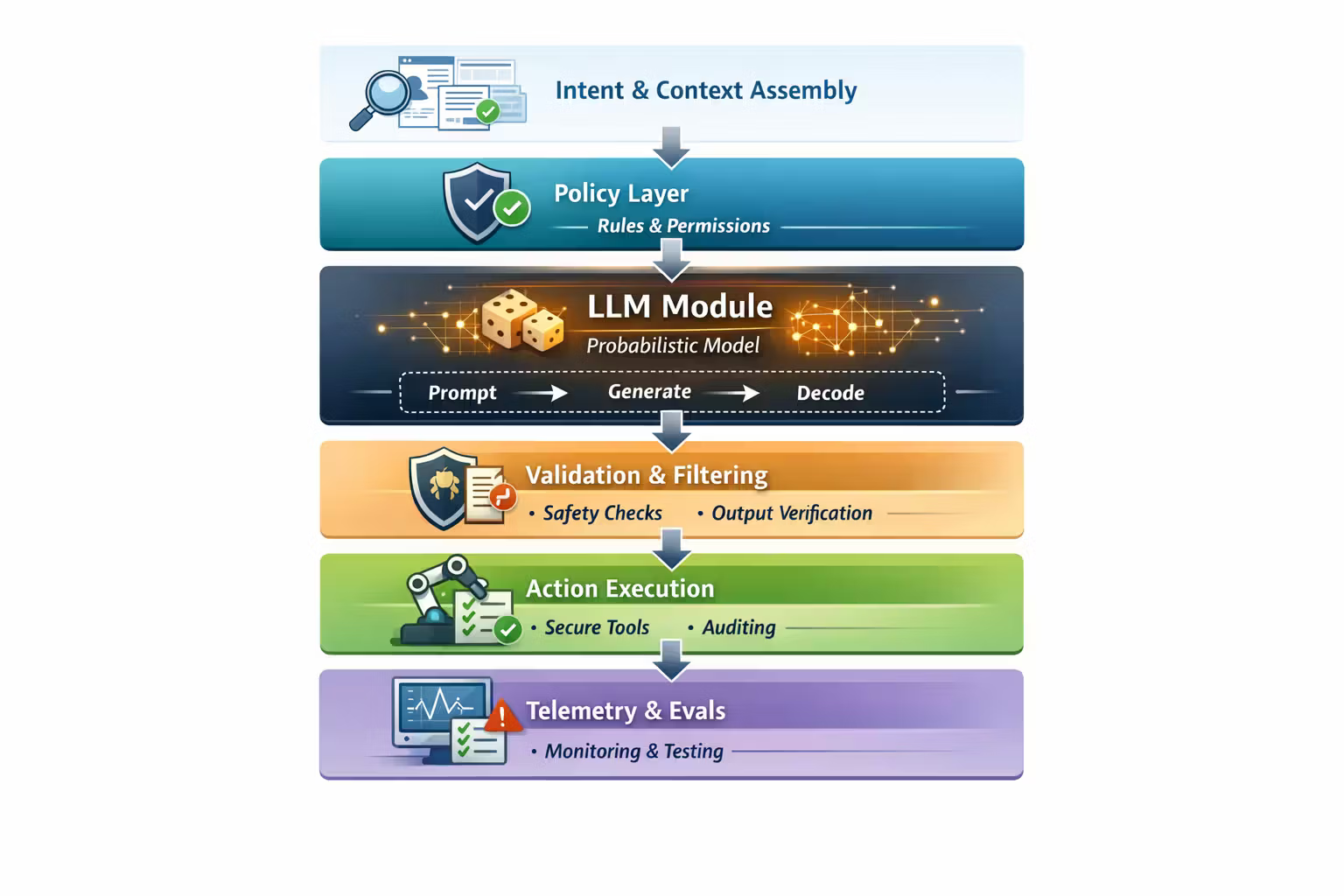
Notice what’s missing:
- “prompt engineering” as the main strategy
Prompts matter, but prompts are only one layer of control. Real systems need multiple layers.
The LLM feature spec: a template that forces clarity
When someone says “we want to add ChatGPT to the product,” the right response is:
“Cool. What is the contract?”
Here’s the spec template I use.
### Feature name
### User value (one sentence)
### Allowed behavior
- what the assistant may do
- what it may suggest
- what it must not do

### Truth boundaries (non-negotiables)
- actions that require confirmation
- actions that require human approval
- actions the assistant cannot trigger

### Inputs (context sources)
- allowed sources (DB tables, APIs, docs)
- disallowed sources (PII, secrets, internal-only)
- freshness requirements

### Output format
- free-form / structured / strict JSON schema
- citation requirements

### Failure handling
- when to abstain (“I don’t know” UX)
- fallback behavior (search, escalation, manual flow)

### Evaluation plan
- offline test set
- regression checks
- launch guard metrics

### Rollout plan
- feature flag + cohort
- monitoring thresholds
- rollback triggers
Then it becomes the cheapest document you ever wrote.
The probabilistic risk register (what breaks, how you notice, what you do)
This is the part teams skip — and then re-invent during the incident.
| Risk | Typical symptom | Detection | Mitigation |
|---|---|---|---|
| Hallucinated facts | Confident wrong answer | Spot-checks, user reports, eval set | Grounding (RAG), citations, “answer only from sources”, abstention |
| Prompt injection | Model follows malicious text | Red team prompts, tool logs | Strict tool policy, content isolation, instruction hierarchy, allowlist tools |
| Data leakage | Sensitive content appears | DLP scans, audit logs | Context filtering, PII redaction, least-privilege retrieval |
| Over-automation | Wrong action executed | Incident reports | Human approval gates, confirmations, read-only mode by default |
| Latency regressions | Slow UX, timeouts | Tracing, p95/p99 | Context budgets, caching, streaming, fallbacks |
| Cost blow-ups | Spend spikes | Token accounting | Token budgets, rate limits, caching, stop conditions |
| Behavior drift | Quality degrades after changes | Offline evals | Eval harness + canary releases + model/version pinning |
It’s to force the team to answer: “How will we know we’re failing, and what will we do when it happens?”
Evals and observability: your new minimum bar
In classic software, unit tests catch regressions. In distributed systems, telemetry catches incidents. With LLMs, you need both.
The eval harness (offline)
You need a repeatable dataset of prompts and expected behavior:
- correct answers (where truth exists)
- refusal cases
- adversarial prompts
- ambiguous prompts (where the right behavior is to ask questions)
- tool use cases (where output must be structured)
The telemetry (online)
You need traces that let you debug:
- what context was assembled
- what policy was applied
- what the model generated
- what tools were called (with args and results)
- how the user reacted (thumbs down, follow-ups, abandonment)
You have a ghost story.
Ship-ready checklist: the “don’t embarrass yourself” edition
Define truth boundaries
Write down what the model cannot be trusted to do. Wire human confirmation for anything irreversible.
Constrain outputs
Use structured formats where possible. Validate schemas. Reject and retry (or fallback) when invalid.
Constrain tools
Typed interfaces. Allowlist tools. Validate arguments. Use idempotency keys on side-effecting actions.
Budget tokens and time
Set context limits per request. Log token usage. Implement timeouts and fallbacks.
Create an eval harness before launch
A tiny dataset is better than none. Automate it in CI. Pin versions and re-run before shipping changes.
Add tracing and a replay path
Store the assembled prompt/context (with redaction). Store tool calls. Make incidents reproducible.
Roll out with a feature flag
Start with internal users. Then a small cohort. Define rollback triggers upfront.
You can do it. You just won’t be able to operate it.
The deeper point: “AI features” are systems features
By the end of 2022, the blog arrived at an uncomfortable truth:
operability is part of product correctness.
LLMs make that even more true.
Because your system’s “correctness” is no longer just:
- code paths
- database state
- API responses
It includes:
- context assembly
- policy enforcement
- model behavior
- and user trust
So the job of an architect is not to make the model smart.
It’s to make the system safe, observable, and evolvable under uncertainty.
FAQ
They can be run deterministically (same context + same decoding choices), but in product reality you still get variability because:
- contexts differ (retrieval, truncation, personalization)
- upstream data changes
- models and policies evolve
- tool results differ over time
So the engineering posture should assume variability even when sampling is “off.”
Rules help, but they don’t create truth.
Hallucination is often the model doing the “most plausible continuation” given missing evidence. The durable fix is to constrain degrees of freedom:
- ground in sources
- force citations
- verify outputs
- and build abstention UX.
Start with assistive outputs:
- drafts, summaries, suggestions
- with clear “review before send” UX
Avoid:
- autonomous writes
- irreversible actions
- hidden tool calls until you have evals, tracing, and guardrails.
Treating the model like a deterministic function and calling it directly from business logic.
The right architecture gives the model a controlled sandbox: policy → context → generation → validation → tools → audit.
What’s Next
This month set the architectural frame:
LLMs are probabilistic components. So we design truth boundaries, guardrails, evals, and observability.
Next month we go deeper into the history of why language was hard:
Why NLP Was Hard
Because the fastest way to build good intuition about transformers and ChatGPT… is to understand what broke before them.
Why NLP Was Hard: RNN Pain, Vanishing Gradients, and the Limits of “Memory”
Before transformers, language models tried to compress entire histories into a single hidden state. This post explains why that was brittle: depth-in-time, vanishing/exploding gradients, and the engineering limits of “memory” — and why attention was inevitable.
Capstone: Build a System That Can Survive (Reference Architecture + Decision Log)
A production system isn’t “done” when it works — it’s done when it can fail, recover, evolve, and stay correct under pressure. This capstone stitches the 2021–2022 series into a reference architecture and a decision log you can defend.