Capstone: Build a System That Can Survive (Reference Architecture + Decision Log)
A production system isn’t “done” when it works — it’s done when it can fail, recover, evolve, and stay correct under pressure. This capstone stitches the 2021–2022 series into a reference architecture and a decision log you can defend.

Axel Domingues
A system doesn’t “die” when a server crashes.
It dies when:
- a deploy can’t be rolled back,
- an incident can’t be explained,
- a queue silently duplicates money,
- a dashboard looks green while users are furious,
- or the cost curve bends upward and nobody knows why.
In 2021 we rebuilt the full-stack mental model: browser reality, HTTP semantics, APIs, caching, async, and the real cost of “distributed”.
In 2022 we got strict: repeatability, reliability, governance, observability, security, distributed data, performance, cloud choices, analytics truth, and cost as a constraint.
This capstone is the stitching.
Not “the one true stack”.
A reference architecture + decision log that helps you build something you can operate and evolve under pressure.
What “survive” means
Correctness, reliability, performance, security, and cost — at the same time.
What you get here
A pragmatic reference architecture + a decision log template you can reuse.
How to use this post
Treat it as a review checklist when designing, reviewing, or rescuing a system.
What’s next (2023)
Platform and runtime choices that encode operability (Nuxt 3 + UnJS as the case study).
The Prime Directive: Operate First, Optimize Later
If you remember one idea from this series, keep this one:
The first job of architecture is to make production behavior legible and reversible.
Everything else — performance, microservices, “modern stacks”, even developer experience — becomes a trap if you cannot:
- observe what’s happening
- change behavior safely
- recover when you’re wrong
It’s boring in the best way:
- predictable deploys
- bounded blast radius
- measurable goals
- known failure modes
Reference Architecture: The Parts That Keep You Alive
Below is a reference architecture I like because it is defensible.
It makes tradeoffs explicit and gives each concern a home:
- correctness
- latency
- reliability
- security
- analytics truth
- and cost control
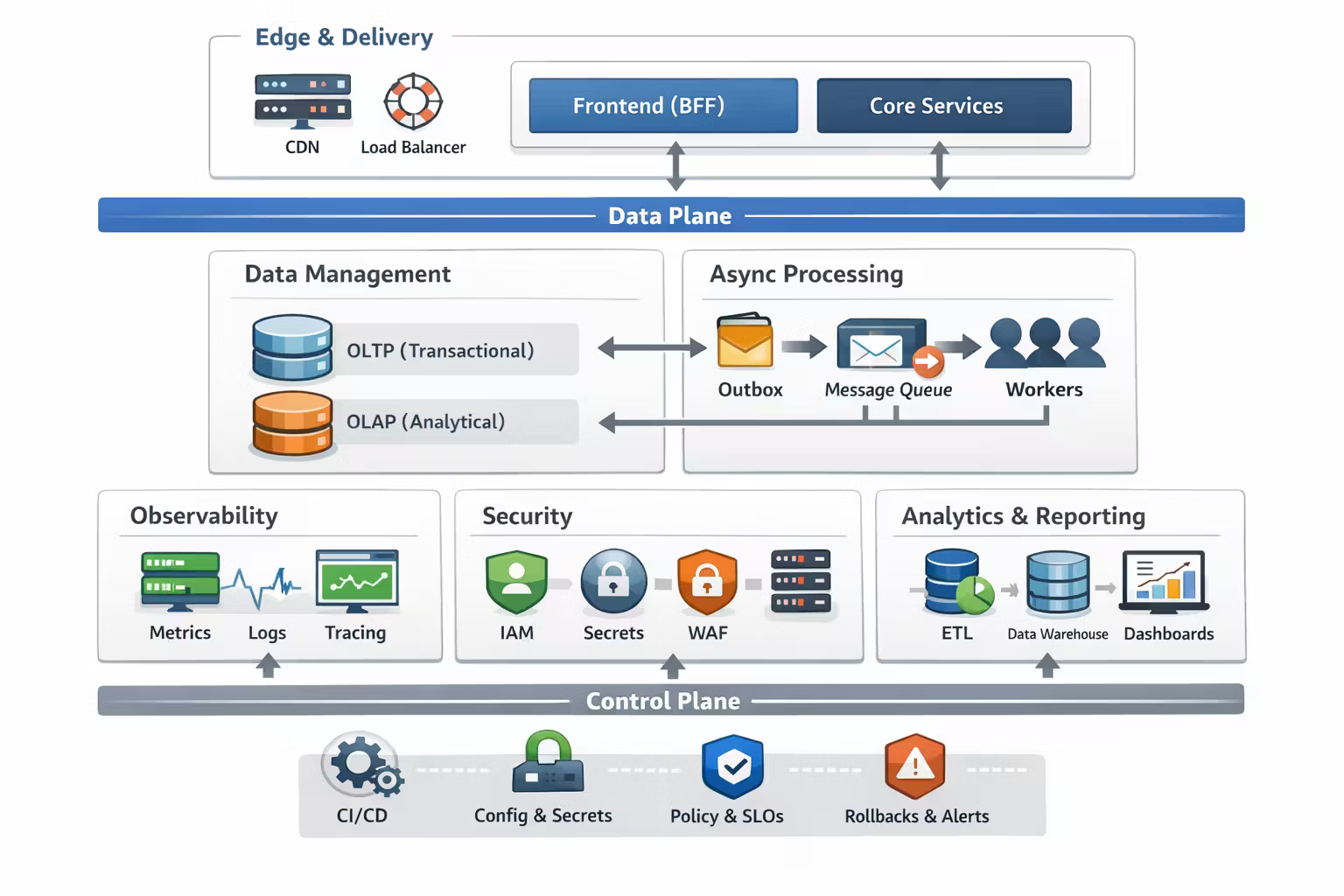
The “Two Planes” mental model
Data plane
Handles user traffic: UI, APIs, async work, data stores. Needs low latency + high availability.
Control plane
Changes and governance: CI/CD, config, secrets, feature flags, policies, rollbacks, SLOs.
If your control plane is weak, your system becomes unchangeable — and you eventually lose.
The Core Building Blocks
1) Edge + Delivery
Your edge isn’t “just CDN”. It’s your first reliability layer.
Typical responsibilities:
- TLS termination and HTTP correctness
- caching and compression (when it’s honest)
- WAF / rate limiting / bot protection
- static asset delivery
- request routing to regions (when applicable)
Do not “accidentally cache” personalized or permissioned content.Cache what is:
- public, versioned, and immutable (assets)
- safely cacheable with clear keys (some read endpoints)
2) UI + Backend-for-Frontend (BFF)
One survival pattern that keeps showing up:
Treat frontend as architecture.
- UI owns user experience and failure behavior (fallbacks, spinners, offline-ish modes)
- A BFF adapts backend complexity to user-facing needs (aggregation, shaping, auth context)
- BFF becomes the performance and correctness boundary for the UI
- N+1 calls
- duplicated auth logic
- inconsistent caching
- and partial failure chaos
3) Core Business: Modular Monolith until it hurts
Microservices don’t solve complexity. They move it into:
- network calls
- consistency guarantees
- tracing and debugging
- deployment coordination
- and cost
Start with a modular monolith when you can:
- clear bounded contexts
- strong internal contracts
- a migration path to split services later
Then split by pain and ownership, not by ideology.
Split when
Deploy coupling slows teams, scaling needs diverge, or security boundaries must harden.
Don’t split when
You’re bored, you saw a conference talk, or “microservices” is the company identity.
4) Data: Separate “Truth” from “Reporting”
This is where a lot of product teams suffer unnecessarily:
- OLTP is for correctness and transactions
- OLAP is for analysis and decision-making
- trying to use one as the other corrupts both
The rule:
Never run analytics workloads on the same database that serves your critical transactional path.
Your transactional database should be boringly stable.
Your analytics world should be:
- append-friendly
- history-aware
- optimized for aggregation
- resilient to schema evolution
That means:
- event schemas with versioning
- idempotent ingestion
- replay capability
- and strict definitions of “truth”
5) Async Work: Outbox + Queue + Workers
Async is where correctness dies quietly.
So we design it like a financial system even when it’s “just emails”.
The minimum survivable pattern:
- Write state + an outbox record in one transaction
- A dispatcher publishes to a queue/event bus
- Workers process with idempotency + retries + dead-letter strategy
- Workflows track state transitions explicitly
6) Observability: SLOs, Not Screenshots
Dashboards are pictures. Survivability needs feedback loops.
At minimum, you want:
- metrics (RED for services, USE for infra)
- logs with structured context (request id / trace id / user id safe fields)
- distributed traces for cross-service causality
- SLOs + error budgets (a contract for tradeoffs)
What you measure
User-facing outcomes: latency, errors, saturation, availability, correctness signals.
What you do with it
You make tradeoffs: ship faster vs stabilize — guided by error budgets.
7) Security: Defaults, Not Heroics
Security that survives is mostly boring defaults:
- least privilege IAM
- secret management (no secrets in env files committed “temporarily”)
- dependency hygiene and SBOM-ish awareness
- boundary protection (WAF, rate limits, auth middleware)
- audit logs for sensitive actions
Threat models beat compliance checklists — because they force you to answer:
“What could go wrong here, and what is our design response?”
The Survival Checklist: What You Must Be Able to Do
If your system can’t do these, it’s not production-ready — it’s production-exposed.
Roll back safely
- every deploy has a rollback plan
- schema changes are backward compatible (or staged)
- feature flags exist for high-risk changes
Debug from the outside in
- start with user symptom → trace → service → dependency
- logs and traces correlate reliably
- you can reproduce a failure path in staging (or via replay)
Degrade gracefully
- timeouts and retries are bounded
- partial failures don’t cascade endlessly
- fallback behavior is explicit (UI and API)
Prove correctness under retries
- idempotency keys exist where money/side-effects happen
- deduplication is designed, not assumed
- dead-letter queues are monitored and actionable
Know your performance envelope
- you have SLOs for key endpoints
- you can explain p50/p95/p99 behavior
- load tests model realistic traffic, not fantasy
Know your cost drivers
- you can attribute cost to workloads, not just accounts
- you can identify “top spenders” by service and by feature
- you can forecast changes (not perfectly — but sanely)
Decision Log: Architecture You Can Defend
Teams don’t fail because they picked “the wrong database”.
They fail because:
- decisions were implicit
- tradeoffs were forgotten
- and constraints changed while the system stayed the same
A decision log is adult supervision for architecture.
Below is a reusable template and a set of canonical decisions that show up in most systems.
ID: ADR-###
Status: Proposed | Accepted | Deprecated
Date: YYYY-MM-DD
Context
- What problem are we solving?
- What constraints (team, time, cost, compliance, latency)?
Options
- Option A
- Option B
- Option C
Decision
- We choose X.
Why
- Drivers (SLOs, operability, cost, correctness, time-to-market)
Consequences
- What gets easier?
- What gets harder?
- What we must invest in next (monitoring, tooling, training)
Decision
- Start modular monolith; split only when ownership or scaling needs force it.
Why
- Preserves velocity while building operability foundations.
- Avoids premature distributed-systems tax.
Consequences
- Requires strict module boundaries and internal contracts.
- Needs clear “extraction seams” to split later.
Decision
- OLTP for transactions; OLAP for analytics; never mix critical queries into OLTP.
Why
- Protects correctness and availability.
- Enables history, replay, and schema evolution in analytics.
Consequences
- Requires event modeling and ingestion discipline.
- Requires governance for “metrics definitions” (truth).
Decision
- Outbox + queue + idempotent workers as the default async pattern.
Why
- Survives retries, timeouts, and “at least once” delivery.
- Makes failure modes inspectable.
Consequences
- Requires idempotency keys and dedup strategy.
- Requires DLQ operations and reprocessing runbooks.
Decision
- Canary/blue-green + feature flags for high-risk changes.
Why
- Reduces blast radius.
- Enables rollback without panic.
Consequences
- Requires metrics-based automation and good alerting hygiene.
- Requires discipline: flags must be cleaned up.
Decision
- Define and review SLOs; use error budgets for prioritization.
Why
- Aligns product and engineering around outcomes.
- Turns “reliability” into a decision-making tool.
Consequences
- Requires work to define SLIs and instrument them.
- Requires cultural shift: “green dashboards” are not success.
Incident Response: Designing for the Worst Day
The worst day is not when the incident happens.
It’s when:
- the alarm is ambiguous,
- the on-call is blind,
- and everyone argues while customers burn.
A survivable system designs the incident loop explicitly.
Detect
Alerts are SLO-driven and actionable, not “CPU is 72%” noise.
Triage
You have a first-15-min playbook and known runbooks for common failures.
Mitigate
Flags, rate limits, graceful degradation, and rollback are fast and safe.
Learn
Postmortems improve the system, not blame humans.
- better timeouts and bulkheads
- better dependency isolation
- better runbooks and dashboards for one critical journey
- safer deployment/rollback controls
The “Survivability Contract” You Can Share with Stakeholders
This is the language I like to use with product leaders:
- We can ship fast until we consume our error budget.
- We prioritize reliability work when user outcomes demand it.
- We invest in instrumentation and rollback safety so we can take bigger bets.
- We do not trade correctness for speed in irreversible workflows.
That is what mature architecture sounds like.
What’s Next
This finishes the series. And now it’s time to close a loop.
This blog started as my machine learning + deep learning journey.
At the end of this year (2022), the world shifted — not because ML got “new”… but because a product (ChatGPT) made these ideas operationally real for everyone.
So next, we start a new series:
Dissecting ChatGPT: what it is, why it works, and what it changes for software.
Not hype. Not prompts.
Architecture, interfaces, failure modes, and the reality of building systems on top of probabilistic engines.
Software in the Age of Probabilistic Components
LLMs aren’t “features” — they’re probabilistic runtime dependencies. This post gives the mental model, contracts, failure modes, and ship-ready checklists for building real products on top of them.
Incident Response and Resilience: Designing for Failure, Not Hope
Most teams “have on-call”. Fewer teams have resilience. This is a practical blueprint for designing systems, teams, and workflows that respond fast, recover safely, and learn without blame.