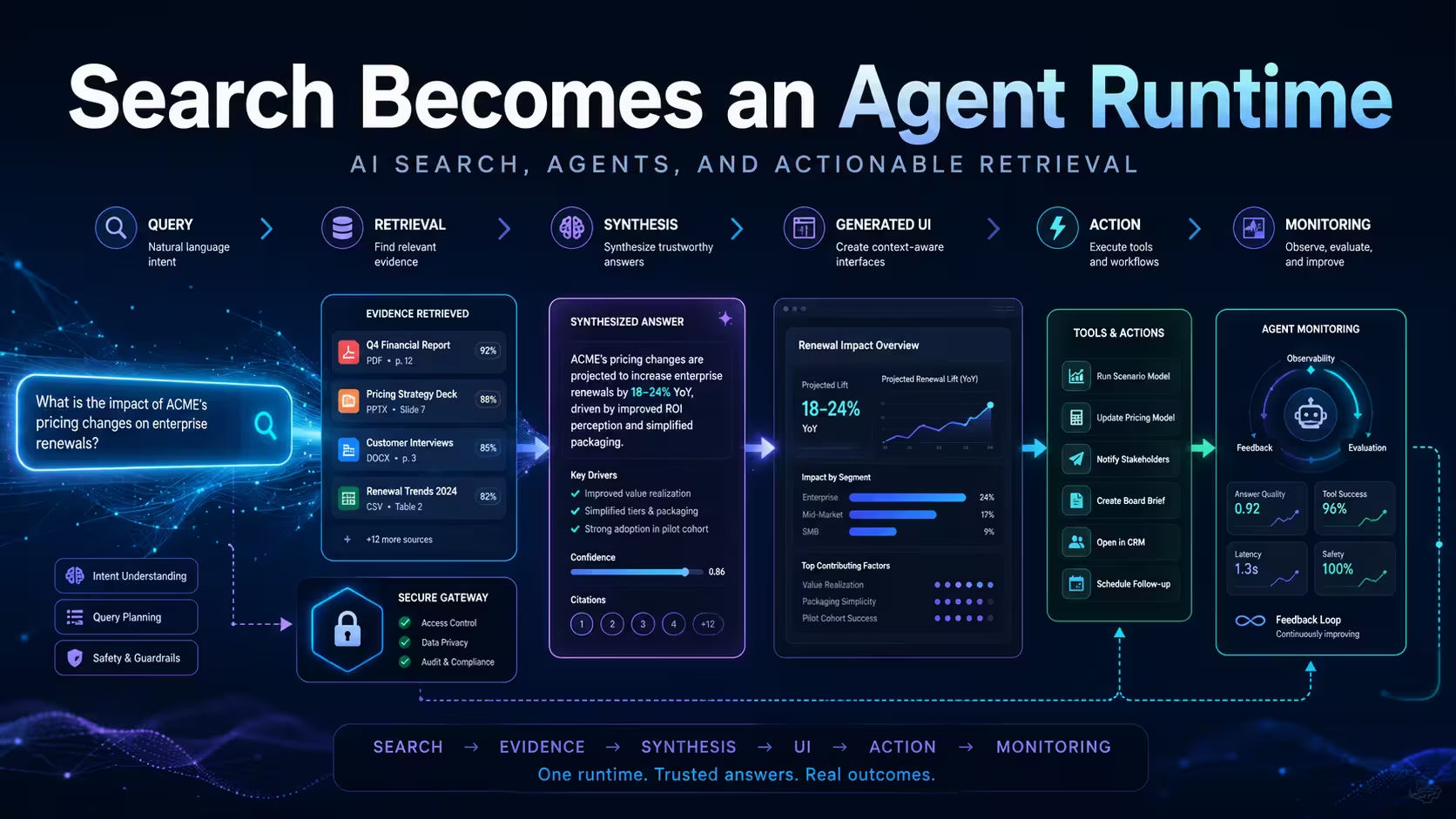
Search Becomes an Agent Runtime
Google’s Gemini Spark and AI Mode point to a bigger shift: Search is no longer just retrieval plus ranking. It is becoming a runtime for synthesis, generated UI, monitoring agents, and action. This post explains the architecture of actionable retrieval — and the reliability contracts needed when search starts doing things.

Axel Domingues
May’s hot topic was not simply “Google added more AI to Search.”
That story is too small.
The bigger shift is this:
Search is becoming an agent runtime.
For twenty-five years, Search mostly meant:
- parse a query
- retrieve documents
- rank links
- let the user decide what to trust and what to do next
Generative search changed the first half:
- retrieve sources
- synthesize an answer
- cite or summarize evidence
But the May 2026 direction pushes further:
- AI Mode turns search into a conversational, multimodal workspace.
- Search agents turn queries into background monitors and task runners.
- Gemini Spark points toward an always-on personal agent that can operate across a user’s digital life.
- Generated UI turns search results from “links” into task-specific interfaces.
That is a new architecture.
Not “better autocomplete.”
Not “chatbot inside a search page.”
A runtime where retrieval, synthesis, planning, UI generation, and action share the same surface.
A bad answer is one failure mode. A bad answer that schedules, buys, emails, books, or monitors on your behalf is a different system entirely.
The trend
Search is moving from retrieval interface to agentic action surface.
The architecture shift
The pipeline becomes: query → retrieve → synthesize → plan → generate UI → act → monitor.
The reliability problem
If answers become actions, source fidelity, permissions, and auditability stop being optional.
The engineering thesis
Actionable retrieval needs contracts: evidence packets, action gates, source scoring, and rollbackable workflows.
Search in one sentence (the old contract)
Classic Search was a ranking system.
It returned documents and made the user responsible for:
- reading
- comparing
- judging credibility
- deciding what to do next
That was imperfect, but it had a clean boundary:
Search helped you find information.
You performed the action.
Agentic Search blurs that boundary.
Now the system may:
- summarize the web
- choose which sources matter
- decide when to ask follow-up questions
- build a custom interface
- run a background monitor
- and trigger tools or transactions
That is why this topic belongs in an architecture blog.
The product surface changed, but the deeper change is the control flow.
What “actionable retrieval” means
Retrieval used to end at “here are relevant documents.”
Actionable retrieval ends at:
“Here is the answer, here is the evidence, here is the proposed action, and here is the control boundary before anything changes.”
That adds three new responsibilities to the search stack.
Evidence
The system must know where claims came from and whether cited sources actually support them.
Intent
The system must separate “I want information” from “I want you to do something.”
Authority
The system must know which actions it is allowed to take, under whose identity, and with what approval.
Memory
The system must decide what persists: monitors, preferences, tasks, reminders, and user-specific context.
This is where Search becomes much closer to an agent platform than a web page.
AI Mode: search becomes a workspace
AI Mode changes the shape of search from “query and links” to “conversation plus workspace.”
That matters because long, messy queries become normal:
- “Compare these options”
- “Use this file”
- “Look at these tabs”
- “Plan this task”
- “Keep checking this for me”
The query is no longer a short keyword string. It becomes a task packet.
A task packet can include:
- natural language intent
- files or images
- browsing context
- user preferences
- location or calendar context
- constraints (“cheap”, “near me”, “family-friendly”, “don’t book yet”)
- what evidence is allowed in the context
- what user state is relevant
- what action is being proposed
- and what must stay behind an approval gate
Gemini Spark: the always-on agent pattern
Gemini Spark is interesting because it points to the other side of agentic search:
background continuity.
Search traditionally answered now.
An always-on agent can:
- monitor information over time
- notice changes
- summarize deltas
- remind you when something matters
- prepare actions for approval
This is not “one request.” It is a workflow.
A Spark-like agent needs a durable loop:
- define the monitoring goal
- retrieve periodically or subscribe to signals
- compare against prior state
- decide whether anything changed
- notify the user
- optionally propose action
- log what happened
That looks less like Search and more like a tiny SRE system for your digital life.
- ownership
- budgets
- stop conditions
- expiration dates
- and a visible “what is this agent doing?” panel
The architecture blueprint: Search as an agent runtime
Here is the mental architecture I’d use for agentic search.
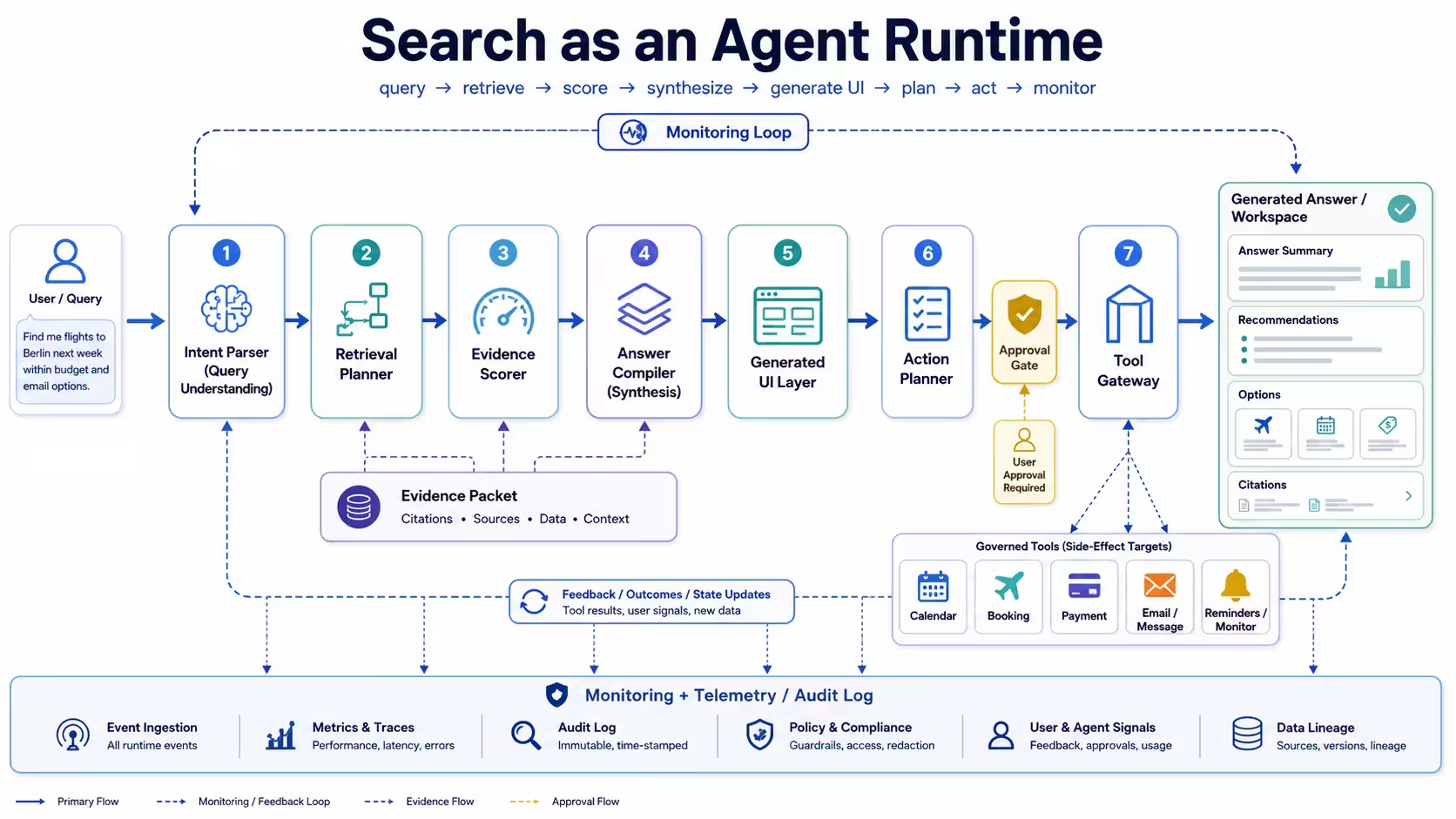
Classifies the request:
- informational (“explain this”)
- comparative (“compare options”)
- transactional (“book / buy / schedule”)
- monitoring (“watch this and alert me”)
- creative (“generate a plan / draft / UI”)
Contract: don’t treat every query as permission to act.
Decides what kind of retrieval is needed:
- web retrieval
- local/user-context retrieval
- vertical retrieval (shopping, travel, local, code, docs)
- freshness-sensitive retrieval
- multi-hop retrieval
Contract: source selection must be inspectable, not magic.
Scores sources for:
- authority
- freshness
- relevance
- diversity
- conflict
- support for specific claims
Contract: citation is not enough. The cited page must support the claim.
Builds the response from evidence:
- summaries
- comparisons
- tables
- caveats
- citations
- uncertainty markers
Contract: separate “source says” from “model infers.”
Creates task-specific interfaces:
- comparison cards
- booking forms
- timelines
- checklists
- filters
- mini-apps
Contract: generated UI must still call governed APIs, not bypass product controls.
Turns a user goal into proposed steps:
- call this provider
- ask this follow-up
- reserve this slot
- create this reminder
- monitor this source
Contract: plans are proposals until authority is granted.
Controls side effects:
- payments
- bookings
- messages
- calendar writes
- account changes
- subscriptions / monitors
Contract: the model is not the security boundary. The gateway is.
Records what happened:
- sources retrieved
- claims generated
- actions proposed
- actions approved
- tools called
- costs and latency
- user corrections
Contract: if the system acts, it must leave an audit trail.
This is the difference between “AI search feature” and “search runtime.”
The hardest problem: evidence fidelity
Generative search has one uncomfortable property:
It collapses many sources into one answer.
That creates convenience, but also removes friction.
Users no longer inspect ten links. They read the synthesis.
So the system inherits editorial responsibility.
Source selection
Which pages were retrieved, ranked, included, ignored, or suppressed?
Claim support
Does each important claim actually follow from the cited source?
Conflict handling
When sources disagree, does the answer expose disagreement or average it away?
Publisher impact
If answers replace clicks, source ecosystems and incentives change.
A useful internal invariant:
A cited answer should be decomposable into claims, and each high-risk claim should map to supporting evidence.
This is not academic neatness. It is how you debug hallucination in a search product.
Action gates: the line between answer and execution
Agentic Search must distinguish four levels of authority.
Level 1 — Inform
The system can answer, summarize, compare, and cite.
No side effects.
Level 2 — Prepare
The system can fill forms, draft messages, create plans, and stage actions.
Still no side effects.
Level 3 — Ask
The system can request explicit approval for a specific action.
The approval must show:
- target
- cost
- recipient / vendor
- data shared
- rollback options
Level 4 — Act
The system performs the action through a governed tool gateway.
Every action gets logged. Irreversible actions require stronger gates.
That is how helpful agents become incident generators.“I prepared this” becomes “I did this.”
Generated UI: useful, but not a permission system
Generated UI is one of the most interesting parts of agentic search.
Instead of returning a static answer, the system can generate:
- comparison tools
- filters
- timelines
- calculators
- travel planners
- shopping flows
- dashboards
That is powerful because the UI can fit the task.
But generated UI also creates a governance problem:
Who decides what this UI is allowed to do?
A generated booking interface must still respect:
- consent
- payment rules
- cancellation policies
- data sharing boundaries
- accessibility
- auditability
The UI may be generated. The permissions must not be.
Background agents: monitors need budgets and expiration
A search agent that watches the web for you is extremely useful.
It is also easy to forget.
That makes lifecycle management non-negotiable.
Every monitor should have:
- owner
- purpose
- sources / scope
- frequency
- budget
- expiration date
- notification channel
- stop button
- audit history
Monitor contract
A background search agent should be visible, bounded, revocable, and explainable.
Without that, you get zombie agents:
- still searching
- still spending
- still notifying
- still holding permissions
- long after the user forgot why they existed
Failure modes I expect in agentic search
This is where the engineering discipline shows up.
Symptom: answer cites sources, but the specific claim is not supported by those sources.
Fix: claim-level evidence checks for high-risk answers, plus source-support evals.
Symptom: answer appears objective, but mostly comes from one source type or one ecosystem.
Fix: source diversity scoring and explicit conflict surfacing.
Symptom: the system performs a task when the user only asked for information.
Fix: intent classification + authority levels + explicit approval for side effects.
Symptom: private context shapes an answer or action in a way the user didn’t expect.
Fix: context disclosure (“using your calendar/preferences”), scoped personalization, and opt-out controls.
Symptom: background agents continue running after the original need is gone.
Fix: expiration dates, visible agent inventory, and regular “still needed?” confirmations.
Symptom: a custom UI exposes actions that should require stricter gates.
Fix: generated UI calls only through a permissioned tool gateway.
What to measure
Agentic Search needs dashboards beyond click-through rate.
A minimal runtime dashboard should include:
Retrieval quality
Source diversity, freshness, authority, and query-source alignment.
Claim fidelity
Unsupported-claim rate, citation mismatch rate, and conflict handling quality.
Action safety
Approval rate, denied actions, risky tool calls, and rollback frequency.
Agent lifecycle
Active monitors, expired agents, budget usage, and notification usefulness.
The agentic search metric is closer to: Did the system help the user complete the right task, with the right evidence, under the right authority?
If I were designing this system: my minimum viable contract
I would not start with “make Search more intelligent.”
I would start with contracts.
Separate answer mode from action mode
A query must be classified before the system can act. The default should be informational.
Emit evidence packets
Every synthesized answer should include source IDs, claim mappings, freshness, and confidence metadata.
Route all side effects through a tool gateway
Bookings, purchases, messages, calendar changes, and subscriptions must never be raw model actions.
Require explicit approval for irreversible actions
The user sees what will happen before it happens.
Add lifecycle management for background agents
Every monitor has owner, scope, budget, expiry, and kill switch.
Log the whole path
Query → sources → answer → UI → proposed action → approval → tool call.
If you can’t reconstruct it, you can’t operate it.
May takeaway
Search used to be an index.
Generative Search made it an answer engine.
Agentic Search turns it into a runtime.
May takeaway
When Search starts acting, retrieval quality is only the first problem.
The real architecture is actionable retrieval: evidence fidelity, intent boundaries, generated UI, tool gateways, background monitors, and auditability.
Resources
Google — A new era for AI Search
Google’s May 2026 framing of AI Search: advanced model capabilities, search agents, agentic coding, and a new AI-powered Search box.
Google — The Gemini app becomes more agentic
The Gemini Spark announcement: a 24/7 personal AI agent designed to manage tasks under user direction.
The Verge — Google Search AI update
Useful product-level coverage of AI Mode, agentic search capabilities, file/context attachments, and generated UI.
Measuring Google AI Overviews
A May 2026 measurement study on activation, source quality, claim fidelity, and publisher impact in AI Overviews.
FAQ
No.
RAG retrieves evidence for generation.
Agentic search adds:
- intent classification
- generated UI
- background monitoring
- tool calls
- approvals
- and lifecycle management
That makes it closer to an agent platform than a retrieval pattern.
Action overreach.
A wrong answer is bad. A wrong answer that triggers a booking, purchase, notification, or account change is worse.
That’s why action gates and tool gateways matter.
No.
Citation is necessary but not sufficient.
The important question is whether the cited source actually supports the specific claim. That requires claim-level checking, especially for high-risk topics.
Copy the architecture, not the hype:
- evidence packets
- generated UI over governed tools
- explicit action authority levels
- background agent lifecycle controls
- telemetry for retrieval, claims, and actions
Frontier Model Release Governance
GPT-5.6 made the release pipeline itself the story: restricted access, government review, vetted partners, capability evaluations, and staged rollout. This post explains why shipping a frontier model now looks less like a product launch and more like a national-security workflow.
The Model Router Era
Weekly frontier releases turned “pick a model” into an operational anti-pattern. In April 2026, routing became the real product: choose models per request, enforce eval gates, and budget cost/latency/security like an SRE system.