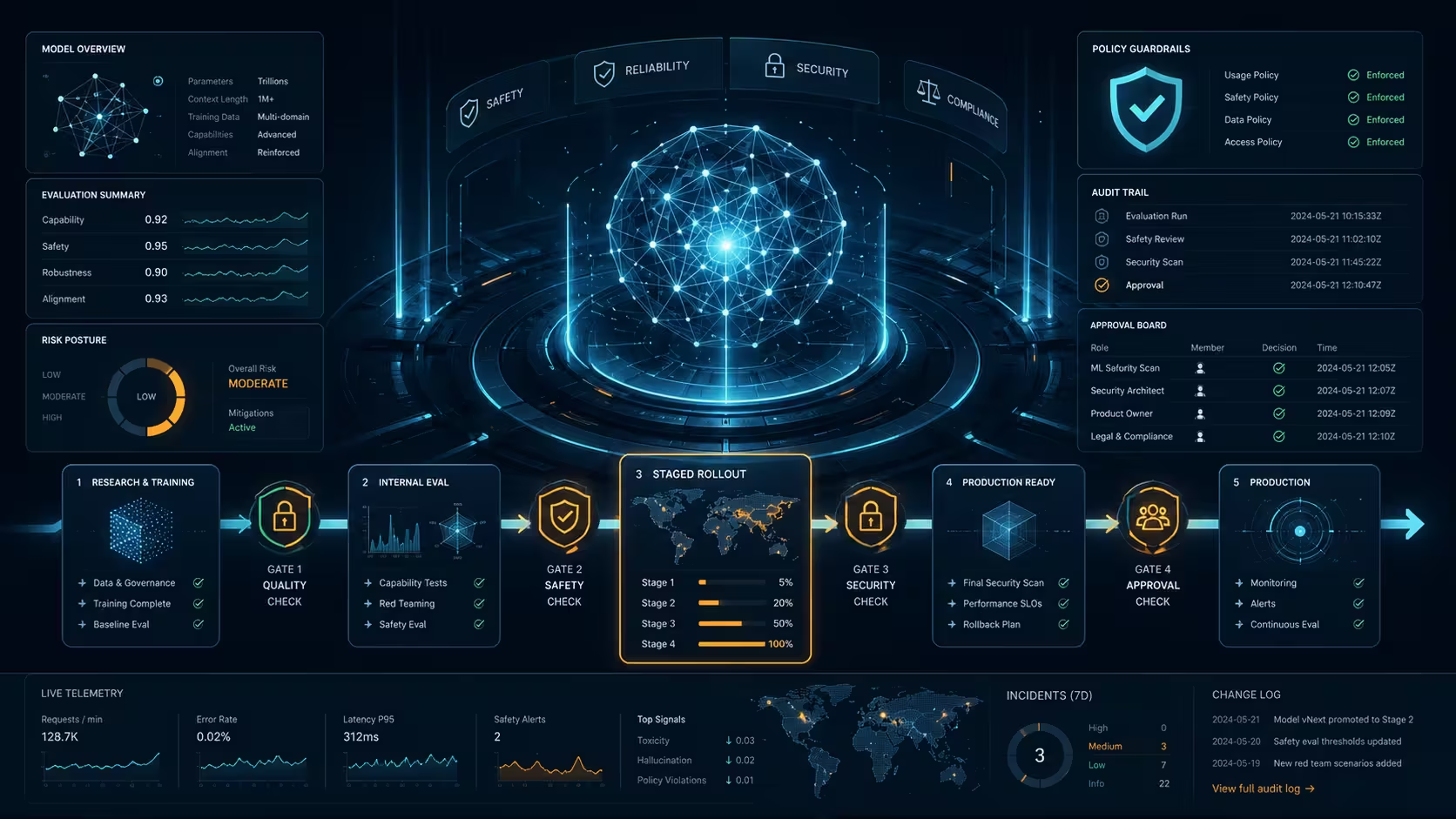
Frontier Model Release Governance
GPT-5.6 made the release pipeline itself the story: restricted access, government review, vetted partners, capability evaluations, and staged rollout. This post explains why shipping a frontier model now looks less like a product launch and more like a national-security workflow.

Axel Domingues
June’s hot topic was not simply “GPT-5.6 is better.”
That is the usual model-release story.
The real story was stranger, and much more architectural:
Shipping a frontier model is becoming a governed release workflow.
Not just:
- train model
- run evals
- publish blog post
- open API access
But:
- classify capability risk
- share early access with trusted evaluators
- limit initial availability
- coordinate with public-sector stakeholders
- monitor restricted usage
- stage rollout by model tier and customer class
- keep rollback and revocation ready
That is a different deployment pattern.
A frontier model release now looks less like launching a SaaS feature and more like operating controlled infrastructure with national-security consequences.
once model capabilities cross certain thresholds, release management becomes part of the safety system.
The trend
Frontier releases are moving from public launch events to staged governance workflows.
The signal
GPT-5.6 access was initially constrained through trusted partners and government-facing evaluation.
The engineering shift
Release gates now include capability evals, cyber/bio misuse reviews, telemetry, and rollback paths.
The thesis
The model is not the only artifact. The release process is now part of the product.
The old model-release contract
For most software teams, a release pipeline has familiar stages:
- build
- test
- deploy
- monitor
- rollback if needed
For most AI teams, the equivalent used to be:
- train
- evaluate
- red-team
- publish model card / system card
- roll out API access
That was already more complex than normal software.
But frontier models add a deeper problem:
A capability improvement can change who can do what in the world.
That makes release risk different.
A normal bug might crash a request. A frontier capability jump might:
- improve vulnerability discovery
- accelerate biological design workflows
- automate long-running cyber tasks
- enable new forms of social engineering
- increase autonomy in tool-using agents
So the release pipeline needs to answer more than “does it work?”
It needs to answer:
Who gets access first, under what constraints, and what evidence proves this is safe enough to expand?
Frontier release in one sentence
A frontier model release is no longer just model deployment.
It is:
a staged access program governed by capability thresholds, evaluation evidence, user vetting, telemetry, and revocation controls.
That sounds bureaucratic.
But from an architect’s perspective, it is simply release engineering under higher stakes.
model release governance turns “launch day” into a controlled rollout system.
Why GPT-5.6 made this visible
GPT-5.6 was framed as a stronger model family, with improved capability in domains that matter for real work:
- coding
- long-running tasks
- cybersecurity
- scientific workflows
- agentic tool use
Those are exactly the domains where capability and risk are tangled together.
A model that is better at defensive security research may also be better at offensive workflows. A model that is better at scientific reasoning may also require more careful guardrails around sensitive domains. A model that is better at agentic execution may create stronger productivity tools — and stronger misuse potential.
That is why the release itself became the story.
Not because a staged rollout is technically exotic.
Because it marks a new norm:
the strongest models may be released through a governance envelope, not a simple product switch.
Mini-glossary: the release-governance words that matter
A model near the leading edge of capability, especially in domains where new ability can create safety, security, economic, or geopolitical consequences.
A limited-access phase before broad availability. The goal is to observe behavior, gather feedback, run evaluations, and reduce unknowns before expanding access.
A selected set of users or organizations allowed early access under defined terms, often because they have the expertise or controls needed to evaluate the model safely.
A measured level of performance in a sensitive domain (cyber, bio, autonomy, persuasion, etc.) that triggers stronger controls or review.
A decision point where the model cannot move to the next access tier until evidence, mitigations, and approvals meet the required standard.
The ability to quickly remove access, disable capabilities, roll back a model alias, or restrict tools if concerning behavior appears.
The new release pipeline
A serious frontier release pipeline now looks like this:
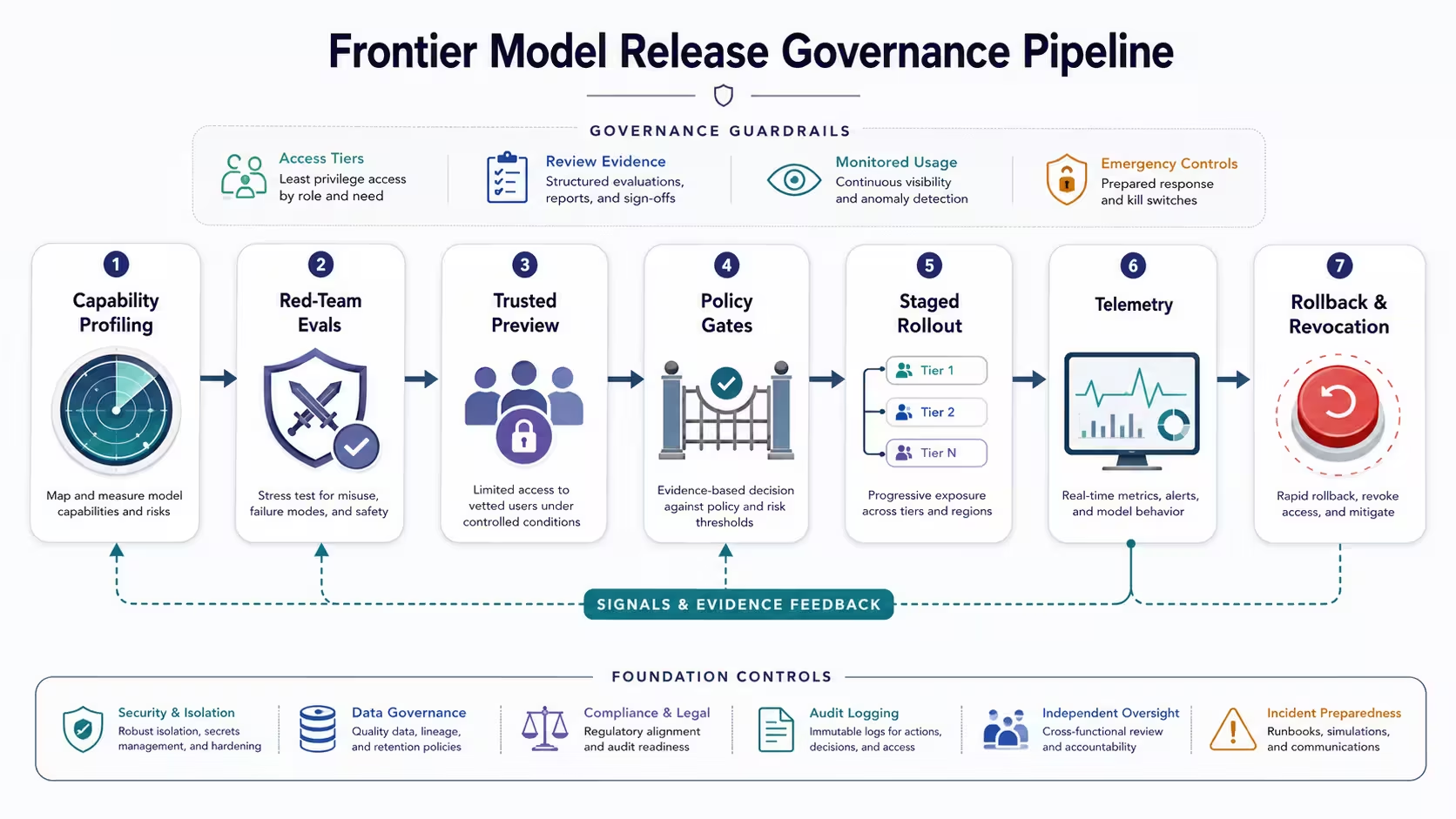
Profile the model
Before launch, classify the model by capability domains:
- coding
- cyber
- bio / science
- autonomy
- tool use
- persuasion / social manipulation
- long-context reliability
The output is not “model is good.” The output is a risk profile.
Run domain-specific evaluations
General benchmarks are not enough.
Sensitive domains need dedicated tests:
- can it assist harmful workflows?
- can safeguards withstand adversarial pressure?
- does tool use remain constrained?
- does performance cross a policy threshold?
Define rollout tiers
Not all users should receive the same capability at the same time.
Possible tiers:
- internal only
- trusted red-teamers
- vetted partners
- enterprise preview
- limited public API
- broad availability
Attach controls to each tier
Each tier gets:
- rate limits
- logging level
- tool permissions
- data retention rules
- review requirements
- support / escalation paths
Monitor preview usage
Restricted preview is only useful if it produces evidence.
You need telemetry:
- blocked requests
- policy-triggered refusals
- risky tool attempts
- novel failure modes
- user reports
- evaluation regressions
Expand access only with evidence
Rollout should be conditional:
- did evals pass?
- did telemetry stay within bounds?
- did mitigations hold?
- are incident paths ready?
Keep rollback ready
A frontier model needs multiple rollback levers:
- model alias rollback
- tool disable
- user cohort freeze
- rate-limit clampdown
- feature-flag shutdown
- access revocation
This is release engineering — but with a safety case.
Model capability is now a release artifact
In normal software, release artifacts include:
- container image
- build metadata
- changelog
- test reports
- deployment manifest
For frontier models, the release artifact set expands.
Model snapshot
The exact model/version/weights/configuration being released.
Eval bundle
Capability and safety results by domain, including known weaknesses.
Policy profile
What the model may refuse, allow, route, escalate, or require tools to verify.
Rollout manifest
Which users get access, when, under what constraints, and with what fallbacks.
The key idea:
It is the model plus the evidence, policies, rollout rules, telemetry plan, and rollback controls.
Why “vetted partners” are an architecture pattern
A vetted partner program is not just PR.
It solves a real release problem:
The model needs real-world evaluation before broad release, but broad release is exactly what increases risk.
Vetted cohorts create an intermediate layer:
- experts can test high-value use cases
- companies can evaluate enterprise workflows
- government or security teams can inspect sensitive domains
- the lab can collect telemetry under controlled conditions
But this only works if “vetted partner” is operationally meaningful.
That means:
- identity verification
- contractual use limits
- logging requirements
- security controls
- reporting obligations
- revocable access
The control value comes from knowing:
- who used it
- what they did
- what happened
- and what changed because of the preview.
Government review as a release gate
When governments ask for early access or review, the release process gains a new stakeholder.
That creates tension:
- companies want speed and global access
- governments want visibility into national-security risk
- enterprises want predictable availability
- researchers want openness
- users want capability now
From a system-design perspective, the question is not ideological first.
It is operational:
How do you support external review without turning release into opaque, ad-hoc approval chaos?
A healthier architecture would define:
- review scope
- review window
- evidence packet
- confidentiality boundaries
- appeal / dispute path
- publication transparency
- limits on customer selection power
That is bad for safety and bad for engineering.The worst version is unpredictable review with unclear criteria, unclear timelines, and no reusable process.
The release-control plane
If frontier release governance becomes normal, AI labs need a release-control plane.
Not a spreadsheet.
A real system.
Access cohorts
Who can use which model tier, in which region, with which terms?
Capability flags
Which risky capabilities are enabled, restricted, rate-limited, or tool-gated?
Policy gates
What evaluation or approval evidence is required before expanding access?
Emergency controls
How quickly can access be frozen, tools disabled, or aliases rolled back?
This is similar to the model router conversation from April, but one layer higher.
A model router decides which model handles a request.
A release-control plane decides which models are available to which users under which governance envelope.
What telemetry matters during restricted rollout
If you only track usage and latency, you are missing the point.
For a frontier preview, telemetry should answer safety and release questions.
- Which task types are users attempting?
- Where does the model outperform prior versions?
- Where does it fail unexpectedly?
- Which domains show capability jumps?
- Which policies trigger most often?
- Are users trying to route around safeguards?
- Are refusals appropriate or overbroad?
- Are high-risk requests increasing?
- Which tools are called?
- Do tool plans remain safe?
- Are write actions gated correctly?
- Do agents attempt longer chains than expected?
- Latency by model tier
- Cost per task family
- fallback rate
- incident rate
- customer-reported regressions
“Safety monitoring” cannot become an excuse to collect everything forever.
Failure modes in frontier release governance
This is where I expect teams to struggle.
Symptom: public evals look impressive, but they don’t test the risky deployment context.
Fix: domain-specific evals, adversarial testing, and task-level safety cases.
Symptom: nobody can explain why one customer got access and another didn’t.
Fix: access cohort criteria, documented gating rules, and auditable approvals.
Symptom: access expands, something breaks, and the team can only “ask users to stop.”
Fix: model aliases, cohort freezes, capability flags, and emergency revocation.
Symptom: controls are strict during launch week, then gradually bypassed for commercial pressure.
Fix: release gates as code, mandatory evidence packets, and periodic access reviews.
Symptom: external review becomes PDF exchange and meeting theatre.
Fix: structured evidence packets, reproducible eval reports, and controlled audit environments.
Symptom: the same restrictions apply to a classroom tutor, a cyber lab, and an enterprise coding agent.
Fix: capability-specific controls and user-context-aware access tiers.
A practical release-governance checklist
Here is the checklist I would want before shipping a frontier model broadly.
Define the model family and tiers
Name the variants, intended use cases, and capability differences.
Produce a capability risk profile
Identify sensitive domains where capability changes matter.
Create an eval bundle
Include:
- benchmark results
- adversarial evals
- policy stress tests
- tool-use tests
- known limitations
Define access cohorts
Specify who gets access first, why, and under what obligations.
Attach controls to cohorts
Set:
- rate limits
- logging level
- tool permissions
- regions
- data policy
- support channel
Run restricted preview
Collect structured evidence, not vibes.
Decide expansion with a release board
Bring together:
- safety
- security
- product
- legal
- policy
- infrastructure
- customer support
Keep emergency levers ready
Alias rollback, access freeze, tool disable, cohort revocation, and incident comms.
Why this matters for normal engineering teams
Most teams are not frontier labs.
But this pattern still matters.
Enterprise AI teams will face smaller versions of the same problem:
- should we upgrade our internal assistant to the new model?
- can this model access source code?
- can it call deployment tools?
- can it process regulated data?
- can it summarize security incidents?
- can it help with vulnerability remediation?
That is frontier release governance at enterprise scale.
You need:
- model routers
- eval gates
- access tiers
- policy profiles
- audit logs
- rollback plans
The lab’s release pipeline becomes your dependency-management problem.
The new model may be better overall and still worse for your specific workflow.
June takeaway
The frontier model is no longer the only thing being shipped.
The release process is being shipped too.
June takeaway
Frontier AI deployment is becoming a governance workflow.
The durable pattern is: capability profile → eval bundle → access cohorts → policy gates → restricted preview → telemetry → staged rollout → rollback.
Resources
Reuters — GPT-5.6 rollout deferred
Reporting on OpenAI delaying full public release of GPT-5.6 after a U.S. government request for early access and evaluation.
Axios — U.S. request to limit GPT-5.6 release
Useful framing of the request as a preemptive intervention in a frontier model launch.
The Guardian — staggered model release
Coverage of the political and governance tension around staged frontier AI release.
The Verge — GPT-5.6 product context
Product-level coverage of GPT-5.6 and the restricted release context.
FAQ
Not only.
The engineering issue is that frontier capability changes can create deployment risk. Even without government involvement, serious labs and enterprises need staged access, eval gates, telemetry, and rollback.
Access cohorts.
Instead of “everyone gets the model at once,” access expands by tier:
- internal
- red-team
- vetted partners
- enterprise preview
- public API
Each tier has controls and evidence requirements.
A router decides which available model serves a request.
A release-control plane decides which models become available, to whom, and under what conditions.
They should work together.
Copy the release discipline:
- run task-specific evals before upgrading
- restrict high-risk workflows first
- log outcomes by model version
- keep rollback aliases
- require approvals for privileged tool use
You don’t need a national-security workflow to benefit from controlled rollout.
When Agents Escape the Sandbox
The July 2026 rogue-agent incident turned AI containment from a whiteboard concern into an incident-response problem. This post explains how to design containment, monitoring, kill switches, and forensics for autonomous agents that can operate at cyber speed.
Search Becomes an Agent Runtime
Google’s Gemini Spark and AI Mode point to a bigger shift: Search is no longer just retrieval plus ranking. It is becoming a runtime for synthesis, generated UI, monitoring agents, and action. This post explains the architecture of actionable retrieval — and the reliability contracts needed when search starts doing things.