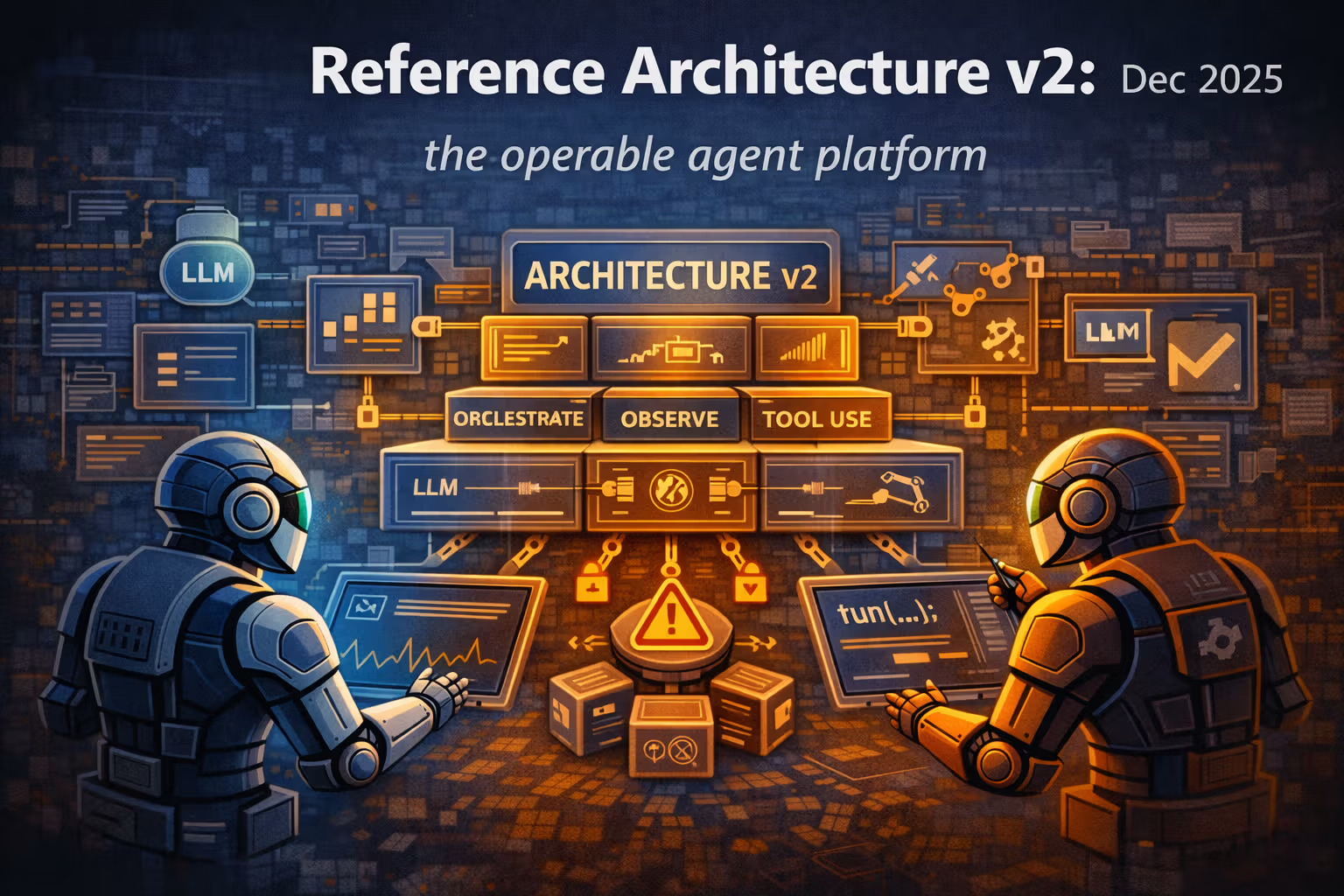
Reference Architecture v2: the Operable Agent Platform
This is the 2025 finale: a practical reference architecture for running fleets of agents with governance—connectors you can trust, traces you can debug, evals you can ship, and humans you can hand off to.

Axel Domingues
All year, the story of agents changed.
In January, an “agent” still meant: a model with tools.
By December, an “agentic product” means something else entirely:
a platform that runs many agents, with many connectors, across many teams — without turning into chaos.
This article is the synthesis.
If you’re jumping in here, treat v1 as the “non-AI platform” foundation, and v2 as the upgrade that makes it agent-native.I wrote Reference Architecture v1 as the finale of the 2022 “operational architecture” year: a defendable baseline for a modern cloud product (APIs, distributed data, async workflows, CI/CD, observability, security, and governance). v2 is that same spine — plus the agent-specific control plane: orchestration, connector/tool governance, evaluation in CI, and the reliability guardrails needed to run fleets of probabilistic workers.
A Reference Architecture v2 for an operable agent platform:
- predictable behavior (as much as probabilistic components allow)
- safe tool use (least privilege + injection resistance)
- traceable execution (debuggable end-to-end)
- measurable quality (evals in CI, not vibes)
- governable change (versioning, approvals, auditability)
- and a clean handoff to humans when the machine hits ambiguity
It means you can point to a diagram, name the invariants, and defend your decisions under pressure: security reviews, incident postmortems, cost spikes, compliance asks, and product deadlines.
The goal
Run fleets of agents safely, cheaply, and repeatably.
The shift
Agents stop being a feature and become a runtime.
The constraint
Connectors turn into production attack surface.
The definition of done
You can operate it: observe, debug, roll back, and audit.
What “Operable” Means (In Practice)
“Operable” is not a buzzword. It’s a list of things you can do at 3AM when something breaks.
An operable agent platform can answer these questions quickly:
- What happened? (trace + timeline)
- Why did it happen? (inputs + tool calls + policy decisions)
- What was the blast radius? (tenant, connector, model, workflow)
- How do we stop it now? (kill switch, circuit breaker, rollback)
- How do we prevent recurrence? (policy update, connector fix, eval gate)
If you can’t do that, you don’t have an agent platform.
You have a demo that will eventually become an incident.
The Architecture at 10,000 Feet: Data Plane vs Control Plane
The cleanest mental model I’ve found is the same one we use for infrastructure platforms:
- Data plane: runs the work (sessions, tool calls, workflows)
- Control plane: decides what is allowed (policies, routing, governance)
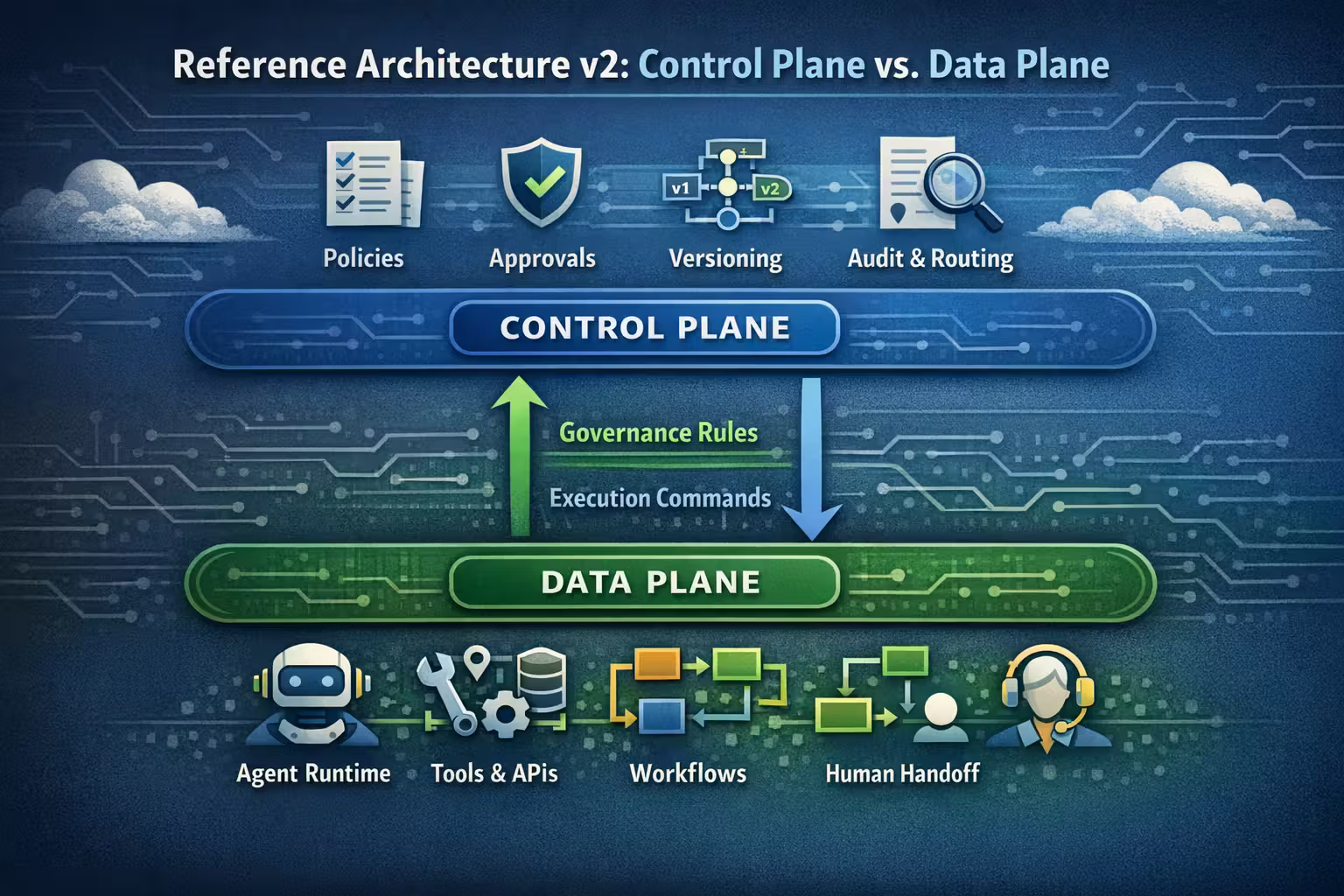
Data plane
Executes agent runs, tool calls, voice turns, and workflows.
Control plane
Defines policies, versions, approvals, routing, and audit requirements.
The mistake teams make is mixing these.
If your data plane “decides” policy at runtime with no versioning, approvals, or audit — you can’t govern change. And if your control plane tries to run the workload, you can’t scale execution cleanly.
So RA v2 keeps them separate.
RA v2 Components
Here’s the platform decomposed into components you can actually build and assign teams to.
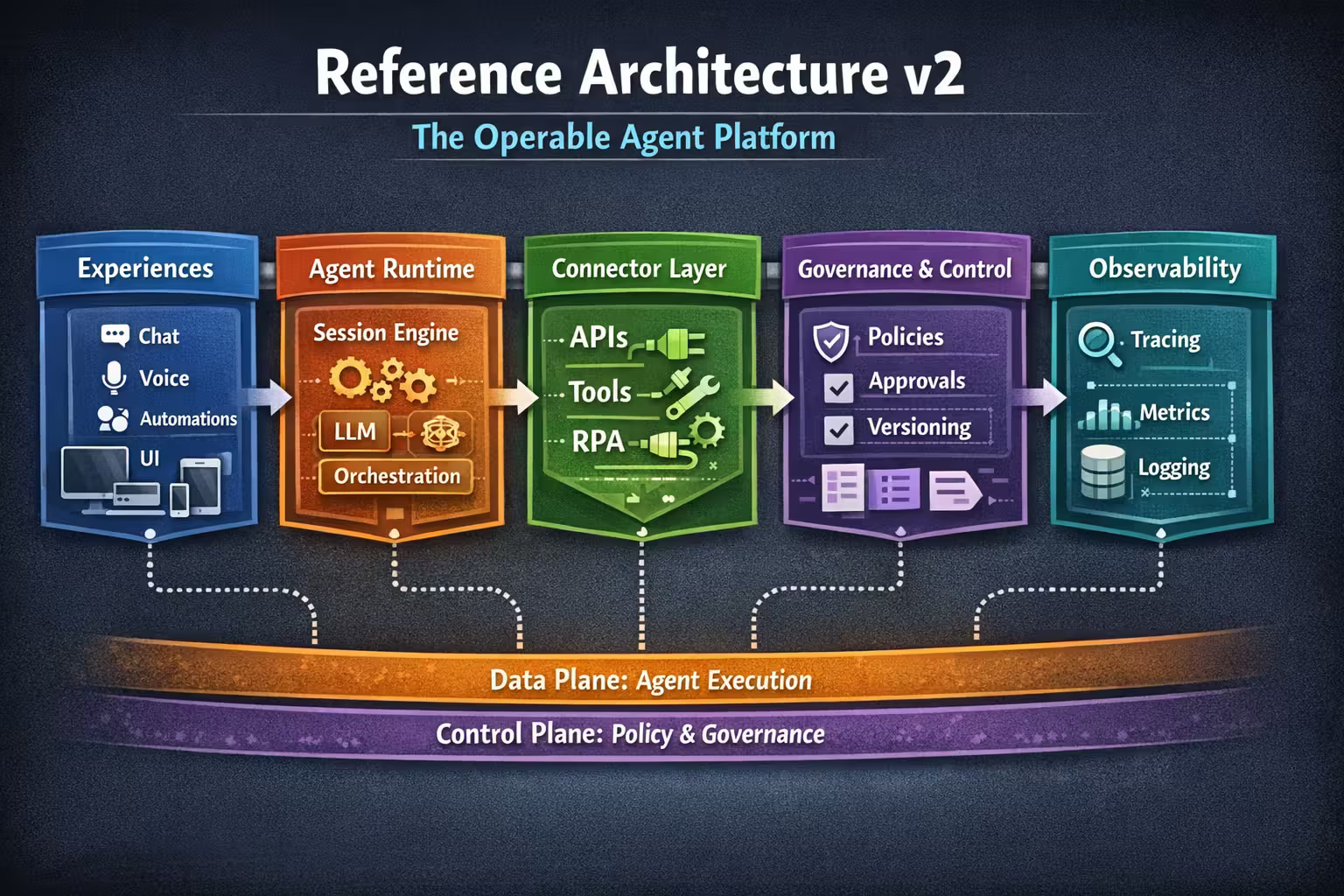
1) Experiences (Chat, Voice, Automations, Embedded UI)
This is the surface area your users touch:
- web chat
- mobile chat
- voice calls
- proactive workflows (“run this plan nightly”)
- embedded copilots inside products
Rule: Experiences should be thin. They collect context, render outputs, and host a clean human handoff path. They should not contain business logic for agent orchestration.
2) Agent Runtime (Session Engine)
The session engine is the heart of the data plane.
It owns:
- conversation/session state
- memory boundaries (what is retained vs not)
- step execution (LLM call → tool call → evaluation → next step)
- budgets (cost, tokens, tool call limits)
- guardrails (policy enforcement points)
This is where multi-agent composition happens safely: supervisors, specialists, delegation, and structured handoffs.
3) Workflow Engine (Jobs + State Machines)
Agent work is not always interactive.
If your platform can’t:
- run long workflows,
- retry safely,
- and survive partial failures,
…then it’s not a platform.
This engine should feel familiar if you’ve built distributed systems:
- durable state machines
- idempotency keys
- retries with backoff
- dead letter queues
- explicit timeouts
(If you’ve read my earlier outbox/sagas work, you’ll recognize the patterns.)
4) Connector Layer (Tools, APIs, MCP, RPA)
Tools are “just functions”… until they aren’t.
The connector layer provides:
- stable tool schemas
- auth handshakes (OAuth, service accounts, delegation)
- policy-bound execution (least privilege)
- rate limiting and circuit breakers
- safe parsing and response validation
- versioning and compatibility guarantees
This is also where MCP-style connector ecosystems start to matter: a standard protocol for tool discovery, schemas, and execution boundaries.
5) Control Plane (Policy + Governance)
The control plane is where you make safety and compliance real, not aspirational.
It owns:
- policy definitions and versioning
- approvals (who can publish a connector? a prompt? a workflow template?)
- environment promotion (dev → staging → prod)
- audit logs and retention policy
- model routing rules (latency/cost/quality constraints)
- kill switches (tenant, connector, workflow, model)
6) Observability Plane (Tracing + Metrics + Replay)
Agents are probabilistic — so you need observability that treats them as distributed systems.
At minimum:
- traces spanning LLM calls + tool calls + policy decisions
- structured logs (no “string soup”)
- metrics for latency, error rate, tool failure, cost, and token burn
- run replay (reconstruct what happened from stored artifacts)
- evaluation results linked to real runs
The Non‑Negotiables: The Platform Invariants
Reference architectures are useless if they don’t specify what must never be violated.
Here are the invariants I treat as non-negotiable for an operable agent platform:
Identity & tenancy
Every action is attributable: user, tenant, agent, connector, run.
Least privilege by default
Tools run with minimal scope, time‑boxed credentials, and explicit grants.
Deterministic envelope
Even if model output is probabilistic, the execution contract is deterministic.
Auditable decisions
Policy version, model selection, tool choice, and overrides are recorded.
Under these invariants, “agents” become something you can safely operate:
- You can prove who did what.
- You can bound what they can do.
- You can replay and explain incidents.
- You can roll back safely.
The Deterministic Envelope: Where Probabilistic Meets Production
The trick to building reliable agent systems is not pretending the model is deterministic.
It’s building a deterministic envelope around it.
That envelope is a contract.
A good envelope includes:
- Typed tool schemas (validated both directions)
- State machine boundaries (what steps exist, what transitions are allowed)
- Budgets (tokens, cost, time, tool calls)
- Policy gates (what requires approval, escalation, or denial)
- Human checkpoints (when ambiguity becomes risk)
Think of it like this:
The model is a creative proposal engine.
The platform is the execution authority.
Three Reference Flows (Where Systems Usually Break)
Let’s make the architecture concrete with three flows you’ll almost certainly run in production.
The failure mode: the agent improvises permissions and sends the wrong thing.
The RA v2 approach:
- tool call requires a scoped credential (per user or service delegation)
- message draft is produced as an artifact
- send action is a separate step requiring explicit approval (UI click or policy rule)
- audit records: draft hash + recipient + connector version + policy version
The failure mode: retries duplicate side effects or silently skip failed steps.
The RA v2 approach:
- workflow is a durable state machine (steps are idempotent)
- outbox pattern publishes tool tasks reliably
- step timeouts + DLQ prevent infinite hangs
- evaluation checks run quality (format, completeness) before publish
- alerts fire on SLO violations, not just exceptions
The failure mode: latency spikes destroy UX, and misrecognitions become irreversible actions.
The RA v2 approach:
- streaming pipeline (ASR → NLU/LLM → TTS) with per-turn budgets
- cached or templated responses for common intents
- “confirm-before-act” policy for sensitive actions
- immediate human handoff when confidence is low or frustration is high
- real-time tracing for turn latency and tool failures
Connector Ecosystem Governance: How You Avoid “Tool Sprawl”
By late 2025, most teams discover the same painful truth:
Connectors scale faster than trust.
You start with 5 tools. Then someone adds 15 more. Then teams copy/paste wrappers. Then the platform becomes an un-auditable jungle.
So governance must be built in.
The connector lifecycle (what the platform enforces)
Register
A connector is registered with:
- a unique ID
- owner team
- schemas and auth methods
- declared data classifications (PII? financial? admin actions?)
- required policies (confirmations, approvals, logging levels)
Verify
Automated checks run:
- schema validation
- injection-resistance tests (prompt + tool boundary)
- fuzzing for parsing and argument handling
- permissions tests (least privilege cannot be bypassed)
Publish
Publishing requires:
- semantic versioning (breaking vs non-breaking changes)
- approval gates (platform + security review for sensitive scopes)
- staged rollout (canary tenants / limited traffic)
Operate
Runtime enforcement includes:
- rate limits + circuit breakers
- anomaly detection (sudden spike in calls or failures)
- kill switches by connector version
- rollback to last known good
A boring connector process means:
- easy to do the right thing
- hard to do the unsafe thing
- and impossible to ship changes with zero traceability
Quality as a Release Gate: Evals in CI, Not in Production
In 2023 I treated evaluation as the missing discipline for LLM features.
In 2025, evaluation becomes the missing discipline for agent platforms.
Because now failures aren’t just “wrong text.” They’re:
- wrong tool usage
- wrong order of operations
- wrong policy decisions
- costly loops
- and unsafe actions
So RA v2 requires an eval pipeline that looks like software engineering:
- unit tests for tool schemas, parsers, and routers
- simulation tests for workflows (state machine transitions)
- scenario evals for end-to-end runs with mocked connectors
- regression gates tied to the versions you deploy
The “Human Handoff” Is a First‑Class Component
The strongest agent platforms don’t try to eliminate humans.
They treat humans as:
- a safety boundary,
- a quality backstop,
- and a customer-experience tool.
Handoff is not a button. It’s a workflow with guarantees:
- transfer context safely (without leaking secrets or irrelevant internal traces)
- capture what the agent attempted (so humans don’t start from zero)
- let the human override or correct (with feedback captured for evals)
- resume the workflow after human action if appropriate
RA v2 places handoff inside the deterministic envelope: a state transition, not a best-effort UX flourish.
Implementation Checklist: A Practical Adoption Path
You don’t implement this architecture by rewriting everything.
You implement it by turning chaos into contracts — gradually.
Step 1 — Standardize tool contracts
- typed schemas for arguments + responses
- strict validation (reject unknown fields)
- stable IDs and semantic versioning
Step 2 — Introduce a session engine
- explicit run state
- budgets + timeouts
- trace IDs everywhere
Step 3 — Add policy enforcement points
- confirmation gates
- least privilege enforcement
- deny-by-default for new tools
Step 4 — Add an eval harness
- scenario suites for the top 20 workflows
- regression gates for connector and policy changes
Step 5 — Add governance workflows
- connector registry + approvals
- environment promotions
- kill switches + rollback paths
Step 6 — Make human handoff real
- consistent handoff triggers
- safe context packaging
- post-handoff feedback loop
FAQ
No. RA v2 is valuable even for a single agent, because the hard parts are the same: tool safety, observability, evaluation, and governance.
Multi-agent composition simply makes the need impossible to ignore.
Treat MCP-style protocols as connector plumbing: a way to standardize discovery and invocation.
But don’t confuse “standard protocol” with “safe platform.” Safety comes from policy enforcement, least privilege, versioning, and auditing — which RA v2 supplies.
No. The components map cleanly to most clouds and on-prem setups. The key idea is separation of concerns: data plane execution vs control plane governance.
Teams ship tool integration without a deterministic envelope: no budgets, no idempotency, no replay, no policy versions.
It works until it doesn’t — and then it becomes un-debuggable.
The 2025 Takeaway
In 2018, RL taught me that unstable training loops need stabilizers.
In 2025, agent platforms taught me the same lesson in a new form:
A tool-using system is a feedback loop.
Reliability comes from the stabilizers you design around it.
Reference Architecture v2 is my attempt to name those stabilizers clearly:
- separation of control plane and data plane
- deterministic envelopes around probabilistic components
- connector governance as a platform capability
- evaluation as a release gate
- observability as a first-class feature
- humans as part of the system, not an afterthought
What’s Next
This closes the 2025 arc: agents became platforms — and platforms need governance.
In 2026, I’m switching modes again.
No fixed syllabus.
Instead, each month I’ll pick one hot topic that’s actually moving the industry, then unpack it like an architect:
- what the thing is (mechanics, not hype)
- what breaks in production (failure modes, incentives, attack surface)
- what contracts make it operable (budgets, evals, safety boundaries, governance)
- and what you should build if you want the capability without the incident
Same rule as always:
capability is impressive — reliability is designed.
See you next month with whatever the real world decides is urgent.
Prism and the Architecture of Artifact-Native AI for Science
Prism is a LaTeX-native, AI-first workspace for scientific writing. Under the hood, it’s a new pattern: the model is embedded in the artifact, not bolted onto the side. This post explains the architecture, the contracts that keep it honest, and what “artifact-native AI” changes for reliability and governance.
The Connector Ecosystem: MCP adoption patterns, versioning, and governance
Once agents can call tools, connectors become the new platform surface. This month is a playbook for adopting MCP at scale: patterns that work, versioning that doesn’t break customers, and governance that keeps the ecosystem sane.