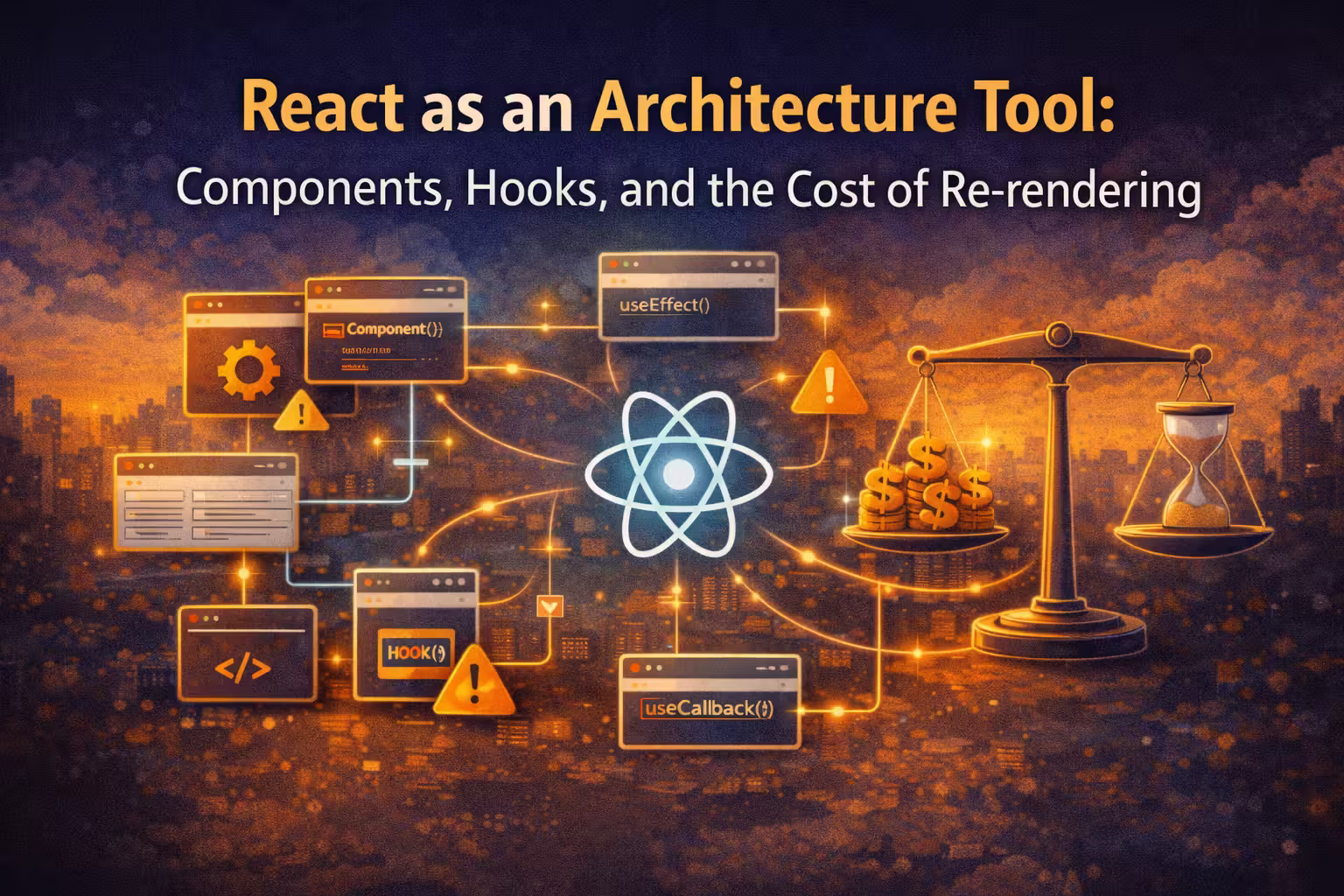
React as an Architecture Tool: Components, Hooks, and the Cost of Re-rendering
React is not a UI library — it’s a runtime for composing change. This post teaches the mental model that makes large React codebases predictable: component boundaries, hooks as architecture, and the real cost model of re-rendering (so you optimize the right thing).

Axel Domingues
In January I zoomed out: the web “compressed” itself into patterns that reduce latency and operational pain.
In February I zoomed in: HTTP is already a distributed systems API.
In March I hit browser reality: the event loop and rendering pipeline explain why UX bugs often smell like backend bugs.
In April we picked a data boundary — REST, GraphQL, tRPC — and admitted that the boundary is where coupling lives.
Now, May:
React is where all those decisions show up as user experience.
And here’s the uncomfortable truth:
In a real product, “frontend architecture” is less about pixels and more about change propagation.
React is a programming model for change propagation.
Treat it like architecture and it scales.
Treat it like “just UI” and your app becomes a haunted house of rerenders, stale state, and performance regressions no one can explain.
The goal this month
Build a mental model of React that survives a 50k+ LOC codebase and multiple teams.
The core idea
React architecture is where you place boundaries so change stays local and predictable.
The sharp edge
Re-rendering is cheap… until it isn’t. You need a cost model.
The payoff
Fewer “mystery bugs”, safer refactors, and performance work that actually moves user metrics.
React is a runtime, not a templating system
If you remember jQuery and “DOM as state,” React feels like a UI library.
If you operate large systems, React feels like this:
- a scheduler (when work happens)
- a pure computation phase (render)
- a side-effect phase (commit + effects)
- a diffing strategy (reconciliation)
- a state propagation graph (who updates whom)
That’s architecture.
A state change schedules a re-render of a component subtree; React computes “what UI should look like” (render), then commits minimal DOM updates and runs side effects.
The two-phase model: render vs commit
Most React confusion comes from mixing these phases.
Render phase
Pure computation: “given state + props, what should the UI be?”
No side effects. No DOM writes.
Commit phase
Apply changes to the DOM. Then run effects.
This is where you touch the outside world.
Why this matters
When a UI bug “sometimes happens,” ask:
- Did I accidentally do a side effect during render?
- Did I assume render happens once?
- Did I rely on timing that isn’t guaranteed?
That’s the same mindset as backend distributed systems:
Don’t assume ordering you didn’t explicitly enforce.
Components are boundaries (not reusable HTML snippets)
Teams often treat components as “UI Lego.”
Architects treat components as module boundaries:
- Where does state live?
- Where do effects live?
- Who is allowed to know about which dependencies?
- Where do you enforce invariants?
- What does “change” affect?
A simple boundary rule that scales
Push state down. Pull effects up.
- “Down” gives locality (fewer rerenders, fewer hidden dependencies).
- “Up” gives control (centralized orchestration, consistent error handling).
This is why container/presentational separation keeps reappearing — not because it’s fashionable, but because it keeps coupling visible.
Boundary component (architecture):
- owns data fetching / orchestration
- owns navigation side effects
- owns global state coordination
- decides which subtrees exist and when
Widget component (UI):
- receives data + callbacks
- renders UI and emits events
- avoids owning long-lived side effects
Hooks are the architecture layer
Hooks aren’t “React magic.” Hooks are dependency injection for function components.
They let you encode “how this part of the system works” as reusable, testable logic.
The three classes of state (stop mixing them)
Most rerender pain comes from mixing these three kinds of state:
UI state
Local interaction: open/closed, selected tab, input focus, ephemeral values.
Server state
Remote truth with caching: loading, stale, refetch, pagination, invalidation.
App state
Cross-cutting session truth: auth, feature flags, locale, global preferences.
The rule
Different state types want different tools and different lifetimes.
If you put server state into a global store “because it’s shared,” you create:
- cache invalidation bugs
- inconsistent loading/error semantics
- rerenders that ripple through the entire app
If you put app state into component state, you create:
- duplicated truth
- subtle drift across screens
- navigation bugs
Hooks are where you encode the correct semantics for each class.
The cost model of re-rendering (what actually gets expensive)
People repeat “rerenders are cheap.” Sometimes they are.
But the full cost of a rerender can include:
- running render functions (JS time)
- allocating objects/arrays (GC pressure)
- re-running expensive selectors or transforms
- rendering large lists
- creating unstable props that invalidate memoization
- triggering child rerenders unintentionally
- layout thrash when commits cause measurement
React’s diffing reduces DOM writes — but it cannot save you from expensive computation.
Your React work has to fit inside that budget where it matters (typing, scrolling, dragging, animations).If you want 60fps, you have ~16ms per frame for everything — JS + layout + paint.
The four rerender traps I see most in production
This is the classic.
// Every render creates a new object and function identity
<Child
  options={{ dense: true }}
  onSelect={(id) => setSelected(id)}
/>
Even if the values are “the same,” the identity changes, and memoization becomes useless.
Fix it when it matters with useMemo / useCallback — but only after measurement.
If you store derived data as state, you create drift.
const [name, setName] = useState(props.user.name) // drift risk
Prefer deriving during render, or store the minimal source of truth and derive from it.
Context is great for true global concerns.
Context is dangerous when you put frequently-changing values in it. One context update can rerender huge subtrees.
Patterns that help:
- split contexts by update frequency
- move fast-changing values to local state
- prefer “selector” patterns or dedicated state libraries when needed
Large lists are where “cheap rerenders” go to die.
Fixes usually look like:
- virtualization (windowing)
- memoized row components
- stable keys that reflect identity
- moving expensive formatting out of hot render paths
Optimization without cargo cult: when to use memoization
React.memo, useMemo, and useCallback are not performance vitamins.
They are tradeoffs:
- they add cognitive load
- they can hide bugs (stale closures, wrong deps)
- they can make performance worse if the memoization work exceeds the saved work
- What is slow? (profile)
- Why is it slow? (root cause)
- What change reduces the cost? (measure again)
A practical “PR checklist” for rerender safety
Avoid accidental coupling
Are we passing “everything” down instead of defining a boundary?
Stabilize identity where it matters
Are we creating new objects/functions in hot paths?
Keep side effects out of render
Are effects centralized and idempotent?
Measure before “optimizing”
Did we use the React Profiler (or real metrics) before adding memoization?
Hooks that scale: patterns I actually trust
Pattern: Custom hooks as “domain adapters”
A good custom hook:
- hides data fetching details
- returns stable, UI-friendly outputs
- encodes retries, cancellation, and error semantics
- makes the component tree boring
type UseUserProfileResult = {
  user: { id: string; name: string } | null
  isLoading: boolean
  error: { message: string } | null
  refresh: () => void
}

function useUserProfile(userId: string): UseUserProfileResult {
  // placeholder: your real impl could use fetch, React Query, etc.
  // the point is the contract: UI doesn't care about transport details
  return { user: null, isLoading: true, error: null, refresh: () => {} }
}
This is the same move we do in backend architecture:
- hide infrastructure details behind a stable interface
- make the rest of the system depend on the contract, not the mechanism
Pattern: “effects are for synchronization, not computation”
If the value can be derived from state/props, derive it in render.
Effects are for syncing with the outside world:
- network calls
- subscriptions
- timers
- imperative libraries (maps, charts)
- analytics
You’re creating a second state machine that can drift.
A concrete example: why “loading spinners everywhere” is an architectural smell
If every component fetches its own data, you get:
- waterfalls
- duplicated loading states
- duplicated error states
- inconsistent retry semantics
- rerenders that ripple unpredictably
The fix isn’t “better spinners.”
The fix is boundaries:
- fetch at the boundary (route / feature container / BFF-aware boundary)
- pass data down as props
- keep widgets dumb
That’s why React architecture feels similar to microservices architecture:
It’s all about choosing where coordination lives.
Debugging React like a systems engineer
When something feels “random,” I walk this ladder:
Step 1 — Identify the trigger
What state update caused this?
- local state?
- context change?
- server state refetch?
- parent rerender?
Step 2 — Identify the boundary breach
Which component now knows something it shouldn’t?
- a widget doing orchestration?
- an effect hidden deep in the tree?
- a “global store” carrying server state?
Step 3 — Identify the hot path
What re-renders frequently?
- typing?
- scroll?
- animation?
- websocket updates?
Step 4 — Profile and measure
Use the React Profiler (or production metrics if you have them).
Fix the biggest cost, not the most annoying code smell.
Step 5 — Install a guardrail
Make it hard to reintroduce the bug:
- lint rules for hooks
- patterns for stable props
- feature boundaries
- testable custom hooks
Closing: React is your UX CPU
React turns data changes into user experience.
If you treat it as an architecture tool:
- your boundaries stay clean
- your side effects stay predictable
- your rerenders stay local
- your performance work is rational
If you treat it as “just UI”:
- your app becomes a global state soup
- you’ll chase regressions with superstition
- and your team velocity will collapse
May takeaway
React scales when you treat components as boundaries, hooks as architecture, and rerendering as a cost model (not a rumor).
Resources
React — Hooks Intro
The canonical foundation: why hooks exist and how to think in function components.
React — Using the Effect Hook
The semantics of effects, cleanup, and the mental model that prevents “random” UI bugs.
FAQ
Not automatically.
Rerendering is React’s mechanism for recomputing UI. It becomes a problem when rerenders:
- are triggered too broadly (poor boundaries)
- run expensive work (lists, transforms, expensive formatting)
- happen in hot paths (typing/scrolling/animation)
Treat it like CPU: it’s fine until you exceed the budget.
No.
Memoization is a tradeoff:
- it adds complexity
- it can hide bugs (stale dependencies)
- it can waste CPU if you memoize everything
Use it when profiling shows a real benefit — especially in hot paths.
Mixing state classes:
- putting server state into a global store “because it’s shared”
- putting app state into local component state “because it’s easy”
The second biggest mistake is putting orchestration logic deep inside widget components.
Keep side effects out of render, and treat effects as synchronization with the outside world.
If the value can be derived, derive it in render. If it touches the outside world, centralize and make it idempotent.
What’s Next
Now that React’s cost model is clear, we can talk about the “boring stack” that makes frontend systems scale:
- routing
- state boundaries
- forms
- validation
- error and loading models
- and how to keep feature work fast without inventing a framework every quarter
Frontend Systems: Routing, State, Forms, and the “Boring Stack” That Scales
The month I stop treating “frontend architecture” as component trivia and start treating it as a system: URLs as contracts, state as truth, forms as transactions, and a boring stack you can operate.
AJAX → Fetch → GraphQL → tRPC: Choosing Your Data Boundary
Your data boundary is not “how we call the API.” It’s a coupling contract between teams, runtimes, and failure modes. This post gives you a practical decision framework for REST, GraphQL, and RPC-style boundaries (including tRPC) — with the tradeoffs that show up in production.