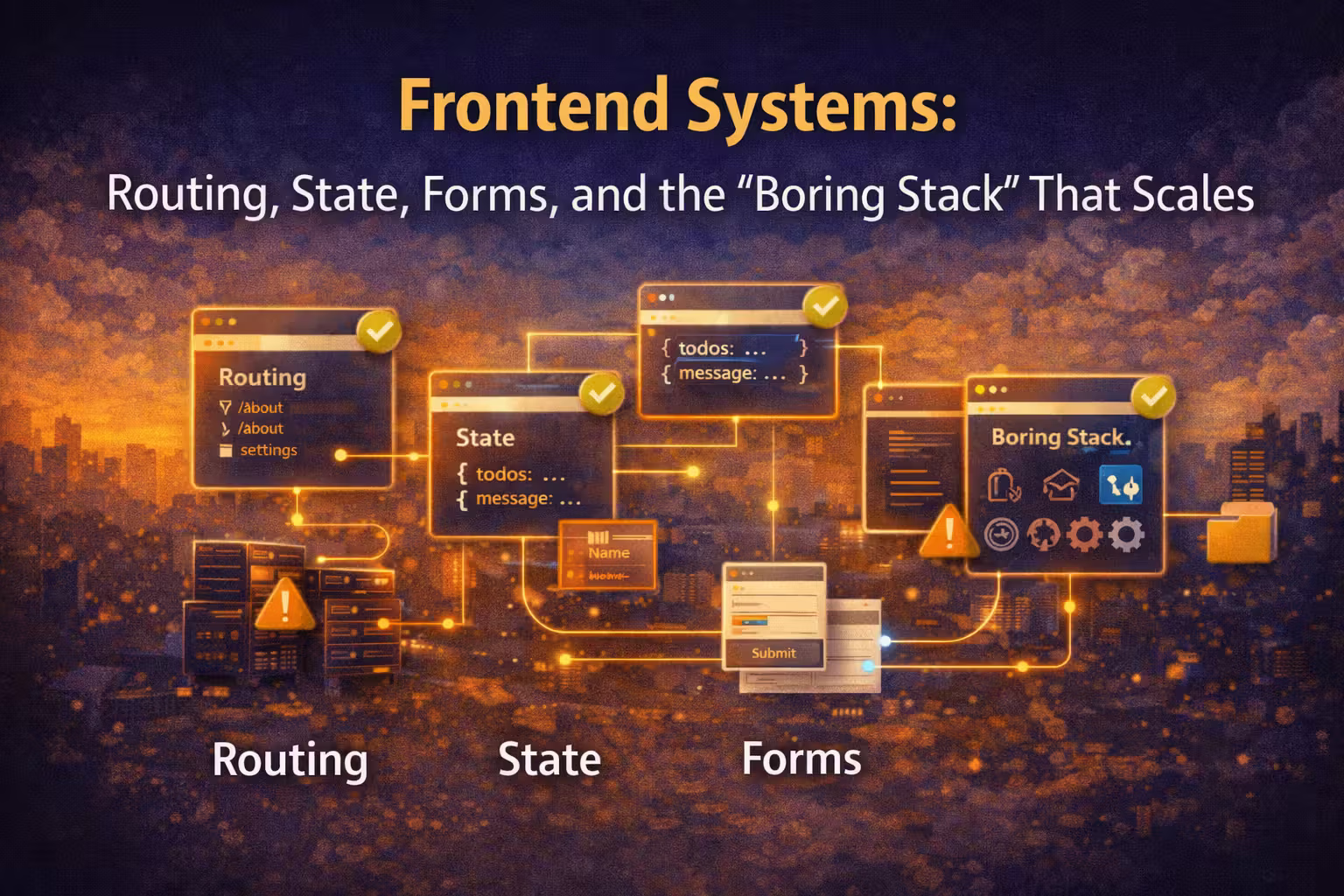
Frontend Systems: Routing, State, Forms, and the “Boring Stack” That Scales
The month I stop treating “frontend architecture” as component trivia and start treating it as a system: URLs as contracts, state as truth, forms as transactions, and a boring stack you can operate.

Axel Domingues
If May was about React as an architectural tool, June is about the thing React doesn’t give you:
A system.
Because real frontends don’t fail in the component tree. They fail at the boundaries:
- a URL that can’t represent reality (deep links, back button, shareable state)
- a state model that lies (stale data, conflicting writes, “global store” chaos)
- a form flow that double-submits money or loses user intent
- a UI that’s “fast in the lab” and janky under real devices + real networks
So this month I’m going to define the boring frontend stack:
Not boring because it’s simple.
Boring because it’s the part you want to stop debating and start standardizing, so your product can scale teams, features, and reliability without re-litigating fundamentals every sprint.
The goal this month
Turn routing, state, and forms into explicit architecture decisions — with checklists you can teach and repeat.
The output
A “boring stack” reference architecture you can adopt, audit, and evolve — without ideology.
The Frontend Is a Distributed System (You Just Don’t Call It That)
The browser is an unreliable runtime:
- CPU varies wildly (old phones exist; tabs get throttled)
- the network lies (latency, packet loss, captive portals, offline)
- the user is adversarial (double clicks, refreshes, goes back, pastes weird input)
- the page can die at any time (crash, navigation, memory pressure)
So when teams say “the frontend is hard”, what they mean is:
There’s a lot of implicit distributed-systems behavior hiding inside UI interactions.
This article is how you make that behavior explicit.
The Boring Stack: Four Boundaries You Must Get Right
Here’s the mental model I want you to internalize:
Routing boundary
The URL is the public API of your UI. If it lies, everything else becomes hacks.
State boundary
Your app has multiple “truth sources.” If you don’t classify them, you’ll fight ghosts.
Form boundary
A form is a transaction builder. Treat it like one: validation, idempotency, failure recovery.
Data boundary
Server state isn’t “frontend state.” Cache it, invalidate it, and stop copying it into global stores.
If you do nothing else: write these boundaries down and make them reviewable.
Routing: The URL Is Your Product Contract
A good URL is not “a path.” It’s a projection of user intent into a stable contract:
- “show me order 123”
- “open search results for query=… and filters=…”
- “take me to step 3 of onboarding”
- “show this dashboard scoped to account X”
If you treat routing as an implementation detail, you’ll end up with:
- pages you can’t deep-link
- broken back/forward semantics
- “state stored in memory” that disappears on refresh
- analytics that can’t attribute flows cleanly
- support tickets that can’t reproduce issues (“what URL were you on?”)
What belongs in the URL (and what doesn’t)
The URL is great for:
- identity: resource IDs, slugs, tenant/account context
- navigation state: current tab, selected item, page number, sort, filters
- reproducible UI intent: “show these results”, “open this modal for item X” (yes, modals can be routable)
The URL is not great for:
- private secrets (tokens, PII)
- large payloads
- volatile internal UI state (a partially typed form field)
Choosing a Router: Not a Library Choice, a Capability Choice
People compare routers like a dependency list.
Architects compare routers by capabilities:
- Nested routes + layouts (shared shells that don’t remount everything)
- Route-level loading + error boundaries (fail locally, not globally)
- Code splitting (don’t ship the whole product to open a settings page)
- Typed route params (or at least centralized route definitions)
- Redirects and auth gating (without infinite loops)
- URL search params as first-class (filters/sorting/pagination)
- Transition UX (loading states that don’t flicker; preserve scroll where it matters)
Framework routing (e.g., file-based) tends to win when:
- you want a full-stack opinion (SSR/SSG/edge integration)
- you want conventions over configuration
- you expect teams to move fast with fewer choices
Library routing tends to win when:
- you need more custom app composition (micro-frontends, embedded shells)
- you want explicit control over data loading and transitions
- you’re in a “frontend platform” setting serving multiple apps
- route changes that remount too much (lost state, jank, expensive fetch storms)
- auth guard loops (redirect → refresh → redirect)
- “empty loading” gaps (no skeletons; app feels broken)
- non-idempotent route loaders (back button triggers destructive side effects)
State: Stop Saying “Global State” (Classify Your Truth Sources)
Most frontend architecture fights come from one category error:
treating all state as one thing.
A scalable frontend distinguishes at least these types:
UI state (ephemeral)
Open/closed, hover, selected row, local toggles. Lives near components.
URL state (shareable)
Filters, pagination, active tabs, selected entity. Must survive refresh.
Server state (cached)
Data from APIs. Must handle staleness, retries, invalidation, dedupe.
Client domain state (owned)
Drafts, optimistic updates, complex editors. You own the source of truth.
The “state placement” decision tree
When you’re about to add state, ask these in order:
Can it be derived?
If the value can be computed from props / existing state, don’t store it. Derived state is a common source of bugs.
Should it be shareable or bookmarkable?
If yes, put it in the URL (search params / path params).
Is it server state?
If the data comes from the server, treat it as cached:
- fetch + dedupe
- retry + backoff
- invalidate + refetch
- stale-while-revalidate behavior
Is it truly cross-cutting client state?
Only then consider a store (context/store library). Keep the surface area small.
You lose cache semantics and you invent your own invalidation bugs.
The “Boring” State Stack That Scales
This is the pragmatic stack I keep seeing win (and why it’s boring):
- Local component state for UI details
- URL state for navigational intent
- Server-state cache for API data (queries/mutations, invalidation)
- A small client store for the rare shared client-owned domain state
That’s it.
Everything else is bikeshedding.
What should go into a client store (and what shouldn’t)
Good candidates
- authenticated user session summary (not the whole profile payload)
- feature flags / experiments (read-only, cached)
- cross-page drafts (e.g., “compose email”)
- UI preferences that aren’t worth a backend roundtrip (theme, density)
Bad candidates
- lists of server entities (“projects”, “orders”, “messages”)
- “everything is in Redux because we started in 2017”
Forms: A Form Is a Transaction Builder
A form is where user intent becomes a write.
That’s a transactional boundary. Treat it with the same seriousness you treat a backend write path.
A form is a state machine
When you design forms explicitly, you stop shipping “mystery UX”:
Idle → Editing
Inputs update locally, validation is friendly, UI is responsive.
Editing → Submitting
Disable double submit, show progress, preserve user intent.
Submitting → Success
Route or update cache, show confirmation, clear draft.
Submitting → Failure
Keep inputs, map errors to fields, provide recovery, avoid rage-click loops.
The three validation layers (and why you need all of them)
Examples:
- required fields
- obvious format checks (email, min/max length)
- immediate feedback that doesn’t block typing
Goal: reduce friction and prevent “avoidable errors”.
Use a schema (shared if possible) to define:
- types
- constraints
- normalization rules (trim, case folding where appropriate)
Goal: prevent divergent rules across components/pages.
Server must still validate:
- permissions
- uniqueness constraints
- business rules
- concurrency and invariants
Goal: the UI is not your firewall.
The “Money Button” Pattern: Idempotency + UX
If a form triggers anything expensive or irreversible (payments, subscriptions, transfers, order placement), you need a combined UX + systems design pattern:
- disable the button on submit
- show a stable progress state
- attach an idempotency key to the request
- treat retries as normal (network failures are normal)
A simple model that works well:
- generate an idempotency key per “intent” (per submit attempt)
- store it in memory + (optionally) session storage for refresh survival
- send it with the request
- backend uses it to dedupe and return the same result
This is where frontend architecture and backend architecture meet — and why I teach them together.
A Reference “Boring Stack” Blueprint
I’m not prescribing an ideology. I’m prescribing roles.
Here’s a stack composition that tends to be stable:
Routing
Nested routes, layout shells, route-level errors, search params as first-class.
Server state
A query cache with invalidation, retries, dedupe, optimistic updates.
Forms
Uncontrolled where possible, schema-driven validation, server error mapping.
Client store (small)
Only for true shared client-owned state: session summary, drafts, flags.
Foldering that supports scale (without over-engineering)
A practical shape (adjust for your framework):
routes/orpages/— route modules + loaders + route-level error UIfeatures/— domain slices (billing, search, onboarding)components/— shared presentational componentsui/— design system wrappers (buttons, inputs, layout primitives)lib/— api clients, schema, utilitiesstate/— store + query client configurationforms/— shared form patterns (field wrappers, error mappers)
The Migration Plan: From “Everything Everywhere” to Boring
If your frontend is already messy, don’t rewrite.
Standardize incrementally:
Step 1: Make URLs honest
Move filters/tabs/pagination into search params. Make deep links work. Fix back button bugs.
Step 2: Stop copying server state into global stores
Introduce a query cache layer. Move “fetch + cache + invalidate” into that layer. Delete duplicated selectors and reducers gradually.
Step 3: Normalize form handling
Pick one form approach for the app. Adopt schema validation. Standardize server error mapping.
Step 4: Document the boundaries
Write down:
- what belongs in URL state
- what belongs in server cache
- what belongs in client store
- what belongs locally
Then enforce in PR reviews.
Debugging: Why UX Bugs Look Like Backend Bugs
This is the theme of this month:
- A “random logout” might be a route guard loop.
- A “slow page” might be a cache miss storm on route transitions.
- A “double charge” might be a missing idempotency key plus a retry.
- A “stale UI” might be a query invalidation gap.
- A “form resets” bug might be a remount caused by route/layout design.
When you classify routing/state/forms as architecture boundaries, these stop being mysteries.
FAQ
Not by default.
Most apps can go surprisingly far with:
- local UI state
- URL state for navigation intent
- a server-state cache for API data
Add a store only when you have true shared client-owned state that cannot be derived or cached.
If the modal represents a meaningful state a user might want to:
- deep link to
- share
- recover after refresh
…then yes, make it routable.
If it’s purely ephemeral (tooltip-level), keep it local.
Prefer uncontrolled inputs where possible, localize state, and avoid routing/layout patterns that remount the entire form on minor navigation changes.
Also: keep expensive derived computations out of render paths.
The “best” is the one that fits your constraints and your team.
But the architecture doesn’t start with brand names. It starts with responsibilities:
- URL as contract
- server state as cached truth
- forms as transactions
- client store as a small, explicit exception
What’s Next
June was about building a frontend that can scale features and teams without collapsing into folklore.
Next month, I’m taking the same “boring” mindset to the server side: Backends
Because the frontend stack only stays boring if the backend is predictable: auth, errors, contracts, consistency, and rollout safety.
Backends: Frameworks Don’t Matter Until They Do (Node, Java, .NET, Go, Python)
Early on, any backend “works.” Then timeouts, GC pauses, cold starts, and operability show up. This is a practical mental model for choosing runtimes and frameworks based on constraints—not vibes.
React as an Architecture Tool: Components, Hooks, and the Cost of Re-rendering
React is not a UI library — it’s a runtime for composing change. This post teaches the mental model that makes large React codebases predictable: component boundaries, hooks as architecture, and the real cost model of re-rendering (so you optimize the right thing).