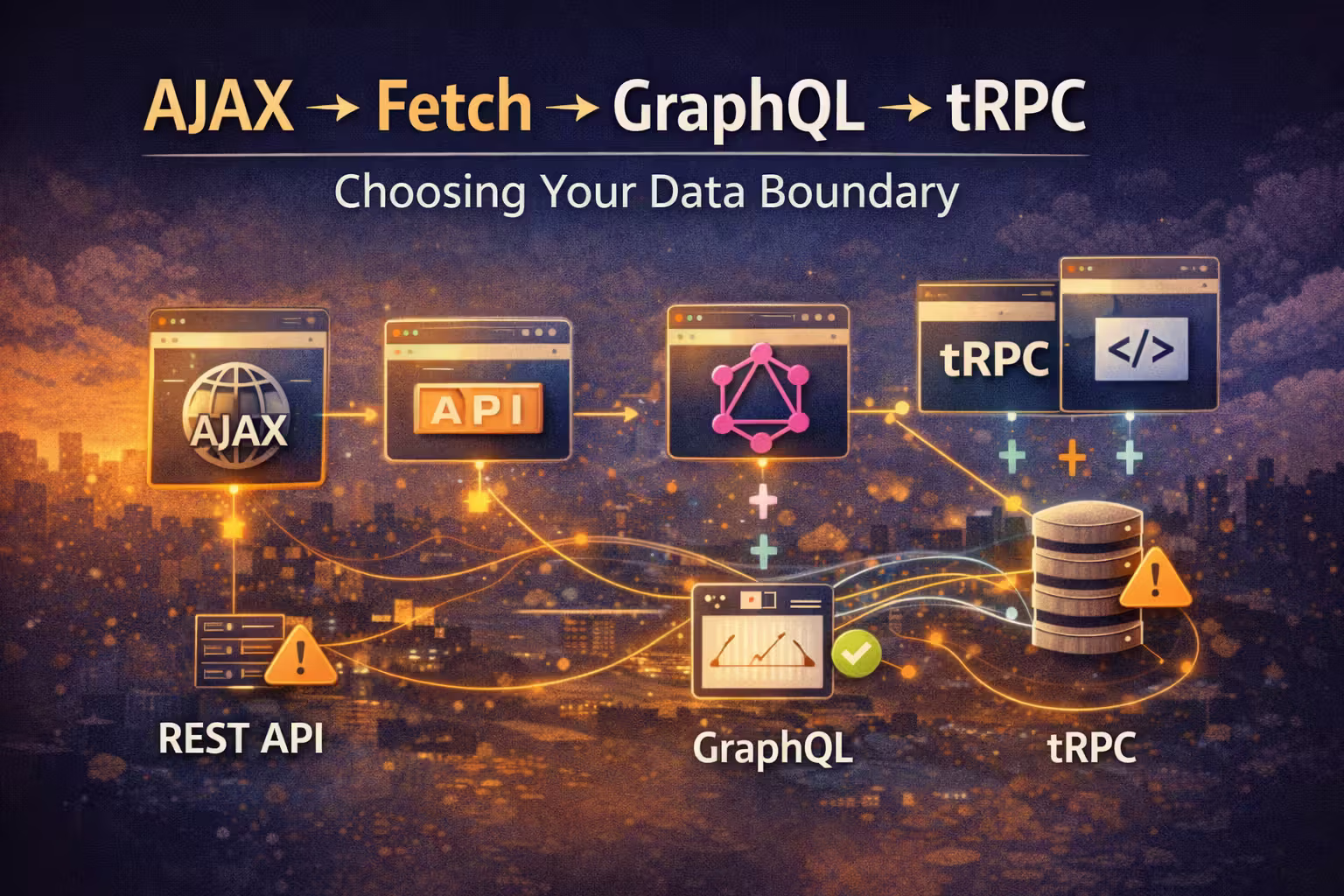
AJAX → Fetch → GraphQL → tRPC: Choosing Your Data Boundary
Your data boundary is not “how we call the API.” It’s a coupling contract between teams, runtimes, and failure modes. This post gives you a practical decision framework for REST, GraphQL, and RPC-style boundaries (including tRPC) — with the tradeoffs that show up in production.

Axel Domingues
January was the macro view: why modern web architecture looks like it does.
February was the wire contract: HTTP is already a distributed systems API.
March was the runtime reality: the browser is a scheduler with a frame budget, and “random UI bugs” are often deterministic timing problems.
April is where these threads meet:
Your data boundary decides how product requirements become network calls, how teams coordinate change, and how failures show up in the UI.
And it’s one of the most expensive things to “just refactor later.”
The boundary is the full contract surface:Not the transport (it’s usually HTTP).
- how clients ask for data
- how servers shape responses
- how types and versioning are handled
- how caching works (or fails)
- how errors + retries behave
- how auth + permissions are expressed
- how the contract evolves without breaking teams
The boundary is where coupling lives
Teams often choose a boundary by vibe:
- “REST is boring.”
- “GraphQL is modern.”
- “tRPC is so clean.”
That’s not architecture.
Architecture is choosing where coupling belongs and what kind of coupling your org can afford.
REST-style
Coupling lives in resource design, endpoint semantics, and compatibility rules.
GraphQL-style
Coupling lives in schema governance and resolver behavior.
RPC / tRPC-style
Coupling lives in shared types, shared runtime assumptions, and release cadence.
“Custom fetch + endpoints”
Coupling lives in your team’s heads… until production forces you to formalize it.
Your job isn’t to pick a “best” boundary.
It’s to pick the boundary whose failure modes your team can operate.
A quick history (because it explains the constraints)
The web didn’t evolve because engineers got bored.
It evolved because product requirements demanded new shapes of coupling.
AJAX made the browser a partial application runtime. It also created the first modern failure pattern:
- “requests in flight” became real
- “out of order responses” became real bugs
- UI state had to survive partial updates
- error handling became a user-experience problem, not just a backend concern
Fetch improved ergonomics and modern flows.
But fetch does not answer:
- How do we shape responses?
- How do we version safely?
- How do we type contracts?
- How do we avoid waterfalls?
- How do we govern breaking changes?
Fetch is a primitive. Boundaries are policies.
GraphQL moved response shaping into a query language:
- the client asks for exactly what it needs
- the server guarantees a schema
It solves a real pain (many clients + volatile UI surfaces).
It also introduces new operational problems:
- resolver performance and N+1 patterns
- abuse controls / query complexity
- caching becomes more subtle
- schema change becomes a governance process
tRPC is the “shared type system boundary”:
- procedures on the server
- called from the client with end-to-end types
- no separate schema/IDL step (DX is excellent)
Tradeoff:
- tighter coupling across client/server
- cross-language clients become harder
- independent versioning becomes harder
- coordinated deployment becomes more important
The boundary decision you’re actually making
When teams ask “REST or GraphQL or tRPC?”, I translate it into five real decisions.
- REST: server owns shape (clients adapt)
- GraphQL: client owns shape (server exposes schema capabilities)
- tRPC/RPC: shape is the procedure return type (the shared language influences it heavily)
This is not cosmetic — it determines how fast UIs can change without backend work.
- REST: compatibility through additive changes, versioning rules, and stable semantics
- GraphQL: compatibility through schema evolution discipline (deprecation, nullability, ownership)
- tRPC/RPC: compatibility through shared types + coordinated releases (or explicit versioned procedures)
- REST: caching can be natural (URLs + GET semantics + CDNs), if you design for it
- GraphQL: caching often moves up the stack (normalized caches, persisted queries, application-level strategies)
- tRPC/RPC: caching is usually client-side query caching; CDN caching is less “automatic” unless you design for it
If edge caching matters, this choice is heavy.
- REST: many endpoints → many places to drift unless you standardize error shape + tracing
- GraphQL: one endpoint → but failures can be partial; you need resolver-level tracing
- tRPC/RPC: procedure calls map cleanly to traces, but you need discipline to avoid “procedure sprawl”
- One product + one team? Tight coupling can be fine.
- Many teams + many clients? Loose coupling and governance matter more than DX.
- Multi-language clients? Shared TS types won’t scale as “the boundary.”
This post is about making those choices explicit.
The myth: “GraphQL solves overfetching / underfetching”
GraphQL can reduce over/under fetching.
But the bigger gain is usually organizational:
GraphQL shines when UI surfaces change faster than backend teams can keep up.
The deeper truth:
Overfetching is usually a symptom of bad boundary granularity, not a missing query language.
- REST endpoints can be page-shaped or aggregation-shaped too (especially via a BFF).
- GraphQL can still create waterfalls and slowness if resolvers are slow or the query plan is naive.
Choose GraphQL for change velocity across many clients, not for “bandwidth vibes.”
A practical decision framework
Here’s a framework that avoids ideology and survives architecture reviews.
Step 1 — Classify your client landscape
- One web client, same repo as backend
- One web client, separate teams
- Multiple clients (web + mobile + partners)
- Public API
- Unknown future clients (platform risk)
Step 2 — Classify UI volatility
- Stable screens (internal tools)
- Moderately volatile (SaaS dashboards)
- Highly volatile (consumer product, experiments, personalization)
Step 3 — Decide where you can afford coupling
- Coordinated releases? Tight coupling can be fine.
- Independent client releases? Your boundary must support independent evolution.
Step 4 — Choose your caching posture
- Do you need CDN/edge caching to matter?
- Do you rely on GET semantics for cost + latency?
- Do you need consistent cache keys and invalidation rules?
Step 5 — Pick the boundary and install guardrails
Whatever you choose, you need:
- a standard error contract
- versioning + deprecation rules
- observability (traces, logs, metrics)
- performance budgets (response sizes, resolver time, query complexity)
They choose a tool and skip the governance that makes it safe.
The “default” recommendation (for modern teams)
If you force me to choose a default, it’s not a tool — it’s a posture:
Default posture
Start with typed REST + an explicit schema contract (OpenAPI/JSON Schema) and add a BFF where needed. Graduate to GraphQL only when your client landscape and UI volatility justify the governance cost.
Why this tends to work:
- it scales to multiple clients
- it aligns with HTTP semantics and edge caching
- observability and rate limiting are straightforward
- you’re not forced into one language runtime
- it’s easier to operate under incident pressure
But “default” is not “always.” So let’s get concrete.
When REST is the right boundary (and how to make it good)
REST isn’t “old.” REST is discipline.
REST works well when:
- resources are stable
- you have clear domain nouns
- you care about caching and edge behavior
- you want independent client releases
- you have multiple client types (including non-TS)
What “good REST” looks like
- URL paths represent nouns:
/users/{id},/orders/{id},/catalog/items - Methods represent intent: GET reads, POST creates/actions, PATCH updates
- Responses are consistent: stable shapes + a standardized error contract
- Changes are additive by default: new fields, new endpoints, deprecate old ones
/doThing,/execute,/getDashboardData- no stable resource model
- every screen creates a new endpoint forever
- clients are tightly coupled anyway… but without types or governance
The real REST tradeoff
REST makes the server choose shapes.
That’s a feature when you want:
- consistent responses
- controlled performance
- caching that works naturally
It’s friction when:
- UI surfaces change weekly
- a single screen needs data across many domains
- UI composition creates endpoint explosion
That’s where GraphQL and/or a BFF often enters.
When GraphQL is the right boundary (and what it costs)
GraphQL shines when:
- you have many clients with different shape needs
- UI volatility is high
- you want a schema contract to coordinate across teams
- you need composition across domains without endless endpoint proliferation
But you pay for it.
GraphQL’s cost model
Schema governance cost
Deprecation rules, nullability discipline, ownership, review process.
Resolver performance cost
N+1 avoidance, batching, caching, query planning discipline.
Security + abuse cost
Depth/complexity limits, persisted queries, field-level auth.
Observability cost
Tracing must see resolver hotspots, not just “/graphql was called.”
GraphQL is not “hard.”
GraphQL is a governance system disguised as an API protocol.
That’s a performance and security liability.
A mental model that survives production
- Treat the schema as a capabilities catalog
- Treat resolvers as adapters to underlying services
- Treat batching, caching, and complexity as first-class architecture
GraphQL doesn’t eliminate backend architecture.
It moves it.
When tRPC is the right boundary (and where it breaks)
tRPC is compelling when:
- your product is full-stack TypeScript
- you can coordinate client/server releases
- you want maximum developer velocity
- you’re building internal-first (no partner API requirements yet)
tRPC becomes painful when:
- you need public APIs or partners
- you have mobile clients outside TS
- you need independent client releases with strict backwards compatibility
- you need decoupling across teams/services
The honest tRPC contract
tRPC is basically:
“Our boundary is the TypeScript compiler.”
That’s powerful. It’s also a coupling choice.
A common lifecycle:
- Phase 1: DX bliss, speed, fewer contract mismatches
- Phase 2: more teams, more clients, release independence matters
- Phase 3: either
- you introduce explicit versioned procedures + compatibility rules, or
- you migrate to contract-first boundaries (OpenAPI/GraphQL)
That’s not failure. That’s maturity.
- How will we expose partner APIs later?
- How will we support mobile later?
- How will we version procedures later?
The hidden fourth option: BFF (Backend For Frontend)
BFF isn’t a protocol.
It’s an architectural placement: a server layer allowed to be UI-shaped.
A BFF can sit on top of:
- REST services
- GraphQL services
- internal RPC services
Its purpose is to:
- reduce client complexity
- reduce waterfalls
- shape data for a specific UI
- protect core services from UI churn
BFF is good when
UI is volatile, domain services are stable, and you want independent evolution.
BFF is risky when
It becomes “the real backend” with no ownership, no tests, and no performance budgets.
BFF is often the pragmatic middle ground:
- stable REST services internally
- UI-shaped composition in the BFF
- governance that stays human-sized
A decision matrix you can use in reviews
Use this as a starting point, not a ideology.
Choose REST-style when:
- multiple clients (web + mobile + partners)
- caching and HTTP semantics matter
- independent client releases matter
- domain nouns are stable
- you can invest in OpenAPI + contract testing
Choose GraphQL when:
- many clients need different shapes
- UI volatility is high
- you need a schema to coordinate many teams
- you can afford governance: limits, tracing, batching, ownership
Choose tRPC/RPC when:
- one full-stack TS product (often a monorepo)
- coordinated releases are realistic
- you want maximum DX and speed
- external/public APIs are not a near-term requirement
Add a BFF when:
- core services must remain stable
- UI needs screen-shaped aggregation
- you want to remove orchestration from the browser
Guardrails that matter more than the tool
Most production pain comes from missing guardrails, not the boundary choice.
These are non-negotiable in serious teams:
Standard error contract
One error shape, one tracing story, one retry story.
Versioning + deprecation rules
Additive change by default. Breaking change requires an explicit plan.
Observability
Trace IDs, per-endpoint/per-resolver timings, client-side correlation.
Performance budgets
Response size limits, query depth limits, timeouts aligned to user expectations.
Install these guardrails early and you can survive almost any boundary decision.
Skip them and even the “best” boundary will eventually fail under load and change velocity.
Concrete patterns (because abstractions don’t ship)
Pattern: “latest wins” for user-driven queries
Search boxes and filters are concurrency machines. Make “latest wins” explicit.
// Pseudocode: AbortController + request versioning
let current = 0
let abort: AbortController | null = null

async function load(query: string) {
  current += 1
  const version = current

  abort?.abort()
  abort = new AbortController()

  const res = await fetch(`/api/search?q=${encodeURIComponent(query)}`, { signal: abort.signal })
  const data = await res.json()

  if (version !== current) return // ignore stale responses
  render(data)
}
This applies to REST, GraphQL, and tRPC alike.
Pattern: idempotency for “money buttons”
If the action can create side effects, the boundary must support idempotency.
- UI disables submit immediately
- client sends an idempotency key
- server treats repeats as safe replays
That’s not “backend stuff.”
That’s the boundary doing its job.
Closing: choose a boundary you can govern
Boundaries aren’t DX preferences.
They’re organizational commitments:
- who owns shape
- who owns compatibility
- who owns caching
- who owns failure semantics
- who owns evolution
Pick the one you can operate.
April takeaway
A data boundary is a coupling contract. Choose it by org model + change velocity + operability, not by hype.
Resources
MDN — Fetch API
Fetch is the primitive. Understanding it helps regardless of the boundary you choose.
FAQ
No. GraphQL is a different boundary with a different governance model.
Some orgs thrive with it (many clients + volatile UI). Some orgs drown in it (no limits, weak tracing, unclear ownership).
End-to-end types are fantastic for DX.
But “better” depends on coupling tolerance:
- coordinated releases → tRPC can be excellent
- independent evolution across many clients/languages → contract-first boundaries scale better
They treat REST as “routes + JSON” and skip discipline:
- inconsistent error models
- no contract testing
- action soup endpoints
- breaking changes without deprecation
Good REST is a stability tool.
They ship a schema without an operating model:
- no query complexity limits
- no resolver-level tracing
- no batching strategy
- no ownership and deprecation policy
GraphQL without governance becomes a performance and security problem.
What’s Next
Now that we’ve chosen where data contracts live, we need to confront the layer that consumes them:
React.
Not as a UI library — as an architectural tool with cost models.
React as an Architecture Tool: Components, Hooks, and the Cost of Re-rendering
React is not a UI library — it’s a runtime for composing change. This post teaches the mental model that makes large React codebases predictable: component boundaries, hooks as architecture, and the real cost model of re-rendering (so you optimize the right thing).
Browser Reality: The Event Loop, Rendering, and Why UX Bugs Look Like Backend Bugs
The browser is a constrained runtime with a scheduling problem: one main thread, many responsibilities, and users who notice missed frames. This post gives you the mental model to debug “random” UX failures as deterministic timing and contention issues.