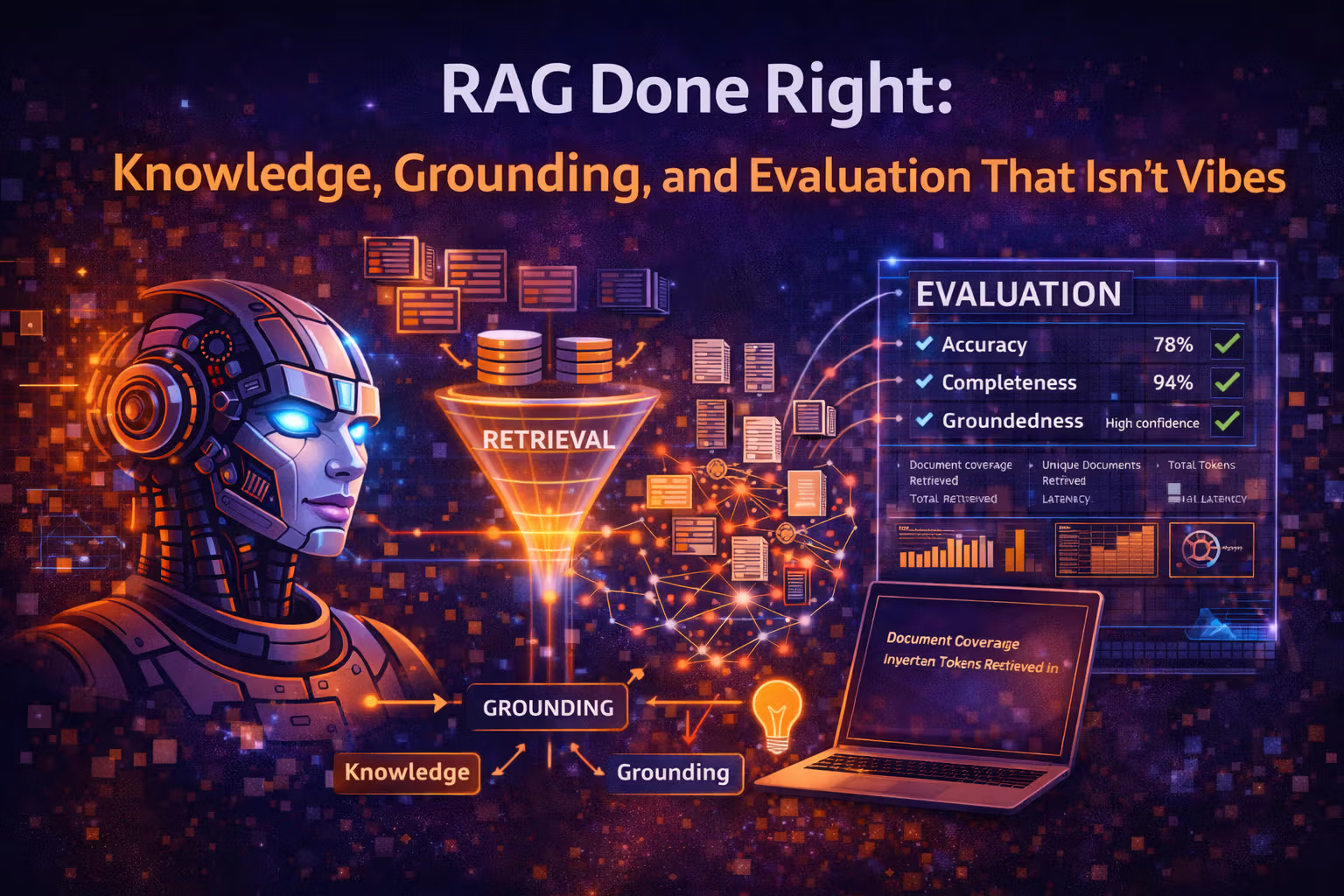
RAG Done Right: Knowledge, Grounding, and Evaluation That Isn’t Vibes
RAG isn’t “add a vector DB.” It’s a reliability architecture: define truth boundaries, build a testable retrieval pipeline, and evaluate groundedness like you mean it.

Axel Domingues
RAG is not a feature.
RAG is what happens when you accept a hard truth:
Your model does not “know your business.”
It knows language. It knows patterns. It knows how to sound right.
So the only way to ship an LLM feature that stays correct as your world changes is to wrap it in an explicit knowledge system:
- what content is allowed
- what content is current
- what content is authoritative
- and how the answer proves it came from that content
That’s Retrieval-Augmented Generation done right.
Not “vector DB + prompt.”
Contracts, pipelines, and evaluation.
What RAG really is
A system that turns your knowledge into bounded context the model can use safely.
What RAG is not
A magic spell that makes hallucinations disappear.
The failure mode
“Looks confident” is not the same as “is grounded.”
The missing piece
Evaluation that measures grounded correctness, not vibes.
The Core Mental Model: Truth Boundaries + Context Assembly
If you remember one sentence from this post, make it this:
RAG is a context assembly pipeline whose output must be testable.
The model is the last step. The reliability comes from everything around it.
So before you pick a vector store, ask a more architectural question:
What must never be wrong?
- Pricing rules?
- Legal clauses?
- Medical instructions?
- Security configuration?
- Customer account state?
Make “I don’t know” a valid outcome, and force answers to cite sources.
From there, you can design the right boundary:
- Strong truth (must be exact): comes from authoritative systems (databases, APIs)
- Weak truth (can be approximate): comes from documents (policies, wikis)
- No truth (creative): can be pure generation (marketing copy, brainstorming)
RAG is primarily for the middle case: documents and knowledge bases that are too big for a prompt and too dynamic to bake into weights.
Mini-glossary (as used in this post)
- Chunking: splitting documents into retrievable pieces (units of recall).
- Embedding: turning text into a vector representation for similarity search.
- Vector index / store: data structure that supports fast approximate nearest-neighbor search.
- Retriever: component that selects candidate chunks for a query.
- Reranker: a second model that re-sorts candidates to improve relevance.
- Context window: the model’s input budget (tokens) for instructions + retrieved content + conversation.
- Grounded answer: a response that is supported by retrieved sources, not just plausible language.
- Citation precision: fraction of citations that truly support the claim they’re attached to.
- No-answer rate: fraction of cases where the system correctly refuses / asks for clarification.
When You Need RAG (and When You Don’t)
RAG is a tax. It adds ingestion, indexing, query-time retrieval, caching, and evaluation.
So spend that tax only when it buys you something real.
You need RAG when…
Truth lives in documents (policies, manuals, runbooks) and changes often enough that “train it in” won’t keep up.
You don’t need RAG when…
Truth lives in structured systems (DBs/APIs). Use tool calls and strong contracts instead of retrieval.
- use tools for live/structured truth (account state, pricing, inventory)
- use RAG for narrative context (policies, explanations, constraints)
Architecture: The RAG Pipeline You Can Defend
Here’s the pipeline that tends to survive production contact:
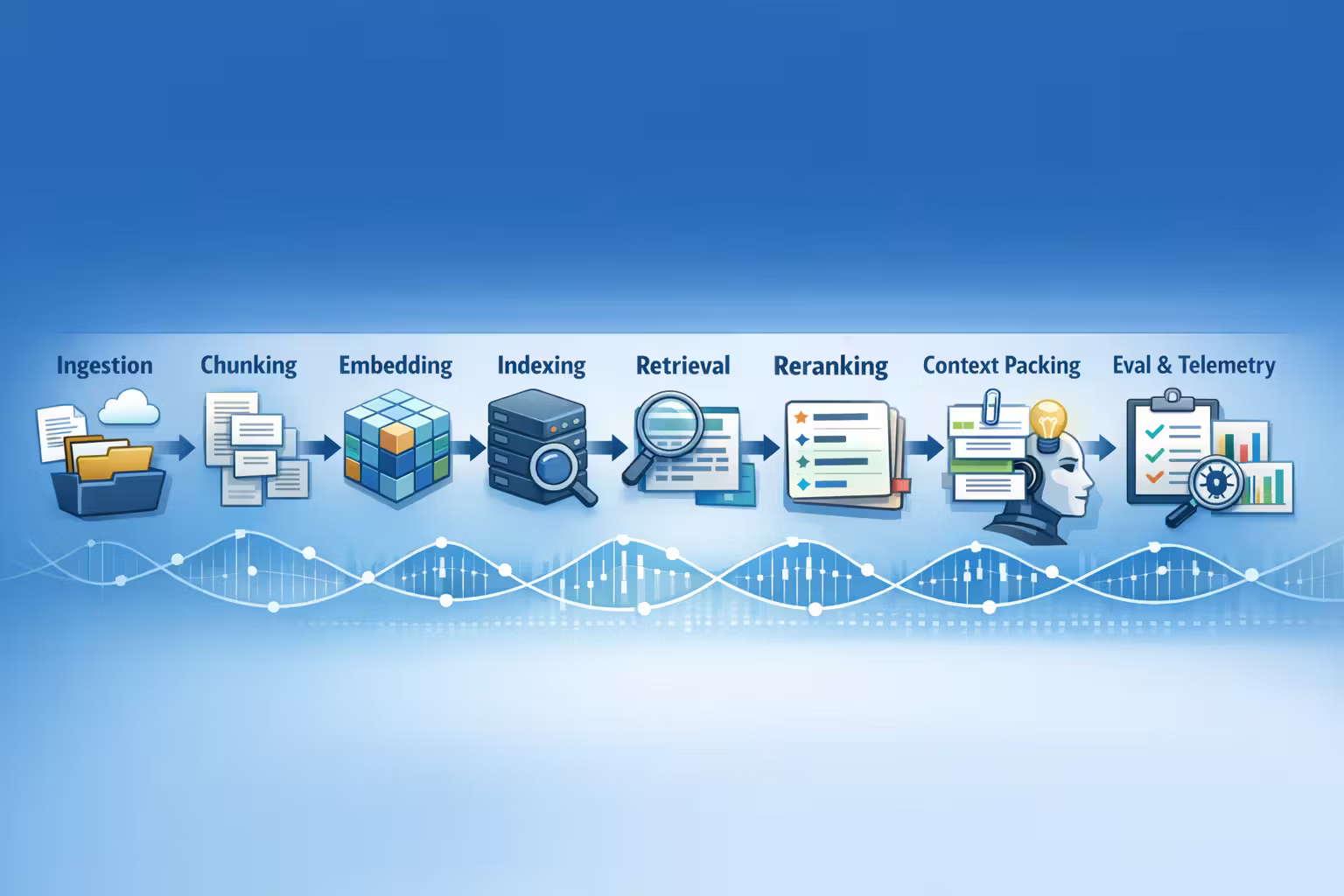
1) Ingestion is an engineering system, not a script
You need a reliable way to pull content from:
- docs (Markdown, HTML, PDFs)
- wikis and knowledge bases
- ticketing systems / incident reports
- product specs and change logs
And you need metadata, not just text:
- source system
- document type
- owner / authority
- update timestamp
- access control labels
- version identifiers
- leak data later, or
- block safe retrieval later.
2) Chunking is a product decision
Chunking determines what your system can recall.
Bad chunking produces:
- fragments without context
- or massive chunks that waste the context window
Good chunking is guided by your use cases:
- policy clauses: chunk by section + keep heading hierarchy
- runbooks: chunk by step sequences + include prerequisites
- API docs: chunk by endpoint + include schema snippets
Chunking is about preserving meaning boundaries.
3) Retrieval is a two-stage system (candidate + rerank)
In production, “vector similarity” is rarely enough.
A robust pattern is:
- Stage A: fast recall (vector search returns N candidates)
- Stage B: precision (reranker re-sorts and filters)
Reranking is where relevance gets real, and where your top-k stops being random.
4) Context packing is where most RAG apps quietly fail
You don’t have infinite tokens.
So you need a context assembler that decides:
- which chunks to include
- in what order
- how much to trim
- what metadata to keep (titles, timestamps, source IDs)
- how to attach citations
This should be deterministic and testable.
If context packing is “whatever came back,” you will ship a system that fails in ways you can’t reproduce.
Grounding: What It Means (and How It Breaks)
Most teams use “grounded” to mean:
“The answer mentions the docs.”
That’s not grounded. That’s decorated.
Grounded means:
- claims can be traced to specific retrieved text
- citations point to the right chunks
- unsupported claims are rejected or flagged
- the system can say “I don’t know” without collapsing
If you don’t measure citation precision, you’re building a liar with footnotes.
Common grounding failure modes
What happens: the right chunk exists, but retrieval doesn’t fetch it.
Why it happens:
- chunking destroyed the meaning boundary
- embeddings don’t capture the query semantics
- metadata filters are too strict (or missing)
Fix: add query rewriting, improve chunking, add reranking, and measure retrieval recall.
What happens: the right chunk is present, but surrounded by noise, and the model chooses the wrong anchor.
Fix: context packing rules: fewer chunks, higher precision, better ordering, and trimmed boilerplate.
What happens: the model forms an answer from priors, then hunts for supporting text.
Fix: force a source-first plan (“cite before you claim”), and consider constrained formats.
What happens: the model answers correctly… for last month’s policy.
Fix: ingest version metadata, apply recency/authority ranking, and require “effective date” in context.
Evaluation: If It’s Not Measured, It’s Not Real
RAG is an evaluation problem disguised as a retrieval problem.
Because you can’t ship “the model seems better” to production.
You need to measure outcomes that map to reliability.
The metrics that actually matter
Answer correctness
Is the final answer correct for this question, in this context?
Groundedness
Is the answer supported by retrieved sources (not model priors)?
Citation precision
Do the citations truly support the claims they’re attached to?
Retrieval quality
Did we fetch the right evidence (recall/precision), fast enough, within budget?
“Vibes eval” is how teams ship regressions
A common anti-pattern:
- you try 20 prompts
- you like the outputs
- you ship
- production traffic finds all the questions you didn’t test
You need a repeatable harness.
Build a golden set (and treat it like a product asset)
Create a dataset of real questions:
- representative of production usage
- tagged by intent/type
- with expected answer shape (not always exact phrasing)
- with a “no-answer is correct” label where appropriate
Separate retrieval evaluation from generation evaluation
Measure two distinct things:
- Did retrieval fetch the right chunks?
- Given the right chunks, did generation answer correctly and cite properly?
If you don’t split these, you won’t know what to fix.
Add adversarial and boundary tests
Include tests where the system should:
- refuse (missing evidence)
- ask clarifying questions
- avoid policy violations
- respect ACL boundaries
Run eval on every change
Changes that can break RAG:
- chunking rules
- embedding model version
- index parameters
- reranker version
- prompt template
- context packing logic
If these aren’t tested, you’re deploying random.
Track regressions by slice, not just overall score
Overall score hides pain. Track by slices:
- question type
- domain/source
- recency
- length/complexity
- “needs tool” vs “docs-only”
Production RAG Is Also a Security System
A RAG system is an information-routing machine.
So security is not an add-on. It is part of correctness.
Non-negotiables
- enforce ACLs at retrieval time (and ideally at index time)
- log which sources were accessed (auditability)
- treat retrieved text as untrusted input (prompt injection exists inside documents)
- sanitize and constrain tool outputs if you mix RAG + tools
Do not assume “internal docs” are safe. Treat retrieval content as hostile until proven otherwise.
A Practical RAG Checklist (The One I Wish Teams Started With)
- What must never be wrong?
- What is the authoritative source of truth for each domain?
- When is “no-answer” the correct behavior?
- What does a correct answer look like (format, citations, tone, safety)?
- What is your latency + cost budget?
- What sources are ingested, how often, and with what SLA?
- How do you version documents and handle deprecations?
- What metadata is required (owner, recency, ACL, type, confidence)?
- What is your re-indexing strategy (full vs incremental)?
- Chunking strategy per document type
- Candidate retrieval parameters (top-k, filters)
- Reranking approach
- Query rewriting (optional, but often worth it)
- Context packing rules (ordering, trimming, citations)
- Golden set + slices + regression thresholds
- Telemetry: retrieval hit rate, groundedness score, no-answer rate, latency, cost
- Replay: store prompts + retrieved chunks + model config for reproducibility
- Rollouts: A/B or staged deploy, with rollback triggers
Resources
Retrieval-Augmented Generation (RAG) paper (Lewis et al., 2020)
The original framing: retrieval as a way to ground generation in external knowledge.
REALM (Guu et al., 2020)
An influential perspective on retrieval as a learned component of language understanding.
FAQ
Not usually.
Fine-tuning shapes behavior and style (and can teach task formats), but it doesn’t solve “fresh knowledge” reliably. RAG solves “knowledge at query time.” In practice, the best systems combine both:
- tune to behave correctly (format, refusal, citations)
- retrieve to stay current and grounded
Because retrieval doesn’t guarantee grounding.
Common reasons:
- the right evidence wasn’t retrieved
- the evidence was retrieved but diluted by noise
- the model answered from priors anyway
- the answer required structured truth (tool), not documents
RAG reduces hallucinations when retrieval + context packing + evaluation are designed as a system.
Split evaluation:
- retrieval-only: did you fetch the right chunks?
- generation-with-given-chunks: can the model answer correctly when evidence is perfect?
If you don’t separate these, you’ll guess—and spend weeks tuning the wrong layer.
Start with a narrow domain and a hard contract:
- a curated corpus
- deterministic chunking
- a reranker
- citations required
- a golden set with regression tests
Then expand one axis at a time: sources, domains, tools, and scale.
What’s Next
This month was about grounding:
- retrieval is a pipeline
- grounding is a contract
- evaluation is the only honest judge
Next month, I’ll move from “answer with evidence” to “act with tools”:
Tool Use and Agents
Because once the model can retrieve knowledge… the next temptation is to let it push buttons.
And that’s where reliability either becomes architecture—
or becomes an incident report.
Tool Use and Agents: When the Model Becomes a Workflow Engine
Tool use is not “prompting better” — it’s turning an LLM into a controlled orchestrator of deterministic systems. This month is about the architecture, safety boundaries, and eval discipline that make agents shippable.
Hallucinations: A Probabilistic Failure Mode, Not a Moral Defect
Hallucinations aren’t “the model lying”. They’re what happens when a probabilistic engine is forced to answer without enough grounding. This post is about designing products that stay truthful anyway.