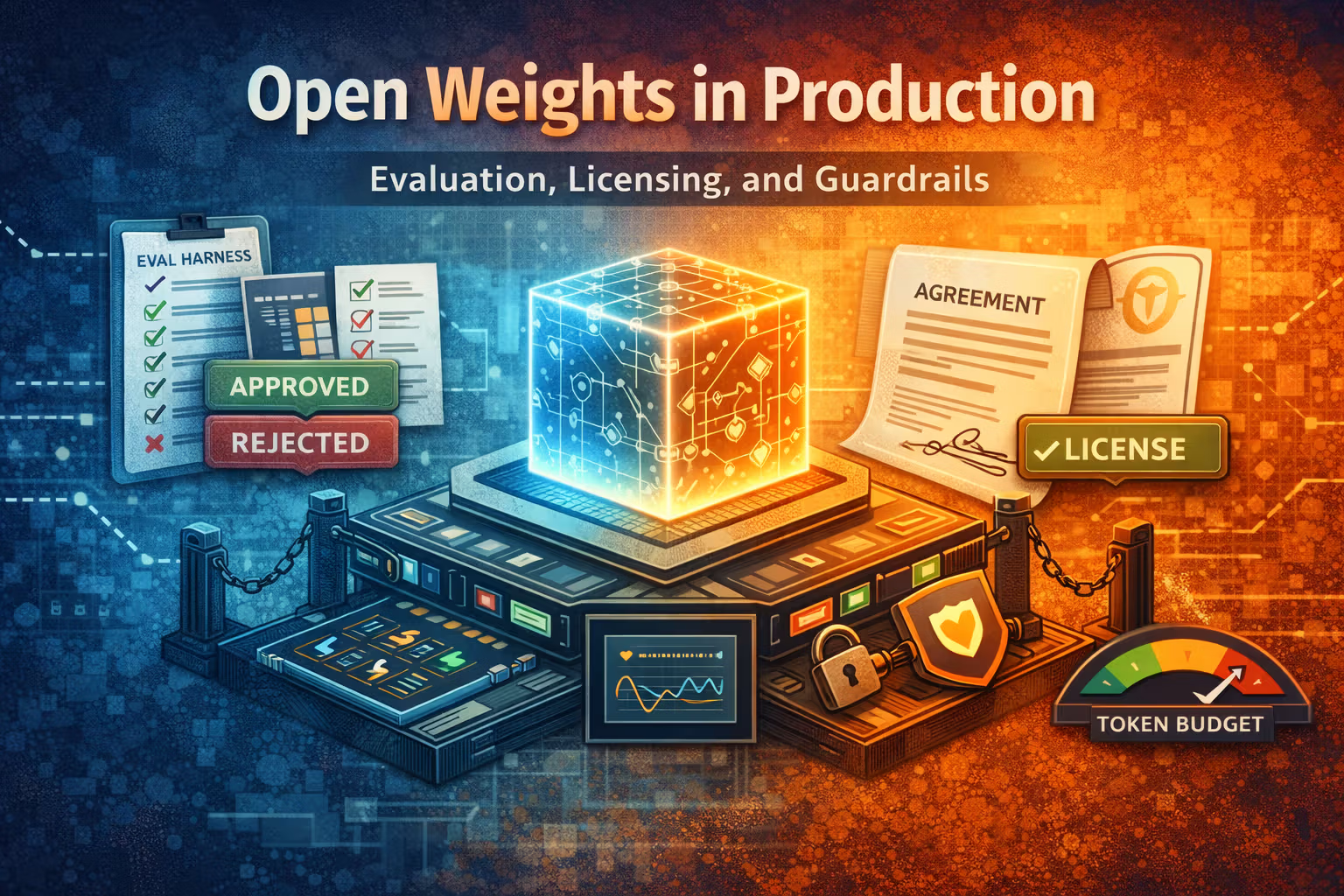
Open Weights in Production: evaluation, licensing, and guardrails
Open weights shift your risk from vendor to you. This month is the playbook: evaluate like a product, treat licensing as architecture, and ship with guardrails that survive real users.

Axel Domingues
April was about choosing models.
May is about owning them.
Because the moment you run an open-weights model in production, you inherit responsibilities that a vendor used to hide behind an API:
- evaluation becomes your release gate
- licensing becomes your compliance surface
- safety becomes your operational discipline
- and “performance” becomes your GPU bill, your latency, your incident
This isn’t an argument for or against open weights.
It’s the missing architecture doc:
how to use open weights without turning your product into an expensive science project.
That does not automatically mean “open source,” and it definitely does not mean “no strings attached.”
The real shift
Open weights move risk and responsibility from the vendor to your system.
The operational payoff
If you do it right, you buy control: privacy, cost shaping, and predictable behavior.
Why teams want open weights (and why they get burned)
Open weights are appealing for good reasons:
- Cost shaping: predictable marginal cost when usage scales
- Data control: sensitive workflows without sending data to a third party
- Customization: domain tuning, adapters, retrieval augmentation, prompt templates
- Availability: fewer “provider incident” surprises
- Portability: your product is not welded to one vendor’s roadmap
And yet… most teams struggle on the first attempt.
Because they adopt open weights the way they adopted libraries in 2015:
“We’ll just run it.”
But an LLM is not “a library.”
It’s a stochastic subsystem with a large blast radius.
So this month, we treat open weights the same way we treated distributed data in 2022:
as a production system that requires controls.
The three deployment postures
There are only three sane ways to use open weights. Everything else is a variant.
1) Vendor API
Fastest to ship. Lowest infra burden. Highest dependency and least control.
2) Managed open weights
A provider hosts the open model for you. Good compromise: control + lower ops load.
3) Self-hosted runtime
Max control. Max responsibility. You own latency, scaling, safety, and outages.
The trap
“Self-hosted” without evaluation + guardrails is just DIY outages.
Evaluation is the product gate (not a research exercise)
If April taught us that model selection becomes architecture, May adds the uncomfortable corollary:
If you can’t evaluate it, you can’t operate it.
Open weights make this non-negotiable because:
- you will upgrade models (or weights)
- you will change prompts and tools
- you will quantize, batch, cache, and optimize
- you will ship “one small change” that shifts behavior unexpectedly
So: you need an evaluation harness that acts like CI.
The minimum viable evaluation harness
Your harness needs to answer three questions continuously:
- Does it still meet the contract? (correctness + format + safety)
- Is it within budget? (tokens, latency, GPU time, fallbacks)
- Is it stable? (variance across runs, regressions, long-tail failures)
Treat LLM output like an API response that can be wrong in creative ways.
What you should measure (beyond accuracy)
Contract adherence
Schema validity, required fields, refusal behavior, tool call correctness.
Truth risk
Hallucination rate on grounded tasks, citation behavior, “confident wrongness.”
Latency and throughput
p50 / p95 / p99, queue delay, batch efficiency, cold start frequency.
Cost and capacity
GPU seconds, memory headroom, context length usage, cache hit rate.
Build a “golden set” that represents your product
A golden set is not a benchmark leaderboard.
It’s a curated set of real tasks that represent your actual failure modes:
- messy user inputs
- edge cases
- adversarial prompts
- incomplete context
- tool failures
- ambiguous instructions
- “looks correct but wrong” traps
Licensing is architecture (because it constrains your product)
This is the part engineers love to skip.
But licensing shapes your architecture as much as:
- a database license
- a cloud provider contract
- an open-source dependency
- a data residency requirement
Open weights come with licenses that vary widely. Some are permissive. Some are conditional. Some are commercial with restrictions.
And the key operational fact is:
Your model is now a dependency with legal constraints.
The practical licensing questions you must answer
- Can we use it commercially?
- Can we modify it (fine-tune, quantize, distill, prune, merge adapters)?
- Can we deploy it behind an API?
- Can we redistribute weights or derivatives (including in containers/images)?
- Attribution requirements (docs, UI, notices)
- “Pass-through” terms for customers
- Restrictions on certain use cases
- Requirements to publish modifications (rare, but check)
Fine-tuning, adapters, merges, and quantization are often treated differently across licenses. You need to know which artifacts you can ship and store.
- Where do we store the license text and notices?
- Who reviews upgrades?
- How do we track model versions in production?
- How do we audit which model answered which request?
Treat the license like a runtime policy
In 2022 we treated “compatibility” as a discipline.
Do the same here:
- put license review in your release checklist
- version your model artifacts and their license metadata
- keep an internal “model bill of materials” (MBOM)
- make upgrades a change-management event, not a casual swap
Guardrails: you are now the safety team
With vendor APIs, you inherit a safety layer you didn’t build.
With open weights, you have to build it.
The way I frame this is simple:
Your model is a powerful worker. Your system is the supervisor.
That supervisor needs three kinds of controls:
- Input guardrails (stop obvious nonsense early)
- Output guardrails (validate contracts, filter unsafe content)
- Action guardrails (tool use with permissions, budgets, and sandboxing)
The “untrusted everything” rule
In January we treated the model as probabilistic. In February we treated documents as untrusted input. In March we treated context assembly as a subsystem.
Now we apply the untrusted rule everywhere:
- user input is untrusted
- retrieved text is untrusted
- tool outputs are untrusted
- and model output is untrusted
This isn’t cynicism. It’s how production systems survive.
A reference architecture for open-weight LLMs
Here’s the simplest shape I’ve seen work reliably:
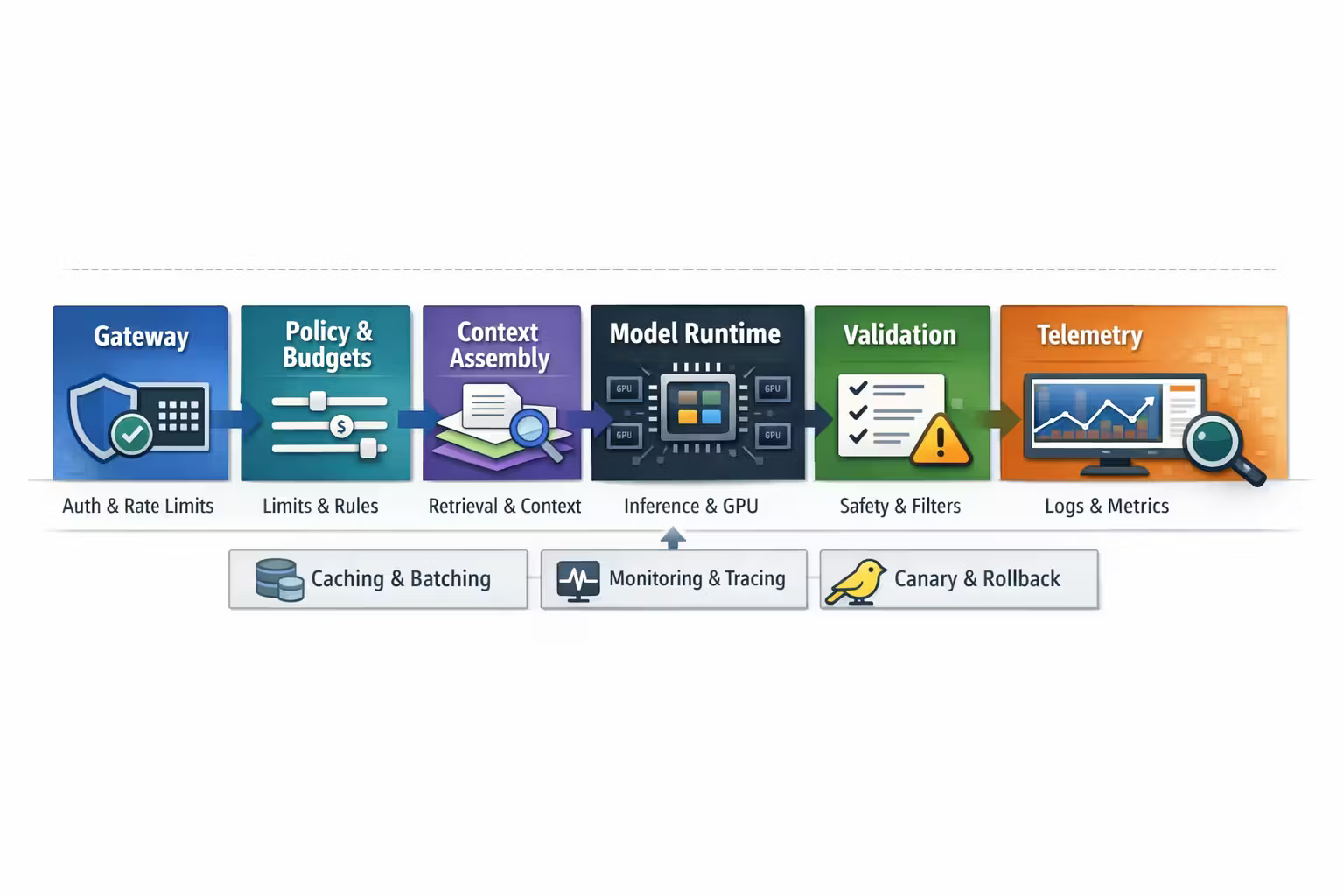
Gateway
Auth, rate limits, customer tiering, request shaping.
Policy + budgets
Which model, max tokens, tool permissions, fallback rules.
Context assembly
Retrieval, summaries, state, memory policy, token accounting.
Validation layer
Schema validation, safety filters, refusal checks, tool call verification.
Under that sits the runtime:
- inference server(s)
- caching and batching
- GPU scheduling
- observability and tracing
- canary and rollback mechanisms
You do not need to start “enterprise.” You do need the boundaries.
Guardrails that actually work in practice
1) Enforce structured outputs (and reject non-compliance)
If your downstream expects JSON, enforce it.
- use JSON schema / typed decoding where possible
- reject invalid responses and retry with a smaller “repair” prompt
- log invalid outputs as evaluation failures
A validator is a contract.
2) Separate generation from decision
If an answer can cause harm (money, permissions, irreversible actions), split it:
- model proposes
- system verifies
- system executes
This is the “humans approve actions” pattern — but automated.
3) Tool use must be permissioned
Tools are not “capabilities.” Tools are attack surface.
- allowlist tools per route/customer tier
- enforce argument schemas
- sandbox execution (timeouts, network egress controls)
- record tool calls as audit events
4) Build a refusal policy you can explain
When open weights fail, they fail oddly. So your product needs a consistent refusal and escalation story:
- what you refuse
- how you explain it
- what users can do next
- how you log it for review
The real operational costs (and how to control them)
Self-hosting open weights makes three costs visible immediately:
- GPU memory and throughput
- long context amplification
- variance (p99 latency and outlier behavior)
Cost controls that don’t ruin quality
Context discipline
Summarize aggressively, retrieve narrowly, cap tokens by route.
Caching
Cache embeddings, retrieved chunks, and deterministic tool results.
Batching
Batch short requests, separate queues by latency tier.
Tiered models
Cheap default, expensive escalation for hard cases.
Most product traffic is routine. Design for that.
A go-live checklist you can actually use
Define contracts per endpoint
- expected output format (schema)
- allowed tools and arguments
- refusal behavior
- max cost/latency budgets
Build the golden set + regression harness
- representative user tasks
- adversarial cases
- tool failure cases
- scorecards for contract adherence and safety
Instrument the runtime
- request traces end-to-end
- token accounting and context composition logs
- GPU utilization and queue depth
- p95/p99 latency per route
Ship with canaries + rollback
- shadow traffic on the new model
- small percent rollout
- automatic rollback on metric regression
Establish a model change policy
- who approves upgrades
- how you version artifacts
- how you record “which model answered what” for audits
Resources
EleutherAI — lm-evaluation-harness (golden sets as CI)
A practical evaluation harness you can wire into release gates: regressions, variance checks, and “does it still meet the contract?”
Stanford CRFM — HELM (holistic, reproducible evaluation)
A framework for evaluating across scenarios and metrics—useful when “accuracy” isn’t the whole product (safety, robustness, bias, etc.).
FAQ
No. Many agent systems work well with vendor APIs.
Open weights are a control move — useful when you need predictable costs, data governance, customization, or resilience against provider shifts.
Teams optimize inference first and evaluation later.
They get fast responses… that are wrong, unsafe, or unstable — and they only discover it after users do.
Not in production.
Prompting is part of the safety story, but it’s not enforcement. You still need validators, tool permissions, and monitoring.
What’s Next
April reframed model selection as architecture.
May added the missing constraint:
Open weights are only “cheaper and safer” if you can evaluate and operate them.
Next month the surface area expands again:
multimodality.
Because the moment your system sees images, hears audio, or speaks back…
UX changes.
And your guardrails and budgets change with it.
Multimodal Changes UX
Multimodal Changes UX: designing text+vision+audio systems
Multimodal isn’t “a bigger prompt”. It’s a perception + reasoning + UX system with new contracts, new failure modes, and new latency/cost constraints. This month is about designing it so it behaves predictably.
Model Selection Becomes Architecture: Routing, Budgets, and Capability Tiers
The moment you have multiple models with different strengths, “pick the best model” turns into system design. This month is a practical blueprint for routing, fallbacks, and budget-aware capability tiers—without turning your stack into an untestable mess.