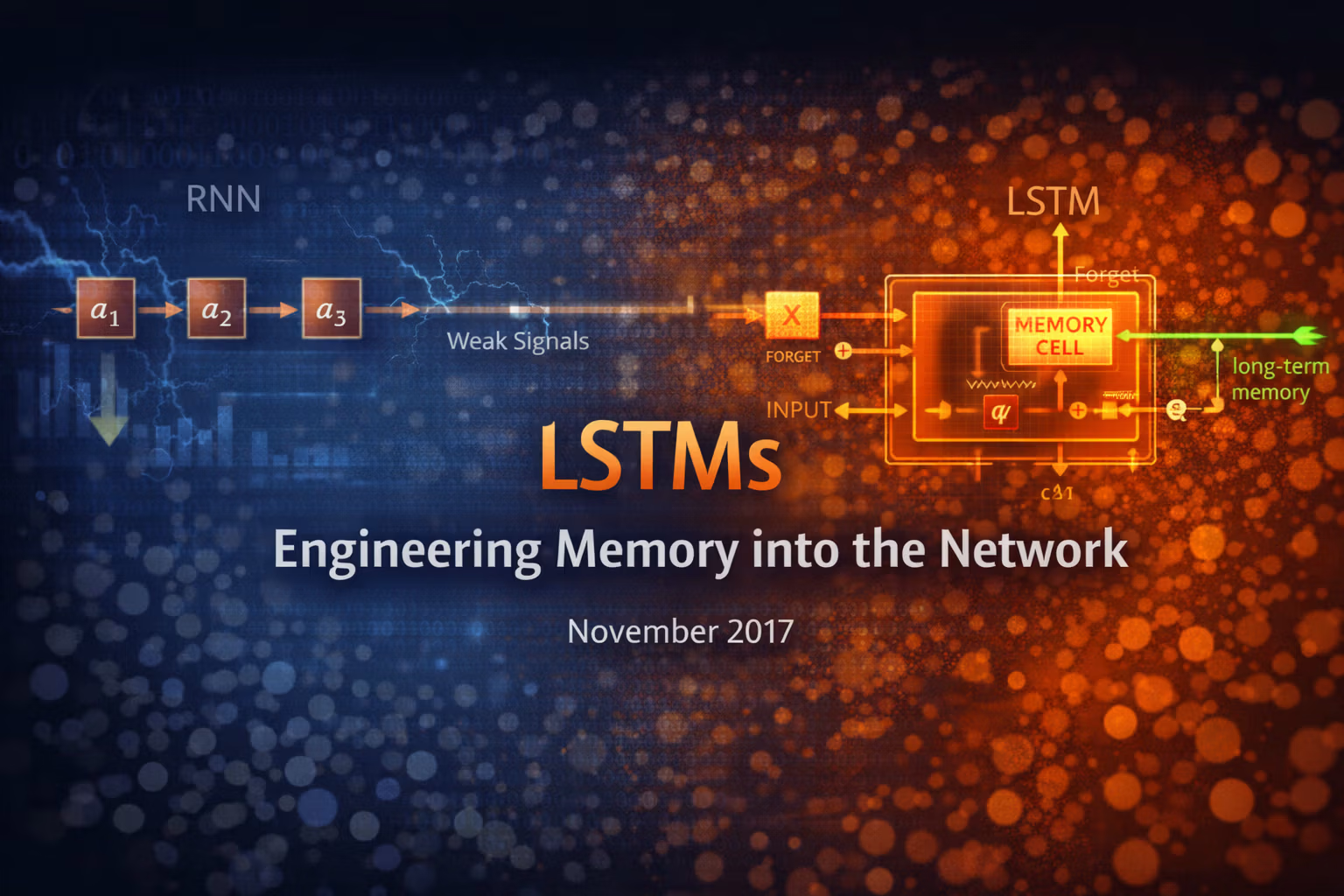
LSTMs - Engineering Memory into the Network
After vanilla RNNs taught me why gradients collapse through time, LSTMs finally felt like an engineered solution - keep the memory path stable, and control it with gates.

Axel Domingues
Last month’s conclusion was painfully clear:
Vanilla RNNs don’t just “struggle” with long-term dependencies — they’re structurally bad at training them.
I could get an RNN to learn local patterns (next character, short context), but the moment I needed it to remember something far back in the sequence, learning simply didn’t reach that far.
This month was the first time in 2017 I felt the “deep learning revolution” in my hands:
LSTMs are not a small tweak. They’re an architectural response to an optimization problem.
What you’ll learn
Why LSTMs are an engineered response to RNN training failure: a stable memory path + gates that control access.
The 3 ideas to keep
- A memory lane that survives time
- Gates as control logic
- A cleaner path for gradients flowing backward from the loss
How to use this post
Read once for intuition, then reuse the “Engineering Notes” checklist when implementing/debugging.
The Shift: Stop Asking SGD to Perform Miracles
In 2016, when something didn’t learn, I had a pretty reliable playbook:
- check the data
- check the cost function
- check the gradients
- tune the learning rate
- regularize
- add features
With RNNs, I did all of that… and still hit a wall.
That’s when it clicked:
Sometimes the right solution isn’t “a better optimizer”.
It’s “a model design that makes optimization possible”.
Try the classic playbook
Data, loss, gradients, learning rate, regularization — the usual fixes.
Notice the structural wall
If the model cannot train long dependencies even when everything is “reasonable”, it’s not only tuning.
Treat architecture as the fix
Sometimes the right move is: change the structure so optimization becomes possible.
LSTMs are exactly that.
It’s not “the network magically learns to remember.”
It’s “we give it a stable memory pathway and let training learn when to write/read/forget.”
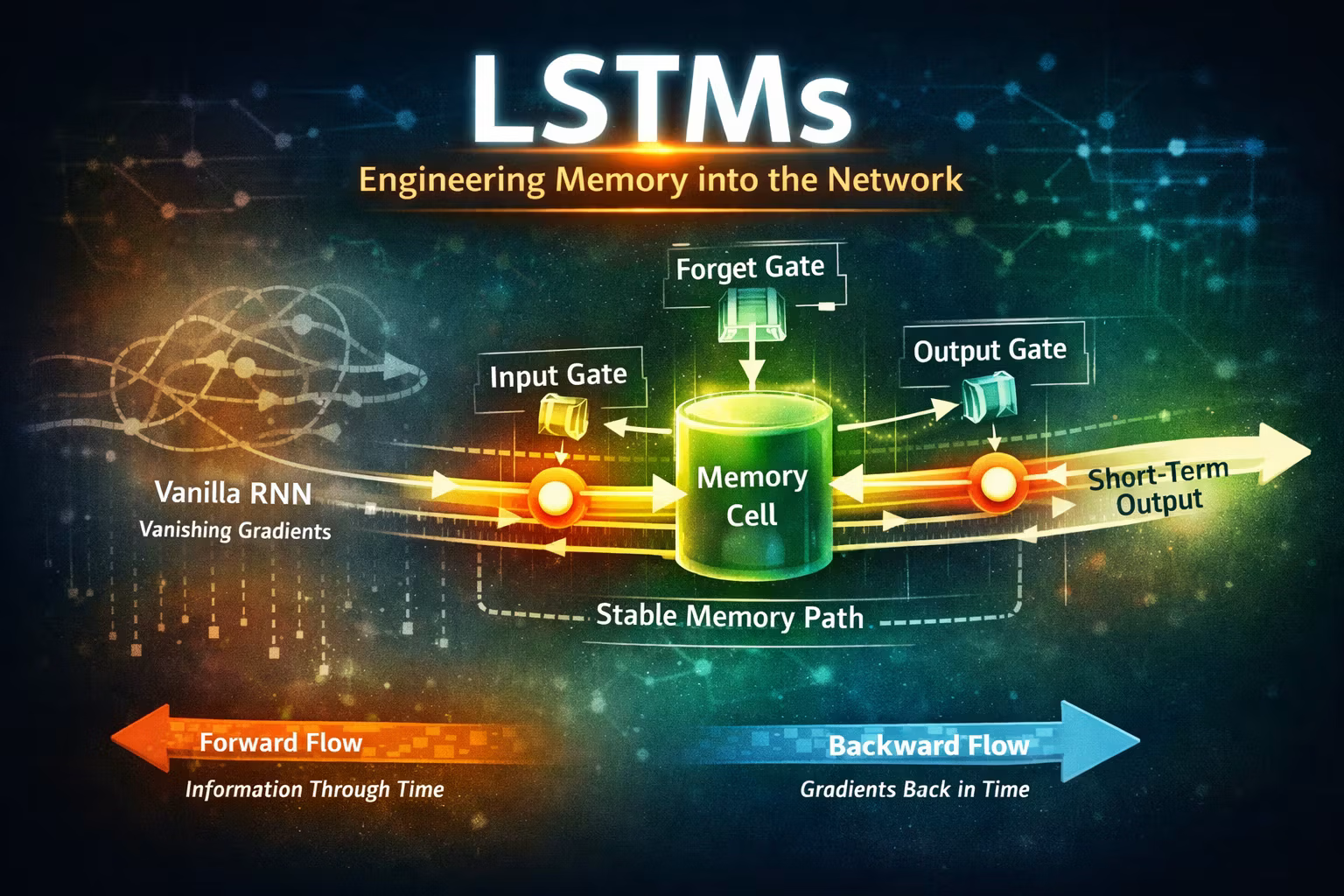
- Cell state: the long-lived “memory lane” designed to stay stable across time.
- Hidden state: the per-step working output used for prediction.
- Gate: a learned controller that decides what to write/forget/expose.
- Long-term dependency: correct behavior at time
tdepends on something far earlier. - Gradient flow: learning signal travels backward from loss → earlier time steps.
The Intuition: A Memory Lane With Gates
When I first read about LSTMs, the gates sounded like ceremony:
- input gate
- forget gate
- output gate
But after October, the gating idea became obvious:
If gradients die through time, build a path where they don’t.
- Forward: information moves through time (past → future).
- Backward: gradients move from the loss back toward earlier time steps.
In my head, I now picture LSTMs like this:
- There’s a memory lane that’s designed to stay stable across time.
- There are controlled doors (gates) that decide:
- what to store
- what to erase
- what to expose as output
So instead of forcing the hidden state to be both:
- short-term processing
- long-term storage
…the LSTM separates those roles.
That separation is the entire point.
What “Long-Term Dependency” Means (In My Own Debugging Terms)
A long-term dependency isn’t abstract to me anymore.
It’s when:
- the correct output at time
t - depends on something that happened at time
t - 50(ort - 200)
A vanilla RNN has to keep that information alive by repeatedly transforming it through the same recurrent weights.
That’s exactly where things go wrong:
- the signal gets diluted or distorted
- gradients stop flowing
LSTM says:
Don’t rely on repeated transformation to preserve memory. Preserve memory directly, and learn controlled updates.
- vanilla RNN improves on short spans but plateaus on longer spans
- performance collapses as I increase sequence length
- early time steps behave like they receive no learning signal
Train on a short length where the model improves, then increase length. If quality collapses sharply, you’ve learned something real: the model struggles to carry learning signal through time.
The Three Gates (Explained Like I Would Explain a System)
I’m intentionally avoiding equations here — because what mattered to me wasn’t the derivation.
It was the control logic.
1) Forget gate: “Is this memory still useful?”
This is the gate that made me stop thinking of memory as passive.
The network can actively decide:
- “keep this”
- “fade this out”
- “delete this”
That’s huge for sequences where context changes.
2) Input gate: “Should I write this new information?”
This prevents the cell from being overwritten all the time.
In practice, it means:
- the model can ignore noise
- it can store something only when it’s confident it matters
3) Output gate: “Should I expose the memory right now?”
This gate separated a subtle thing I didn’t appreciate before:
- Having memory
- Using memory
The LSTM can store something for later without constantly outputting it.
That helps training too, because it avoids forcing every internal state to be immediately “useful” for prediction.
Why This Solves the RNN Training Pain (Without Pretending It’s Magic)
October’s failure mode was:
- gradients shrink or explode across time
- training becomes unstable
- long-term dependencies are basically unreachable
LSTMs don’t eliminate difficulty, but they change the game:
- the memory lane is designed to remain stable
- gates allow controlled interaction with that lane
- training has an easier job because gradients can travel longer
In other words:
LSTMs don’t make sequence learning “easy”.
They make it possible.
What I Built This Month (Practical, Not Perfect)
I did two things in parallel:
- A “from-scratch mindset” implementation sketch (to learn shapes and data flow)
- A minimal working model training on a toy sequence task (to test whether memory actually works)
My toy tasks (the point was long memory)
I used small synthetic problems where success requires remembering something far back:
- “store a symbol early, reproduce it much later”
- “detect whether something appeared in the first half of the sequence”
The goal was not accuracy.
The goal was to see:
- does training improve reliably?
- does performance remain stable as sequence length increases?
This is where LSTMs started to feel like a real tool.
My Biggest “Aha”: Architecture Is a Form of Regularization
In 2016, regularization was mostly:
- add a penalty
- tune lambda
- reduce variance
In 2017, I’m seeing another form:
Architectural constraints.
CNNs encode locality and translation bias.
LSTMs encode stable memory and controlled flow.
Those are not just representational choices.
They’re choices that shape what learning is likely to succeed at.
- It’s not “choose a flexible model and regularize it later.”
- It’s “choose a model that already respects the structure of the data.”
Engineering Notes: What Still Went Wrong (Even With LSTMs)
LSTMs aren’t automatic.
I still hit real issues:
Training instability didn’t vanish, it just became manageable
- Learning rate still mattered a lot.
- Gradient clipping still helped.
- Momentum sometimes accelerated progress, sometimes destabilized it.
Shape bugs were everywhere
The LSTM has more moving pieces:
- hidden state
- cell state
- multiple gate computations
One swapped dimension can silently break learning.
This month reinforced my “shape debugging” habits from Octave days.
It’s boring. It prevents hours of confusion.Write down the expected shapes for every tensor/state before coding.
Overfitting showed up quickly on small tasks
LSTMs can memorize tiny datasets fast.
This is where dropout started to become relevant again — but not in the abstract.
It was the difference between:
- “model learned the task pattern”
- “model memorized these exact examples”
Connection Back to 2016 ML: Same Fundamentals, New Constraint
Everything here still feels like the 2016 foundation — just under a new kind of stress.
- Optimization: still gradient-based learning
- Diagnostics: still about interpreting failure modes and fixing the right thing
- Regularization: still essential, now including architectural constraints
- Bias vs variance: still visible, but sequence models can swing wildly to either side
The thing that changed is what I consider “a valid fix”.
In 2016, fixes were mostly:
- change features
- change regularization
- change the model class
In 2017, a fix can be:
- change the architecture so gradients can survive
That’s a different level of thinking.
What Changed in My Thinking (November Takeaway)
I used to assume training difficulty was mostly about hyperparameters.
Now I’m convinced:
Training difficulty is often an architectural property.
LSTMs taught me that the right model design can turn an impossible optimization problem into a solvable one.
What’s Next
I’ve now hit the major “building blocks” of 2017:
- MLPs and why depth is hard
- ReLUs and why activations matter
- initialization and optimization
- CNN intuition and hierarchy
- RNNs and why time breaks things
- LSTMs as an engineered fix
December 2017 is the synthesis.
What actually changed between classical ML and deep learning?
What stayed the same?
And what does my “next step” look like after a year of building intuition the hard way?
FAQ
Not completely, but they changed the dynamics enough that learning long-range dependencies became realistic. In practice, training was still sensitive to learning rates and still benefited from gradient clipping, but it stopped feeling “structurally impossible.”
I think of hidden state as the “working output” at each time step, and cell state as the “long-lived memory lane” that is updated in a controlled way. The separation makes optimization more stable.
Usually yes, between independent training examples.
If you carry state across unrelated sequences, you can leak context and training becomes confusing. If your data is a continuous stream where sequences truly connect, you may intentionally carry state — but then you must be explicit about boundaries.
From Classical ML to Deep Learning - What Actually Changed (and What Didn’t) (and My Next Steps)
A year after finishing Andrew Ng’s classical ML course, I’m trying to separate enduring principles from deep learning-specific techniques—and decide where to go next.
Vanishing Gradients Strike Back - The Pain of Training RNNs
RNNs looked elegant on paper. Training them exposed the same old enemy—vanishing/exploding gradients—just with “depth in time”.