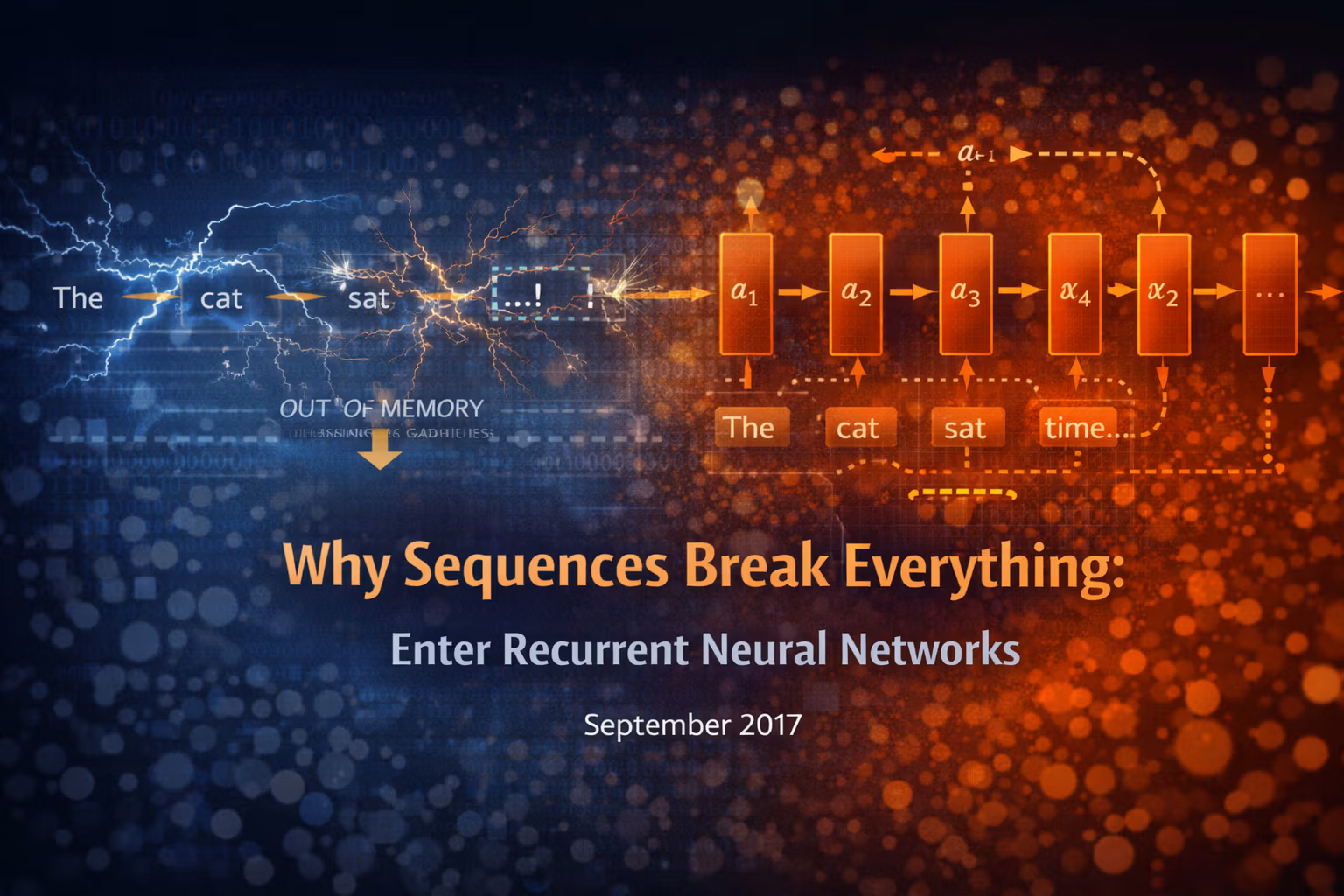
Why Sequences Break Everything - Enter Recurrent Neural Networks
Images were hard, but at least they were static. Sequences add “time”, shared weights, and state — and suddenly the assumptions I relied on in 2016 stop holding.

Axel Domingues
Convolutions taught me something comforting: if you bake the right structure into the model, learning becomes easier.
Then I switched to sequences.
And the comfort disappeared.
Text, sensor streams, audio, click trails… sequences introduce a brutal reality:
order matters, and the past can change the meaning of the present.
In 2016 I could pretend each training example was self-contained.
In September 2017, that illusion broke.
This is the month I met Recurrent Neural Networks — and understood why people say “sequence data breaks everything”.
What this post gives you
A clean mental model of RNNs: state, unrolling, and shared weights over time.
The 3 ideas to remember
- Order matters
- State carries context
- Unrolling turns “loops” into depth
The engineering mindset
RNNs are learnable and fragile — so you’ll need instrumentation (state norms, gradients, sanity runs).
The Problem That Finally Forced Me Into RNNs
I tried to approach sequence problems with my “classic ML brain”:
- take a window of the last
ksteps - engineer features (counts, averages, deltas)
- throw logistic regression / SVM / even a small MLP at it
And it worked… until it didn’t.
The failures were consistent:
- longer context mattered, but my window couldn’t grow forever
- changing
kchanged the whole problem - handcrafted features were a guessing game
It felt like vision before CNNs: a messy feature pipeline.
So I asked the obvious question:
Can the model learn the features it needs from raw sequences, the way CNNs learn features from pixels?
That question leads directly to RNNs.
- Time step: one position in the sequence (character, sensor tick, token, click…).
- Hidden state
h(t): the model’s running summary of what it has seen so far. - Unrolling: rewriting the loop as repeated cells across time.
- Shared weights: the same parameters used at every step.
- Long-term dependency: when correct output needs information from far back in time.
The Core Idea: A Network With Memory (State)
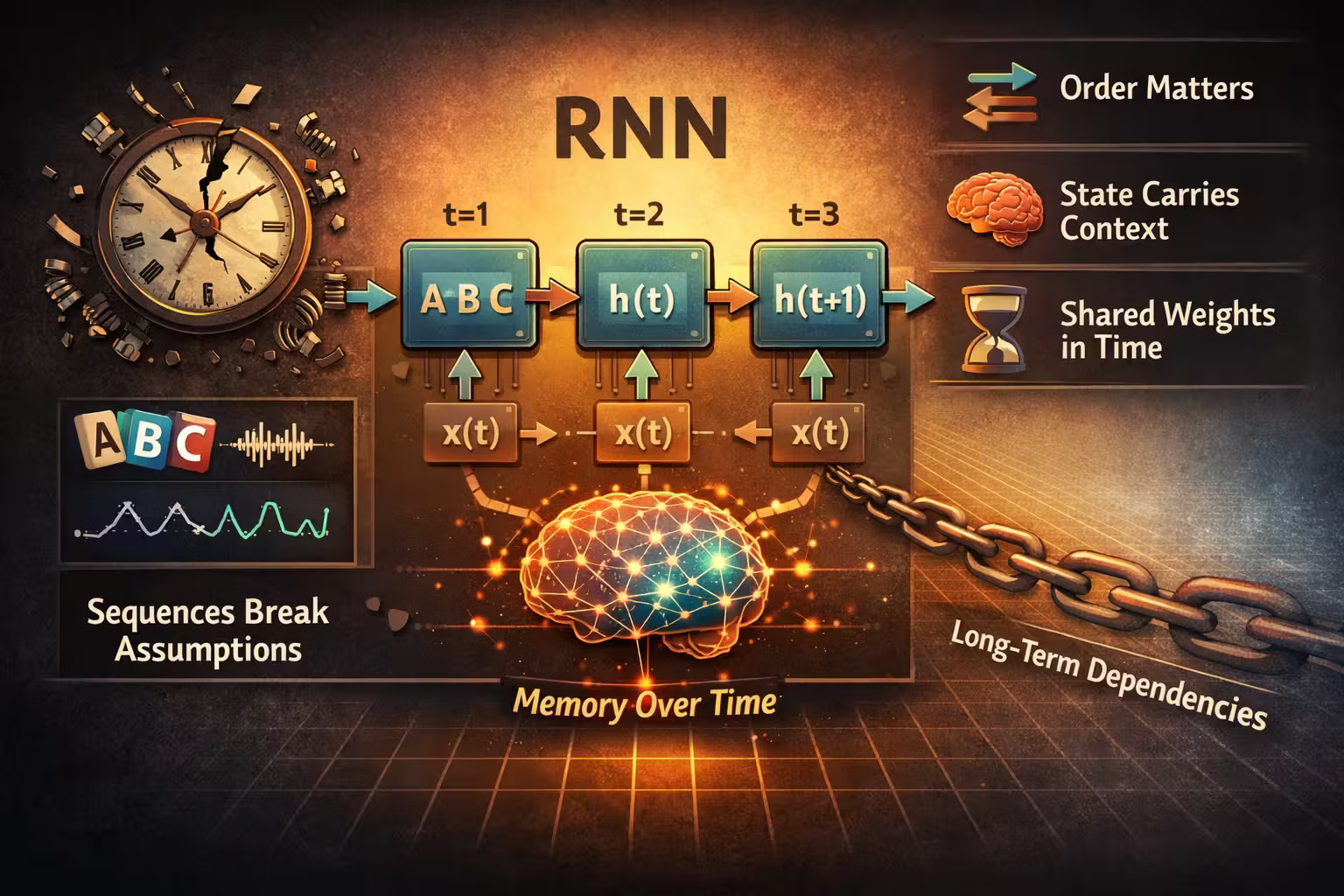
An RNN is just a neural network that keeps a running internal summary:
- at each time step
t - it takes input
x(t) - and the previous hidden state
h(t-1) - and produces a new hidden state
h(t)
That hidden state is the “memory”.
- The hidden state is not a database of past inputs.
- It’s a compressed summary the model learns to update as the sequence progresses.
Not memory like a database.
Memory like: “what I’ve seen so far.”
This shifted my mental model from:
- “one input → one output”
to:
- “a stream of inputs → evolving internal state → outputs”
So instead of me designing features, the network builds them step-by-step.The hidden state is a feature vector that the model learns to build over time.
Hidden state should usually be reset at sequence boundaries (between independent examples), or you’ll leak context from one example into the next and training will behave strangely.
Unrolling: The Trick That Made It Click
I kept getting stuck on the word “recurrent” as if it was mystical.
The breakthrough was unrolling.
If you “unroll” an RNN through time, you don’t see a loop anymore.
You see a stack of repeated cells:
- same computation repeated at each time step
- same weights shared across steps
- different inputs each step
- different state each step
Once I saw it unrolled, it stopped being exotic.
Replace the loop with copies of the same cell
Draw the same cell repeated for t = 1..T.
Keep weights the same, let state change
The parameters don’t change across time steps — the state does.
Read training consequences immediately
Unrolling reveals a long dependency chain: later errors can depend on much earlier steps.
It became:
a deep network where depth = time.
That’s also when I got nervous, because I already know what deep networks do to gradients.
(That’s next month.)
Shared Weights Over Time: Why This Isn’t Just “Another MLP”
CNNs use parameter sharing in space.
RNNs use parameter sharing in time.
That parallel helped me a lot.
- CNN: “this edge detector should work anywhere in the image”
- RNN: “this transformation should apply at every time step”
CNN parameter sharing
Same detector reused across space
→ “works anywhere in the image”
RNN parameter sharing
Same transformation reused across time
→ “works at any position in the sequence”
The cost of sharing in time
Errors at late steps can depend on computations from early steps
→ long chains in backprop through time
That means:
- fewer parameters than a “different network per time step”
- generalization across sequence positions
- a consistent way to process variable-length inputs
It also means:
- errors at time step 50 still depend on computations from time step 1
- training becomes sensitive to long chains of influence
The good and the painful come from the same source.
What Makes Sequences Different (And Why My 2016 Assumptions Failed)
1) Independence is gone
In 2016, a training example felt like a standalone row in a table.
In sequences, each element is correlated with neighbors by definition.
Treating time steps as independent is like shuffling a sentence’s words and calling it the same sentence.
2) Input and output shapes aren’t fixed anymore
With most classical ML:
- input size is fixed
- output size is fixed
- Many-to-one: one output for the whole sequence (sentiment, anomaly flag)
- Many-to-many (aligned): one output per step (tagging, per-tick classification)
- Many-to-many (shifted): predict next step (next character/token)
- Seq-to-seq (different lengths): input and output lengths differ (translation-style)
With sequences, you can have different patterns:
- one output for the whole sequence (sentiment)
- one output per time step (tagging)
- output sequence differs from input sequence (translation-style tasks)
Even if I’m not going near translation yet, just realizing these “shapes of problems” mattered was huge.
3) “Past context” is a learnable object
This was the biggest shift:
Instead of feature engineering for context, the RNN carries context forward as state.
Data order is not noise.
Data order is information.
The First Practical RNN I Built (Small, Real, and Humbling)
I kept it deliberately simple:
- character-level sequence prediction (predict the next character)
- tiny vocabulary
- short sequences (at first)
- minimal architecture (one recurrent layer + linear output)
The goal wasn’t state-of-the-art.
The goal was to build a system I could debug.
Dataset choice
Next-character prediction is great because you can see progress in samples, not just numbers.
Debug goal
Make it learn local structure fast on a tiny dataset before scaling anything.
My “sanity run” rule
If it can’t overfit a tiny slice a bit, something is wrong (data, shapes, loop, or gradients).
Prepare the dataset as sequences
Turn text into integer ids, then create (input_seq, target_seq) pairs offset by one step.
Start with very short sequences
I began with sequence length like 10–20 so I could reason about what “context” even means.
Implement the forward pass with explicit time steps
No magic loops at first — I wrote it so I could print shapes at every step.
Add a simple training loop and track loss
If loss doesn’t decrease fast on a tiny dataset, something is wrong.
Inspect failure cases
Look at predicted characters and see what kind of “mistakes” it makes:
- random noise vs plausible structure
- local consistency vs long-range coherence
The humbling part:
- it learned local patterns fast
- it struggled with anything requiring longer memory
Which was the perfect setup for October.
Debugging Notes: The New Failure Modes I Didn’t Have Before
“It learns, but only short-term”
This was the most common behavior.
The model starts producing reasonable local sequences (spaces, punctuation patterns), but loses coherence quickly.
That was my first taste of the long-term dependency problem.
“Training is unstable”
I had runs where loss dropped, then exploded.
That was new.
In classic ML, optimization was frustrating but not chaotic.
Here it could be chaotic.
“State becomes a mystery box”
With CNNs, feature maps gave me something to inspect.
With RNNs, the hidden state is harder to interpret.
So I had to add my own debugging tricks:
- print norms of hidden state over time
- check if state saturates
- check gradients (even roughly)
First checks:
- increase sequence length gradually (don’t jump)
- inspect hidden-state norms over time (do they collapse or explode?)
- sample predictions at different time offsets (where does it break?)
First checks:
- learning rate too high
- gradient magnitude spikes (even rough logging helps)
- hidden state saturating or blowing up
First checks:
- log state norms per time step
- log average loss per time step
- run on a tiny dataset and print a few step-by-step predictions
- hidden state norms
- loss per time step (averaged)
- gradient magnitude checks
Why This Mattered to Me (Given My 2016 Background)
Last year I learned:
- optimization is the core
- regularization is a discipline, not a trick
- diagnostics tell you what to do next
RNNs made me apply those principles under harsher conditions.
This was still supervised learning.
Still gradients.
Still cost functions.
But the structure changed the battlefield:
- depth isn’t only layers anymore
- depth is time
- and time can be very long
What Changed in My Thinking (September Takeaway)
Data order is information, not noise.
In 2016 I thought of learning as:
mapping inputs to outputs
In 2017, with sequences, I started thinking of learning as:
building a state that carries context forward
That’s a different mental model.
And it makes it obvious why sequence learning deserved its own class of architectures.
What’s Next
I can now describe RNNs confidently.
But I can also see the storm coming.
If unrolling makes an RNN “deep in time”, then training it means gradients have to travel through a long chain of steps.
Next month is about the pain point everyone warned me about:
Vanishing Gradients Strike Back
FAQ
In a sense, yes — but the key is shared weights and state. Unrolled, an RNN becomes a deep network across time steps, which changes the optimization behavior dramatically.
You can, and sometimes it works. But it forces you to pick a context length upfront and hand-design what matters. RNNs let the model learn what to keep, and handle variable-length sequences naturally.
Debuggability. With CNNs I can inspect feature maps. With RNNs the hidden state is harder to interpret, so I had to build my own instrumentation (state norms, gradient checks, sanity runs on tiny datasets).
Vanishing Gradients Strike Back - The Pain of Training RNNs
RNNs looked elegant on paper. Training them exposed the same old enemy—vanishing/exploding gradients—just with “depth in time”.
Pooling, Hierarchies, and What CNNs Are Really Learning
Convolution made CNNs "possible". Pooling and depth made them "useful" - invariance, hierarchies, and feature maps that start to look like learned vision primitives.