Cloud Infrastructure Without the Fanaticism: IaaS, PaaS, Serverless, Kubernetes
A practical mental model for choosing cloud primitives without ideology—based on responsibility boundaries, scaling, reliability, cost, and team operating capacity.

Axel Domingues
There’s a phase every team hits where “cloud choice” becomes a personality trait.
- “We’re Kubernetes people.”
- “Serverless is the future.”
- “Just give me VMs; everything else is hype.”
- “Managed PaaS or nothing.”
None of these are wrong.
What’s wrong is treating them as identity.
Because cloud infrastructure isn’t ideology — it’s a responsibility trade:
What parts of the system do you want to own at 3 a.m.?
This post is a practical mental model for choosing between:
- IaaS (VMs + networks + disks)
- PaaS (managed runtimes / app platforms)
- Serverless (FaaS + managed workflows)
- Kubernetes (a platform you build and operate)
Not by vibes — by constraints.
What you’re really choosing
A responsibility boundary — what you own vs what the provider owns.
The “adult” question
When incidents happen, do you have the operational capacity to handle what you chose?
The clean mental model: “Compute is cheap, operations are not”
Every cloud option is a different answer to the same question:
How much platform work do you want to build and maintain?
The common trap is evaluating options as features. The correct evaluation is as ongoing obligations:
- patching, upgrades, CVEs
- scaling behavior
- deployment safety
- observability hooks
- networking complexity
- identity and access boundaries
- cost predictability
- incident blast radius
- change management / governance
The more you don’t want to do those things, the more you want managed services.
The more you must control those things, the more you accept ownership.
That’s it. Everything else is commentary.
The four models (and what you actually buy)
Let’s stop using buzzwords and instead describe the contracts.
IaaS
You rent machines (virtual or bare metal) and build everything else.
PaaS
You deploy an app; the platform handles runtime, scaling, patching, routing.
Serverless
You run functions + managed workflows; you trade control for elasticity.
Kubernetes
You build your own platform on top of containers (and then operate it).
A more honest way to compare:
IaaS (VMs)
You own:
- OS patching and hardening
- runtime installation and upgrades
- capacity planning (or at least autoscaling policies)
- process supervision, service discovery, load balancing
- backups, failover wiring, DR posture
- all the “platform glue”
You get:
- maximum control
- familiar debugging (SSH is a hell of a drug)
- predictable performance characteristics
- fewer abstraction surprises
PaaS (managed app platforms)
You own:
- the app and its build
- scaling settings and constraints
- config and secrets practices
- runtime-level metrics/logs integration
- your dependencies (DB, cache, queues)
The provider owns:
- most patching and runtime lifecycle
- routing/load balancing
- horizontal scaling primitives
- basic operational scaffolding
You get:
- speed and safety for the “common case”
- fewer moving parts
- a platform that resists footguns
Serverless (FaaS + managed workflows)
You own:
- function code, packaging, dependency risk
- event triggers, retry semantics, idempotency
- timeouts, memory limits, cold start constraints
- observability stitching (especially across async boundaries)
The provider owns:
- fleet management
- scaling to zero and burst scaling
- most of the runtime and infra
You get:
- elasticity without capacity planning
- very fast iteration for event-driven systems
- strong alignment with async workloads
Kubernetes (containers + orchestration)
You own:
- the cluster lifecycle (or you pay to partially offload it)
- networking, ingress, service mesh (if you choose)
- deployment tooling, policies, and governance
- security posture, RBAC, admission control
- platform SRE workload, on-call reality
You get:
- a consistent deployment abstraction
- portability (sometimes)
- more control than PaaS, more structure than IaaS
- a foundation for multi-team scale (if you operate it well)
The responsibility spectrum (the diagram I wish teams used)
Instead of arguing about tools, map where the work goes.
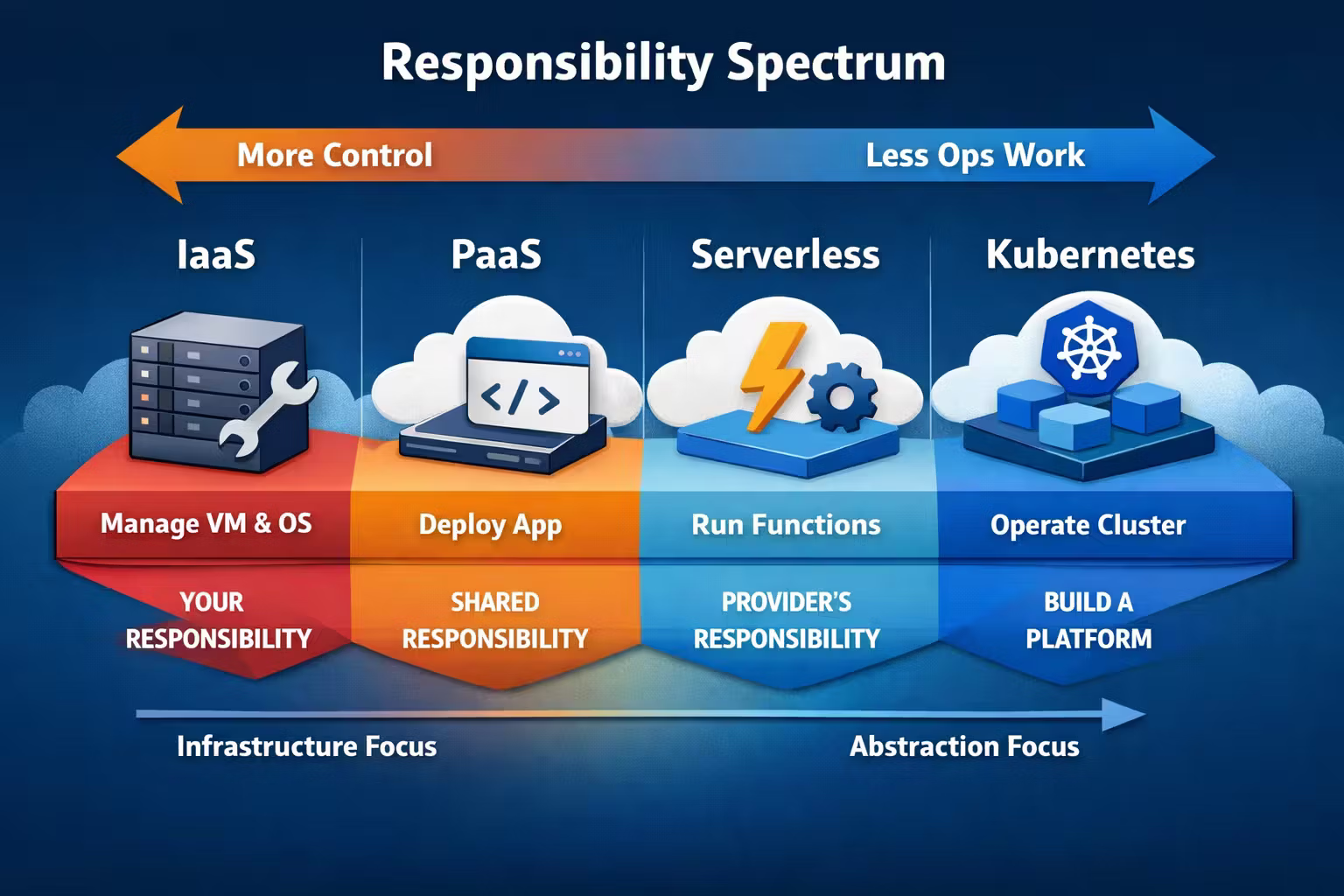
A quick heuristic:
- If your team can’t comfortably operate a distributed system, don’t volunteer to operate the platform too.
- If your compliance, networking, or runtime constraints demand control, don’t pretend PaaS abstractions will magically fit.
Decision axes that matter in real life
Most “cloud comparisons” skip the only questions that consistently decide outcomes.
Axis 1: Team operating capacity (the underrated one)
Ask:
- Do we have SRE/platform engineers, or are we a product team?
- Is on-call already heavy?
- Do we have time for platform upgrades, cluster security, and incident drills?
- Do we have reliable automation and testing for infrastructure changes?
If the answer is “no”, you need more managed services, not fewer.
Axis 2: Change velocity vs change safety
- PaaS and serverless tend to enforce safer defaults.
- Kubernetes gives you more knobs — and therefore more ways to break things.
- IaaS gives you complete freedom — including freedom to create bespoke, fragile snowflakes.
Axis 3: Workload shape
- Spiky, event-driven, async: serverless wins (if latency constraints permit).
- Steady, long-running services: PaaS or Kubernetes.
- Special runtimes, stateful oddities: IaaS or Kubernetes (sometimes PaaS if supported).
Axis 4: Latency and tail behavior
- Cold starts and per-request isolation can hurt p95/p99 latency in serverless.
- Kubernetes and IaaS let you reserve capacity and tune performance.
- PaaS can be excellent here, depending on the platform and configuration.
Axis 5: Compliance / isolation / network control
- Some orgs need VPC controls, custom networking, strict egress policies, dedicated hardware, or specific OS baselines.
- That can push you toward Kubernetes or IaaS — but don’t let “compliance” become a blanket excuse for “DIY everything.”
Axis 6: Cost predictability
- Serverless can be very cheap at low traffic and very expensive at scale depending on usage pattern.
- Kubernetes can be cost-efficient at scale if you run it well; it can also be a cost leak machine.
- PaaS often trades a premium for simplicity.
- IaaS costs can look cheap until you price in people-time and operational risk.
The biggest cloud cost is usually: engineering time + risk.
A decision matrix you can actually use
This isn’t a scorecard — it’s a prompt to think clearly.
Choose PaaS when:
- you want reliable deployments with minimal platform work
- your runtime fits the platform (common languages/frameworks)
- you value guardrails: health checks, autoscaling, rollbacks, managed routing
- you have a small-to-mid team and want to focus on product
- you want “boring” operations and a smaller blast radius
Choose serverless when:
- your workload is event-driven: queues, webhooks, file processing, cron, ETL, glue code
- you need burst scaling or “scale to zero” economics
- you can design for idempotency, retries, and timeouts
- your latency budget can tolerate cold starts or you can mitigate them
- you want to isolate work units and reduce operational state
Choose Kubernetes when:
- you have multiple teams shipping many services and need consistent deployment contracts
- you need custom networking, sidecars, policy enforcement, or runtime standardization
- you need portability for a real reason (not as a slogan)
- you can staff platform ownership (platform team or SRE capacity)
- you have strong automation, observability, and incident response discipline
Choose IaaS when:
- you have special runtime requirements (legacy, custom OS, specific kernels)
- you need deep control over performance, networking, or host-level behavior
- you’re running stateful systems that need careful tuning and predictable capacity
- you have operational maturity and want to avoid platform abstraction constraints
- you need a stepping stone migration path (VMs first, platform later)
The “platform stack” reality: most good systems are hybrids
The healthiest architectures I’ve seen are not “one choice.” They’re a layered blend:
- PaaS for the mainstream stateless services
- Serverless for event handling, cron, glue, low-frequency tasks
- Managed databases, caches, and queues (almost always)
- Kubernetes only when it solves real multi-team scale problems
- IaaS for the few weird snowflakes you can’t avoid (and you keep them contained)
The pragmatic goal
Use the most managed option that still meets your constraints.
Only “graduate” to more control when you can prove the constraints.
Patterns that win in practice
Pattern 1: “PaaS core, serverless edges”
- Put the product API and core services on PaaS (boring, scalable, observable).
- Use serverless for:
- webhooks
- cron-driven workflows
- file/queue processing
- integration glue
- scheduled batch jobs
- Keep shared concerns consistent: auth, logging, tracing, config, secrets.
This gives you a simple operational center with elastic edges.
Pattern 2: “Kubernetes as a product, not a cluster”
If you do Kubernetes, treat it like internal infrastructure with:
- a platform roadmap
- golden paths (templates, paved roads)
- opinionated defaults
- security policy as code
- cluster upgrade automation
- service onboarding that is faster than DIY
If your Kubernetes experience is “every team invents its own ingress and its own Helm chart,” you’re not gaining control — you’re multiplying chaos.
Pattern 3: “Serverless workflows, not serverless spaghetti”
Serverless becomes a mess when:
- every function triggers 3 other functions
- retries are implicit and invisible
- state is scattered across logs
The fix is to introduce explicit orchestration:
- workflow engines (managed where possible)
- explicit state machines
- explicit idempotency keys
- event schemas and versioning
- trace correlation IDs from the start
Pattern 4: “IaaS as containment for the weird stuff”
If you must run weird workloads on VMs:
- isolate them (network boundaries, blast radius)
- put a strong deployment discipline around them (immutable images, rollouts)
- keep them out of your main development path
- measure and plan their retirement
The cost model you should use (and the one teams forget)
There are two cost models:
- Bill cost (cloud invoice)
- Operating cost (people + risk + time + incidents)
Teams obsess over #1 and quietly drown in #2.
Here’s the reality:
- Kubernetes can lower bill cost if you run high utilization and standardize workloads.
- Kubernetes can also increase operating cost massively if you don’t have platform maturity.
- PaaS often increases bill cost but reduces operating cost dramatically.
- Serverless can be almost free or shockingly expensive depending on traffic shape and execution time.
Reliability posture by model (where incidents come from)
You don’t get reliability “for free” anywhere — you just shift where failure happens.
IaaS failures look like
OS patching gaps, snowflake config drift, manual deployments, fragile failover.
PaaS failures look like
Platform limits, noisy neighbors, deployment misconfig, opaque platform incidents.
Serverless failures look like
Retry storms, idempotency bugs, cold starts, event version mismatches.
Kubernetes failures look like
Cluster upgrades, networking/ingress policy mistakes, runaway resource usage, platform drift.
The key is to build guardrails where your chosen model tends to fail.
A “boring but correct” checklist before you pick
Define your non-negotiables
- latency SLOs (p95/p99)
- compliance constraints (network isolation, data residency)
- runtime constraints (languages, system deps)
- expected traffic shape (steady vs spiky)
- team operating capacity (on-call maturity, platform skills)
Establish your baseline building blocks
No matter what you pick, you need:
- CI/CD with safe rollouts and fast rollback
- secrets management
- centralized logs + metrics + traces (and correlation IDs)
- a clear data strategy (managed DB, backups, DR)
- a queue/event backbone for async work
- cost visibility (tags/labels, budgets, alerts)
Choose the simplest platform that satisfies constraints
Start managed and only add control when you can justify it.
Make the decision reversible (as much as possible)
- package your app cleanly (12-factor-ish)
- keep dependencies explicit
- avoid coupling business logic to platform-specific semantics without benefit
- version your events and APIs
- treat infrastructure as code
“Graduation paths” that don’t destroy your team
The worst path is a big-bang platform migration. The best path is incremental, measured, and reversible.
Path A: Start PaaS → adopt serverless for edges → consider Kubernetes later
This is the most common successful path for product companies.
Path B: Start IaaS → enforce immutable images + pipelines → move to PaaS/Kubernetes
This is common in enterprises migrating legacy systems.
Path C: Start serverless → introduce workflows + contracts → keep a core service layer stable
This works well for event-heavy integration products — but you must invest early in correctness (idempotency, contracts).
Anti-patterns (the ones I keep seeing)
Kubernetes is not “standard” the way HTTP is standard.
Kubernetes is a platform that requires:
- governance
- operational excellence
- ongoing upgrades
- deep observability and security investment
If you don’t have platform capacity, you’re choosing a tax.
Serverless is great for:
- event-driven tasks
- async workflows
- bursty workloads
It’s usually not great for:
- low-latency, high-throughput APIs
- long-running processes
- complex local dependencies
- systems that require tight control over concurrency and resource usage
VMs feel simple because you can “just log in and fix it.” That’s not simplicity — that’s manual operations debt.
If you need SSH to keep production stable, the system is telling you something.
Multi-cloud can reduce vendor risk — but it increases complexity.
If you don’t have:
- a consistent abstraction layer
- a portable operational model
- consistent observability and security controls
You’re not reducing risk. You’re multiplying failure modes.
A reference “cloud choice” decision log template
If you want this to become architecture (not opinion), write it down.
Use this as your decision record:
- Context: what are we building, what’s our team size, what’s our on-call maturity?
- Constraints: latency, compliance, runtime, traffic shape
- Options considered: IaaS / PaaS / serverless / Kubernetes
- Decision: what we choose now
- Why: mapped to constraints and operating capacity
- Tradeoffs accepted: what pain we accept
- Exit strategy: what would force us to change this decision?
- Guardrails: what policies and automation we put in place
Architecture is the ability to explain your decisions
If you can’t explain it in a page, you probably chose it as identity.
Resources (worth bookmarking)
AWS Well-Architected Framework
A practical set of questions and tradeoffs across reliability, security, cost, operations, and performance.
Google SRE Book
The canonical “operate like an adult” reference: SLOs, error budgets, incident response, and capacity thinking.
FAQ
Not always — but it’s often a tax.
If you have a clear platform need (multi-service scale, policy enforcement, deep networking controls) and platform capacity (people + process), it can be the right move.
If you’re doing it because it feels modern, you’re likely buying complexity you don’t need.
Lock-in is not binary; it’s a gradient.
Serverless often couples you to event models, managed workflows, and provider-specific semantics. Kubernetes can reduce some lock-in but tends to lock you into the Kubernetes ecosystem and its operational model.
The right question is:
- What lock-in are we accepting?
- What does it buy us?
- What would it cost to exit?
A hybrid:
- PaaS for core services
- serverless for edges and async
- managed databases/queues/caches
- excellent CI/CD + observability + security defaults
It’s the fastest path to “reliable enough” without building a platform team prematurely.
Only if you have a strong reason and strong operational maturity.
Managed databases exist because state is hard. If you choose to operate stateful systems yourself, you’re choosing on-call complexity, upgrades, backups, and recovery engineering.
For most teams: managed DBs are the best bargain in cloud.
What’s Next
This month was about choosing infrastructure without ideology — by understanding responsibility boundaries and operational capacity.
Next month the series shifts from “where do we run it?” to “what data are we producing?”
Data Engineering for Product Teams
Because if you mix operational truth with analytics convenience, you will eventually ship lies — and then make decisions based on them.
Data Engineering for Product Teams: OLTP vs OLAP, Streaming, and Truth
Most “data problems” are actually truth problems. This month is a practical mental model for product teams: where truth lives, how it moves, when to stream, when to batch, and how to keep analytics useful without corrupting production.
Performance Engineering End-to-End: From TTFB to Tail Latency
Performance isn’t a tuning phase — it’s an architecture property. This month I lay out an end-to-end mental model (browser → edge → app → data) and the practical playbook for improving both “fast on average” and “fast under load” without shipping fragile optimizations.