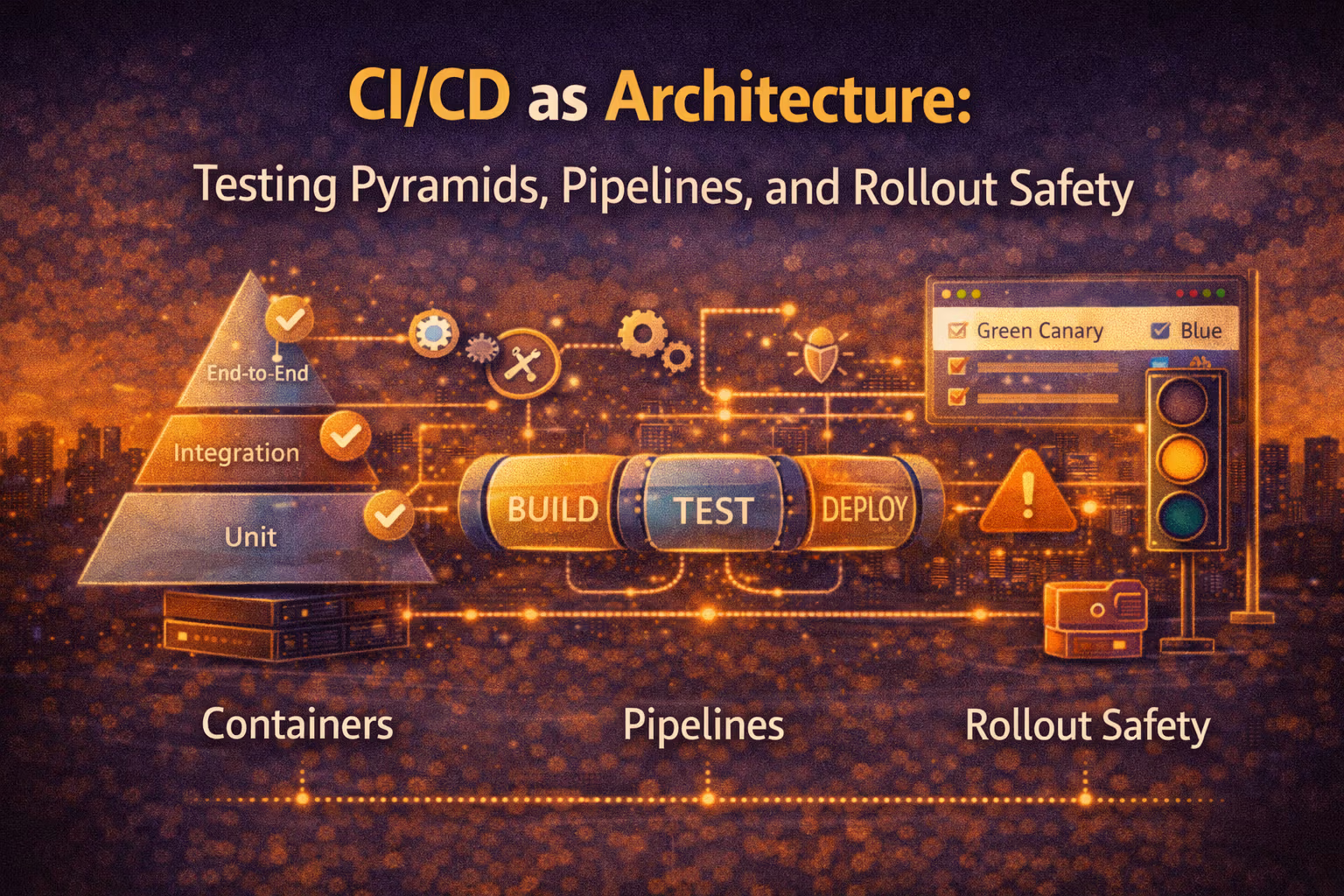
CI/CD as Architecture: Testing Pyramids, Pipelines, and Rollout Safety
CI/CD isn’t a DevOps checkbox — it’s the architecture that makes change safe. This month is about test economics, pipeline design, and rollout strategies that turn “deploy” into a reversible decision.

Axel Domingues
Most teams treat CI/CD as plumbing.
Something you wire once, complain about forever, and blame when production burns.
But in mature systems, CI/CD is something else entirely:
It’s the architecture of change.
It determines:
- how fast you can ship without gambling
- how often “green” still breaks prod
- whether a bad deploy is an incident… or a non-event
- whether teams can move independently without stepping on each other
This month is about turning CI/CD into a safety system — with crisp mental models you can teach, review, and enforce.
Not “how to use a tool.”
How to design a system that remains safe while it changes.
The goal this month
Make change safe by design: tests that pay rent, pipelines that produce trust, and deployments that can be reversed.
The mindset shift
CI/CD is not automation.
It’s the contract between code and production.
The real output
Not “passing builds.”
A system where every deploy is boring.
The failure you’re avoiding
“Green pipeline, broken prod” — and no safe way back.
CI/CD Is an Architecture Layer (Whether You Admit It or Not)
If you design your runtime architecture carefully but ignore your delivery architecture, you end up with a paradox:
- your system is “well-designed”…
- but change is chaos
The delivery architecture answers questions like:
- What is the deployable unit? (service, module, monolith, frontend bundle)
- What is an artifact? (container image, package, immutable bundle)
- How do we promote it? (dev → staging → prod)
- What can block a release? (tests, policy checks, SLO burn, approvals)
- How do we roll back safely? (revert, roll back, disable features, drain traffic)
- What’s the blast radius? (one service, one region, one tenant, everyone)
If these aren’t explicit, they still exist — they’re just encoded as tribal knowledge and late-night heroics.
If you can’t control the experiment, you don’t have CI/CD — you have a build server.CI/CD is the mechanism that converts change into a controlled experiment.
The Testing Pyramid Is an Economic Model (Not a Diagram)
People quote the testing pyramid like a rule.
It’s better understood as a budget.
Every test has a cost profile:
- Runtime cost (minutes in pipeline, compute, parallelization limits)
- Maintenance cost (flake rate, brittleness, data setup burden)
- Debug cost (how fast you get to root cause)
- Coverage value (what kinds of bugs it can actually catch)
- Confidence value (how much it should block a release)
When you treat tests as economics, the pyramid becomes obvious:
Unit tests
Cheap, fast, stable. Great at logic + edge cases. Poor at integration truth.
Integration tests
Medium cost. Catch contract issues and wiring bugs. Must be curated to avoid slow creep.
End-to-end tests
Expensive and fragile. Validate critical paths only. Treat as “smoke alarms,” not a net.
Production validation
The only environment with real traffic. Requires safe rollout + observability to be useful.
It produces slow pipelines, flaky builds, and low trust.E2E as the primary safety net.
If your only confidence is “run the whole system,” you’ve already lost speed and safety.
The Pipeline Is a State Machine That Produces Trust
A good pipeline is not “steps.”
It’s a state machine with two outputs:
- a promoted artifact
- a credibility score (implicit): Do we trust this enough to release?
That credibility score comes from layers of evidence.
The core pipeline states
Build once, produce an immutable artifact
- build from source → produce a single artifact (e.g., container image)
- stamp it (version, commit SHA)
- push to an artifact registry
- never rebuild the same version differently
Verify the artifact, not the repo
- run unit tests + static checks during CI
- run integration checks against the built artifact
- treat “it passes locally” as irrelevant
Promote through environments, don’t “redeploy from source”
- dev → staging → prod should be promotion
- the artifact is identical; only config changes
- environment differences are exposed early
Enforce policy as code
- dependency scanning, SBOM, licenses, secrets detection
- infrastructure checks (terraform plan, policy compliance)
- drift detection and change approvals where needed
Gate prod on signals that matter
- critical tests
- required approvals for risky changes
- release windows (if you must)
- SLO burn alerts (if you’re already degrading, don’t deploy)
Flaky tests are not “just annoying.”A pipeline should fail fast on problems that won’t fix themselves.
And it should retry automatically on problems that might.
They are a credibility leak.
“Green But Broken” Usually Means You’re Measuring the Wrong Things
When a pipeline is green but prod fails, it’s rarely mysterious.
It’s typically one of these:
Your staging isn’t production-like (data, traffic patterns, config, dependencies).
Fix by:
- using prod-like config in staging
- testing with production-ish datasets (scrubbed)
- creating synthetic traffic that mimics load/edge cases
One service changed a contract and nothing enforced it.
Fix by:
- consumer-driven contract tests where it matters
- schema versioning rules
- explicit backward compatibility policies
Code deploy and schema deploy aren’t coordinated safely.
Fix by:
- expand/contract migrations
- dual-read / dual-write only when justified
- backwards-compatible reads before writes
It validates “does it run,” not “does it behave under load and failure.”
Fix by:
- load tests for critical flows (bounded)
- chaos-style dependency failures in staging
- canary in production with observable success criteria
Rollout Safety: Deployments as Reversible Decisions
A deployment strategy is the thing that decides whether prod is a cliff.
When you say “rollout safety,” you’re really asking:
- Can we limit blast radius?
- Can we observe correctness quickly?
- Can we reverse without heroics?
The practical rollout toolbox
Blue/Green
Two environments. Flip traffic. Fast rollback. Requires careful handling of data migrations.
Canary / progressive delivery
Route a small % of traffic to the new version. Roll forward or back based on signals.
Feature flags
Separate deploy from release. Ship code dark, enable gradually, kill quickly when needed.
Ring deployments
Promote by cohort: internal users → beta → small region → full fleet. Great for large orgs.
- naming things (what is a release? what is a version? what is an environment?)
- invalidating things (what does rollback actually mean when data changed?)
The Rollback Truth: Not Everything Rolls Back
Teams say “we can roll back” and then discover the trap:
- the binary rolls back
- the data does not
So rollout safety depends on migration discipline and compatibility discipline.
The minimum viable migration discipline
- Use expand/contract migrations:
- expand schema in a backward-compatible way
- deploy code that can read both forms
- migrate data
- contract later (remove old columns/paths)
- Never ship a change where:
- new code requires new schema immediately and
- old code cannot run on new schema
That single constraint forces architecture maturity.A deploy must be safe in both directions for at least one release window.
Architecture Checklists
These are the checklists I want teams to print and argue about.
Pipeline design checklist
- Build once → produce immutable artifact (image/package)
- Artifact promotion (not rebuilding) across environments
- Secrets handled via runtime injection (not baked into artifacts)
- Parallelization strategy (fast feedback for main branch)
- Policy as code (security + compliance gates where needed)
- Clear ownership for pipeline reliability (it’s a product)
Test portfolio checklist
- Unit tests cover domain logic and edge cases
- Integration tests cover contracts and critical dependency wiring
- E2E tests are limited to true business-critical flows
- Flake budget is enforced (flake is treated as a defect)
- Tests produce actionable failure output (fast diagnosis)
Release and rollout checklist
- Deployment strategy chosen intentionally (blue/green, canary, ring)
- Rollback plan is explicit and tested
- Compatibility policy for API/schema changes
- Feature flags for high-risk or UI/behavior changes
- Observable success criteria for canary (not vibes)
Common Anti-Patterns That Kill Delivery
If a human has to remember it, it will be forgotten at 2am.
Replace manual steps with:
- automation
- policy as code
- approvals only where risk justifies it
Pipelines are products. If nobody owns reliability, everyone suffers.
Fix by:
- defining ownership and SLAs for CI/CD
- measuring lead time, failure rate, MTTR for pipeline itself
Staging often becomes a museum: stable, unlike prod, and misleading.
Fix by:
- keeping config parity
- running regular prod-like synthetic workloads
- testing rollout behavior itself (not just app behavior)
If your only rollout is “deploy to everyone,” you’re relying on luck.
Fix by:
- canary
- feature flags
- ring deployments
- explicit rollback strategy
Resources
Google SRE Book — Release Engineering
A classic explanation of why release processes are reliability mechanisms — and why automation is a means, not the goal.
DORA / Accelerate — Metrics That Matter
The most useful vocabulary for delivery performance: lead time, deployment frequency, change fail rate, and time to restore.
FAQ
You need deployment safety before you split systems.
Microservices increase change frequency and surface area. Without solid CI/CD, you’ll ship slower and fail more.
Fast enough that engineers don’t work around it.
As a rough heuristic:
- mainline checks in minutes
- deeper checks asynchronously (post-merge) when possible
- canary validation as the final proof
Limit blast radius and make rollback real.
If a bad deploy affects 1% of traffic and you can undo it in minutes, you’ve turned incidents into small, survivable events.
Treat flake like a defect with an owner.
- quarantine quickly
- fix or delete aggressively
- track flake rate as a metric
- never let “rerun until green” become normal
What’s Next
If CI/CD is the architecture of change, then observability is the architecture of truth.
Next month:
Observability that Works
Because safe rollouts only work if you can see reality quickly — and decide based on signals, not hope.
Observability that Works: Logs, Metrics, Traces, and SLO Thinking
Observability isn’t “add dashboards.” It’s designing feedback loops you can trust: signals that answer real questions, alerts tied to user pain, and tooling that helps you debug under pressure.
Containers, Docker, and the Discipline of Reproducibility
Containers aren’t “how you deploy apps” — they’re how you make environments stop being a variable. This is the operational discipline: immutable artifacts, repeatable builds, and runtime contracts you can actually rely on.