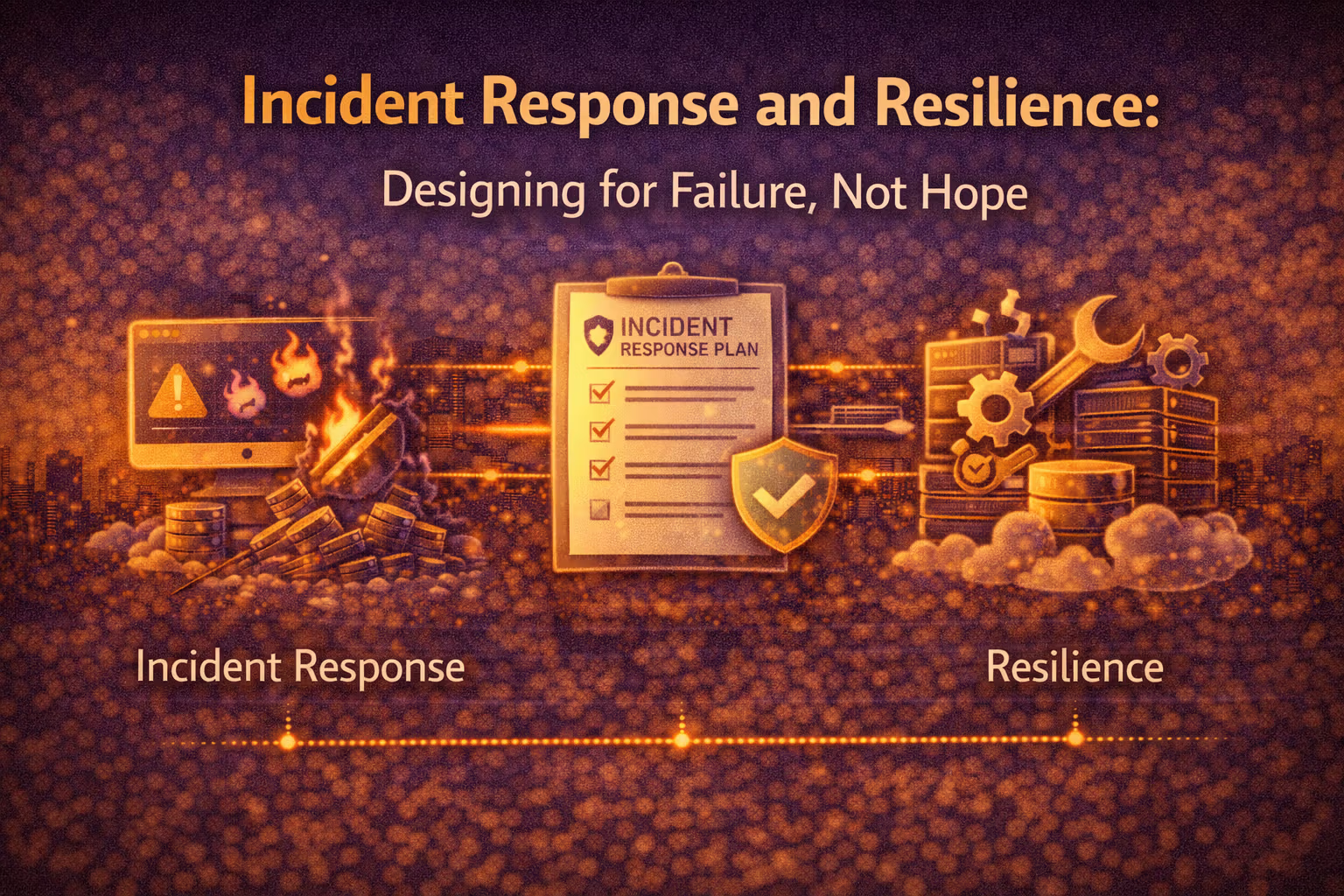
Incident Response and Resilience: Designing for Failure, Not Hope
Most teams “have on-call”. Fewer teams have resilience. This is a practical blueprint for designing systems, teams, and workflows that respond fast, recover safely, and learn without blame.

Axel Domingues
The first time you run a real incident, you realize something uncomfortable:
Your architecture doesn’t fail when it’s wrong. It fails when it’s surprised.
And production is very good at surprise:
- the slow query that “never happens” suddenly happens 10,000 times
- the retry you forgot about turns a small blip into a thundering herd
- a deploy goes out on Friday because the pipeline was green
- a dependency degrades in a way nobody thought to alert on
This post is not about heroics.
It’s about designing the system (and the team) so that when failure happens:
- detection is fast
- response is calm
- mitigation is safe
- recovery is predictable
- learning improves the system instead of burning people out
Incident response is where every design decision shows up—timeouts, retries, deploy strategy, observability, ownership, and the human workflow around all of it.
The real goal
Reduce time-to-mitigate and avoid repeat failures—not “avoid all incidents”.
The mindset shift
Resilience isn’t a feature you add later.
It’s a property you design into the system.
What we’ll build
A practical incident model: roles, playbooks, alerting, and safe mitigation patterns.
What “good” looks like
Fast detection, small blast radius, reversible changes, and blameless learning.
Incidents Are Product Events, Not Engineering Shame
An incident is any unplanned event that:
- harms customers
- threatens data/security
- violates an SLO (or will soon)
- forces the team into emergency mode
Notice what’s missing: the word “outage”.
Many incidents are not full downtime. Most real pain is partial:
- elevated latency (especially tail latency)
- increased error rate for specific endpoints
- degraded dependencies
- stuck queues and backlogs
- data drift and silent corruption
Degradation is where you can still make safe decisions. Full outages are where you panic.
Severity is about impact, not drama
A simple severity rubric (adapt to your org):
- SEV0: active security/data integrity threat, or critical business functions down globally
- SEV1: major customer impact, widespread outage/degradation
- SEV2: partial customer impact, high error rate/latency on key paths
- SEV3: limited impact, internal tooling or single customer / region
The point isn’t perfect classification.
It’s aligning the team on how big the response should be.
Incident Response Is a System: People + Process + Architecture
When incidents go badly, it’s usually not one thing. It’s the interaction of:
- ambiguous ownership (“who decides?”)
- incomplete instrumentation (“we don’t know what’s happening”)
- unsafe mitigation (“we can’t roll back cleanly”)
- fragile dependencies (“one failure becomes many”)
- missing practice (“we’ve never done this under pressure”)
So treat IR as a designed system with an explicit lifecycle:
The incident lifecycle
Prepare → Detect → Triage → Mitigate → Recover → Learn
The Fastest Way to Lower MTTR Is Role Clarity
The mistake most teams make: everyone becomes a “doer” at once.
That feels productive… and it destroys coordination.
A good incident is boring because it has roles.
- Incident Commander (IC): owns the clock and the decision-making. Not the deepest debugger—the coordinator.
- Comms Lead: updates stakeholders and customers. Keeps engineers from being interrupted.
- Primary Responder / SME: runs diagnosis and mitigation work.
- Scribe: timestamps decisions, hypotheses, and actions (this becomes your postmortem timeline).
- No IC → multiple parallel “fixes”, nobody owns rollback decisions.
- No Comms → engineers get DM’d by execs, customers, and support while debugging.
- No Scribe → after the incident, you reconstruct history from memory and Slack chaos.
But you can’t skip the responsibilities.
The Golden Rule: Stop the Bleeding Before You Find the Root Cause
In a live incident, “root cause” is often a trap.
You are operating under:
- incomplete information
- shifting conditions
- user behavior changes
- cascading effects you don’t fully understand yet
Your job is to restore acceptable service first.
Root cause comes later, when the system is stable enough to observe.
Mitigate first. Understand second.
Designing for Failure Starts with Containment
Resilience is not “never failing.”
It’s failing in a way that’s bounded and recoverable.
Here are the patterns that matter most in incidents.
Timeouts everywhere
A call that never times out is an outage that never ends.
Retries with backoff + jitter
Retries are load generators. Without jitter, they synchronize into retry storms.
Circuit breakers + bulkheads
Stop calling the dying dependency. Isolate pools so one failure doesn’t starve everything.
Rate limiting + load shedding
Under overload, reject some work intentionally to protect critical paths.
Timeouts: the hidden SLO killer
Common mistake: timeout at the edge, none inside.
Result: the customer request times out at 30s… but backend work keeps running for minutes, piling up and consuming capacity.
A healthier pattern:
- short timeouts between internal calls (few seconds)
- enforce a “request budget” (the total time you’re willing to spend)
- cancel propagation where possible (don’t keep doing work after the client gave up)
Retries: success and amplification
Retries are good when:
- the failure is transient
- the operation is idempotent
- you have backoff + jitter
- you stop retrying when the system is clearly unhealthy
Retries are catastrophic when:
- the failure is persistent (dependency is degraded)
- the operation is not idempotent (you duplicate side effects)
- all clients retry at the same interval (synchronized flood)
If you suspect a retry storm, check:
- did error rate spike at the same time as request rate?
- are client timeouts causing “double work” on the server?
- are multiple services retrying the same dependency?
- do you see periodic spikes aligned to a retry interval?
- did a single dependency latency increase trigger timeouts upstream?
Circuit breakers + bulkheads: reduce cascade
- Circuit breaker: after N failures, stop calling the dependency for a cool-down window.
- Bulkhead: isolate resource pools (threads, connections, queues) so one failing dependency cannot starve unrelated work.
Resilience is mostly resource isolation.
Safe Mitigation Is a Deployment Capability, Not a Runtime Trick
Most mitigations are deploy operations:
- roll back
- roll forward with a hotfix
- flip a feature flag
- disable a bad code path
- route traffic away from a region or dependency
If your deploys are slow, risky, or manual… your incident response will be slow and risky too.
If changes are easy to undo, you can move faster with less fear.
The “reversible changes” toolbox
- feature flags / kill switches for risky paths
- gradual rollouts (canary, percentage-based)
- blue/green where rollback is a traffic switch
- config changes that are validated and versioned
- database safety: backwards-compatible migrations and dual-write strategies
It’s an additional incident.
Observability That Helps During Incidents
Dashboards don’t save you when:
- they show averages
- they are not tied to user impact
- they don’t tell you what to do next
In incidents, you want fast answers to four questions:
- Is the customer impacted? How?
- Where is the bottleneck / failure domain?
- Is it getting better or worse?
- What mitigation moved the needle?
SLIs, not vibes
Measure what users feel: error rate, latency, availability, freshness.
Percentiles, not averages
p95/p99 latency is where incidents hide.
Correlation IDs
Traces connect “the slow page” to the specific slow dependency.
Alerts as triggers
Alerting is for action. Dashboards are for exploration.
- Alerting on CPU/memory without tying it to user impact
- Alerting on every error instead of “error rate above threshold for X minutes”
- Alerts without runbooks (“what do I do with this?”)
- Duplicate alerts across services for the same underlying failure
- Alerting on averages (p50 looks fine while p99 is on fire)
Put these at the top, always:
- Golden signals: latency (p95/p99), traffic, errors, saturation
- Dependency health: error rate + latency for critical downstreams
- Queue/backlog depth: “are we accumulating work?”
- Deploy markers: “did something change?”
How to Run the Incident (A Practical Playbook)
This is the minimal workflow that keeps teams sane.
Declare the incident early
If there’s real customer impact or likely impact, declare it.
It’s cheaper to downgrade a false alarm than to catch up after 40 minutes of confusion.
Assign roles immediately
Pick an IC. Pick a Comms Lead. Pick a Scribe.
Then let the responders debug without being dragged into coordination chaos.
Stabilize the system
Mitigation options are usually:
- rollback or disable the recent change
- shed load / rate limit
- isolate the failing dependency
- reduce blast radius (regional failover, partial feature disable)
Verify improvement with SLIs
Measure before/after on:
- error rate
- p95/p99 latency
- backlog depth
- customer-facing symptoms
If metrics didn’t move, the mitigation didn’t work—undo it and try another.
Communicate in a predictable rhythm
Stakeholders don’t need constant spam.
They need updates on a schedule:
- current impact
- what’s being tried
- next update time
Transition to recovery
When the system is stable:
- remove temporary mitigations carefully
- drain backlogs safely
- validate data integrity
- keep monitoring for regressions
Close with a clear “all clear”
Don’t end incidents with silence.
Make the end explicit:
- what improved
- what remains risky
- what follow-ups are coming
A timeline turns “we think it happened around then” into real learning.
Postmortems: Blameless, Not Aimless
“Blameless” does not mean “nobody is responsible.”
It means:
- we assume people acted reasonably with the information they had
- we focus on system conditions that made the failure possible
- we create corrective actions that reduce the chance of recurrence
Good postmortems answer:
- what was the impact?
- how did we detect it?
- what was the timeline?
- what were the contributing factors?
- what mitigations worked and didn’t?
- what will we change (with owners and dates)?
Prefer actions that change the system, not actions that “remind people”.
- ✅ Add timeouts, jitter, circuit breakers
- ✅ Improve alert thresholds and runbooks
- ✅ Add load shedding for overload
- ✅ Add deploy gates / canary checks
- ✅ Automate rollback paths
- ❌ “Be more careful next time”
- ❌ “Add a meeting to review deploys” (without automation)
- ❌ “Write a doc” (without operational ownership)
“Five whys” often pushes teams into a single root cause and stops early.
A better framing is contributing factors:
- what conditions allowed the failure?
- what signals were missing?
- what made mitigation slow?
- what made the blast radius large?
- what prevented safe rollback?
Resilience Is Practice: GameDays and Controlled Failure
The most dangerous time to learn incident response is during a real incident.
Practice reduces panic and exposes design gaps.
A good “GameDay” is not chaos for chaos’ sake. It’s a controlled exercise that validates:
- alerting (did the right people get paged?)
- diagnosis speed (did we know where to look?)
- mitigation safety (could we roll back/disable?)
- communication (were stakeholders informed?)
- recovery (did we drain backlogs safely?)
The goal is confidence, not destruction.
The Architect’s Incident Readiness Checklist
If you want fewer 2AM disasters, this is the list to pressure-test.
Failure containment
Timeouts, retries (with jitter), circuit breakers, bulkheads, rate limits, load shedding.
Safe change
Fast rollback, canary deploys, feature flags, backward-compatible schema changes.
Observability
Golden signals, percentiles, traceability, deploy markers, meaningful alerts with runbooks.
Human system
Clear ownership, on-call rotation, escalation paths, practiced incident roles, comms rhythm.
And people burn out faster than systems.
Resources
FAQ
Not necessarily.
The IC role is about coordination and decision-making under uncertainty.
The best IC is often someone who:
- stays calm
- understands the system boundaries
- communicates clearly
- protects responders from distraction
Reversibility.
Fast rollback + safe deploy patterns reduce both blast radius and recovery time. If your mitigation is risky, you’ll hesitate—and MTTR grows.
No. But practice is.
Start with GameDays, runbook drills, and small fault injection. The point is to validate that your alerting, mitigation paths, and comms work under pressure.
Treat alerting as a product with ownership.
- alert on user-impacting symptoms
- dedupe alerts across services
- tie alerts to runbooks
- measure alert quality (false positives and “no action needed” pages)
What’s Next
This month was about surviving the bad day:
- detecting fast
- coordinating calmly
- mitigating safely
- and learning without blame
Next month is the capstone for 2022:
Build a System That Can Survive
We’ll assemble the whole year into an operational reference architecture you can defend—plus the decisions (and tradeoffs) that made it coherent.
Capstone: Build a System That Can Survive (Reference Architecture + Decision Log)
A production system isn’t “done” when it works — it’s done when it can fail, recover, evolve, and stay correct under pressure. This capstone stitches the 2021–2022 series into a reference architecture and a decision log you can defend.
Cost as a First-Class Constraint: FinOps for Architects
Reliability is non-negotiable, but “cost” is where architecture meets physics. This month is a practical playbook: how to model cost, allocate it, and design guardrails so your system scales without surprising invoices.