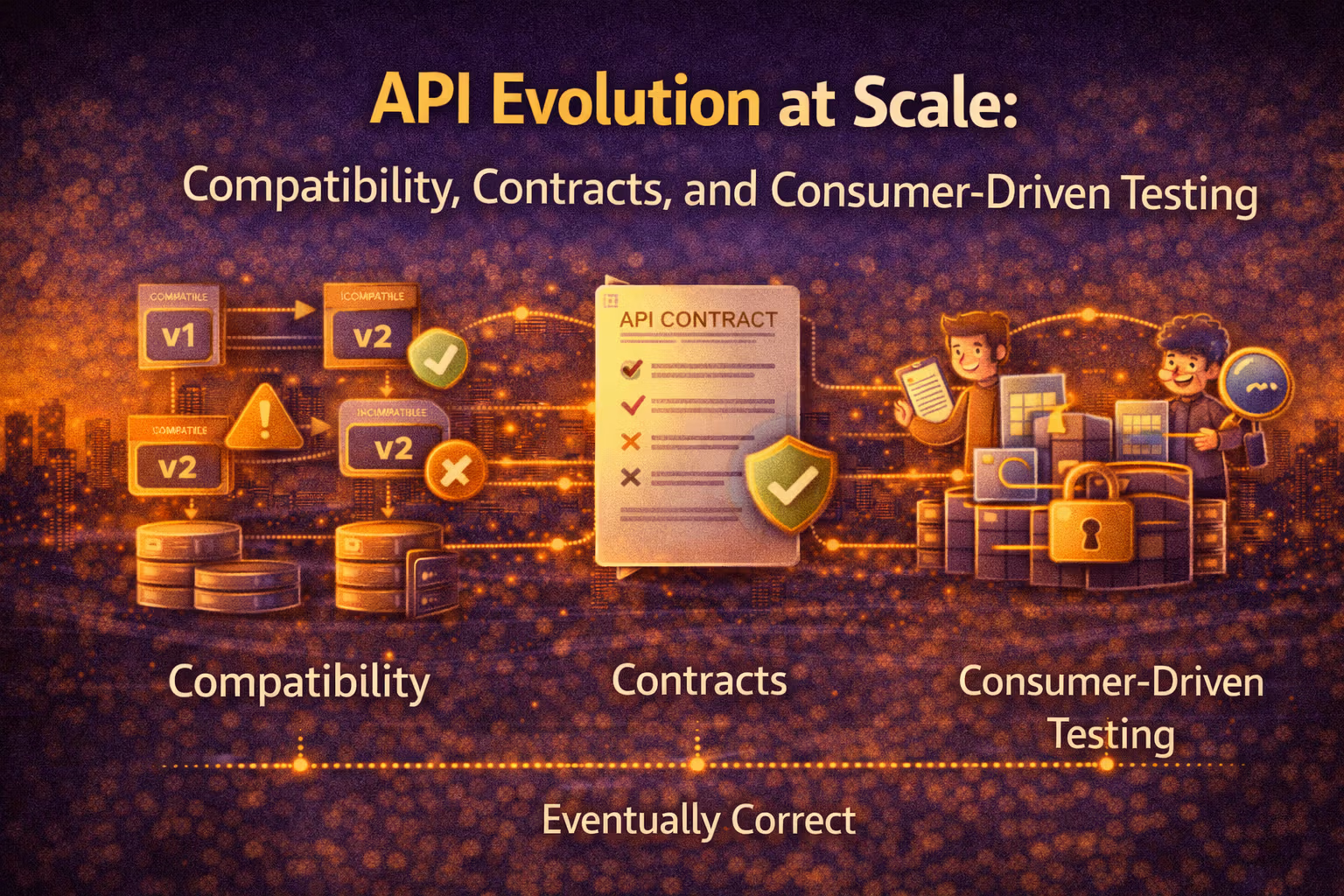
API Evolution at Scale: Compatibility, Contracts, and Consumer-Driven Testing
APIs don’t fail because they’re slow — they fail because they change. This month is about designing contracts you can evolve, enforcing compatibility automatically, and scaling teams without “everyone upgrade on Tuesday.”

Axel Domingues
APIs are the part of your system you don’t get to rewrite.
Not because it’s impossible.
Because the moment you have:
- more than one client,
- more than one team,
- or more than one deployment cadence…
“Just update everyone” becomes a fairy tale.
This month is about API evolution as architecture:
- how to make change safe without coordination
- how to ship new capabilities without breaking old clients
- how to enforce compatibility by default
- and how to stop discovering breakage in production
The bigger your org gets, the more API design becomes a governance problem, not a coding problem.the hard part isn’t building APIs — it’s evolving them.
The real goal
Ship changes without requiring synchronized upgrades across teams.
The core mechanism
Turn “what we meant” into an explicit contract (and test it continuously).
The maturity marker
Compatibility stops being a best-effort promise and becomes an enforced invariant.
The payoff
Teams can move independently, and rollbacks stay possible because clients don’t explode.
The API Is a Product (Even If You Didn’t Mean It)
In early-stage systems, an API is “a function call over the network”.
In mature systems, an API is:
- a dependency graph
- a deployment contract
- a risk surface
- and a business continuity plan
If the API breaks, the system doesn’t “degrade.”
It fractures:
- clients pin versions
- teams stop upgrading
- hotfixes become permanent branches
- and every release becomes a negotiation
So the architectural move is to treat your API like a product:
- it has users (consumers)
- it has versioned expectations
- it needs change control
- and it needs telemetry to prove what’s safe to remove
Mini-glossary: Compatibility Isn’t One Thing
- Backward compatible (server → old clients): a newer server still works with older clients.
- Forward compatible (client → old servers): a newer client still works with older servers.
Most API work is about being backward compatible, because servers roll out continuously while clients lag.
- Wire contract: shape and types (fields, status codes, headers, event schema).
- Semantic contract: meaning (what “approved” means, when “pending” can happen, idempotency expectations, ordering rules).
Wire compatibility is necessary.
Semantic compatibility is where incidents are born.
- Additive change: adds a new optional field, new endpoint, new event type, new enum value (careful!), new response attribute.
- Breaking change: removes or renames fields, changes meaning, changes validation rules, changes defaults, changes requiredness, changes error behavior.
Most “breaking changes” are disguised as “small refactors.”
The One Rule That Scales: Be Strict on Output, Tolerant on Input
When systems are small, both sides can “agree”.
When systems scale, agreement becomes expensive — so your API must be resilient to drift.
A practical pattern:
- Tolerant Reader (input): accept partial input; ignore unknown fields; don’t require clients to echo server-owned data.
- Strict Writer (output): never silently change meaning; keep responses stable; introduce new fields instead of mutating old ones.
clients will be older than servers
and servers will see shapes they didn’t predict.
JSON/HTTP Evolution: Rules That Avoid 80% of Incidents
This is the checklist I want teams to internalize.
Never “reuse” a field
If a field’s meaning changes, create a new field.
Reusing names creates invisible breakage.
Prefer optional + additive
Add fields, don’t mutate fields.
Old clients ignore what they don’t understand.
Treat validation as a breaking change
Making a previously-accepted input invalid is a real breaking change.
Roll it out like one.
Errors are part of the contract
Status codes, error codes, and retry semantics must be stable.
Changing them breaks clients just as hard as schema changes.
Don’t break clients with “helpful” changes
Here are classic “small improvements” that caused large incidents:
- “We now require
X-Customer-Id” (clients don’t send it everywhere) - “We cleaned up 400 vs 404” (client logic depended on the old behavior)
- “We started returning
nullinstead of missing fields” (deserializers differ) - “We enforced uniqueness” (old clients occasionally duplicated requests)
- “We fixed timezone handling” (semantic contract changed)
Branching logic comes from:
- status codes
- error codes
- default values
- enum values
- and “sometimes this is omitted”
Versioning: Don’t Use Versions to Hide Breaking Changes
Versioning is useful — but it’s also an easy escape hatch:
“We’ll just bump v2.”
The problem is that versions accumulate.
Old versions don’t disappear; they become a permanent support tax.
A more scalable stance:
- use additive changes as the default
- use versioning as the exception
- and measure adoption before you remove anything
A pragmatic versioning policy
Default: evolve within a version
- Add optional fields and new endpoints.
- Keep existing behavior stable.
- Deprecate gently (with telemetry).
Introduce a new version only when you must
Examples:
- you must change fundamental semantics
- you must redesign identifiers
- you must change auth model
- you must change pagination model broadly
When you version, plan the deletion on day one
- Define a deprecation window.
- Instrument usage.
- Communicate the exit.
- Keep the migration path boring.
A version should exist because it unlocks a better long-term contract — not because it’s convenient for the server team.
Contract-First Is Not Documentation. It’s a Build Artifact.
Most teams have “API docs”.
Few teams have an API contract.
A contract is something you can:
- validate,
- diff,
- test,
- and gate deployments on.
Examples:
- OpenAPI specs for HTTP
- JSON Schema for payloads
- Protobuf/IDL for RPC/event payloads
- AsyncAPI for event-driven APIs
The architectural goal is simple:
Turn expectations into artifacts that your pipeline can enforce.
Consumer-Driven Contract Testing: The Missing Scaling Mechanism
When you only have provider-side tests, you test what you think clients do.
Consumer-driven contract testing flips it:
- consumers publish the expectations they rely on
- providers verify they still satisfy those expectations
- deployment gets blocked before production breakage
This isn’t a testing trick. It’s organizational architecture.
Producer’s blind spot
Provider tests can’t predict what clients depend on “by accident”.
Consumer’s reality
Consumers encode the exact requests/responses they rely on.
No guessing. No meetings.
Automated enforcement
Providers verify against consumer contracts in CI.
Compatibility becomes a gate.
Independent deployment
Teams ship independently because the pipeline catches contract drift early.
The “Pact shape” (even if you don’t use Pact)
A minimal Change Data Capture (CDC) loop looks like this:
- Consumer records: “When I call
GET /quotes/{id}, I expect status 200 and fields X/Y/Z.” - Consumer publishes that contract to a shared place (a broker or a repo).
- Provider pulls all current consumer contracts and verifies them in CI.
- Provider deploy is blocked if any consumer contract fails.
- Optional: Provider publishes a verification result back to the broker.
- you have multiple teams,
- clients deploy independently,
- and breakage costs real incident time.
Events Are APIs With Worse UX (Treat Them With More Respect)
Event-driven systems often “move faster” — until an event schema changes and downstream consumers explode silently.
Event evolution has all the same problems as HTTP evolution, plus:
- consumers might be offline for hours/days
- old messages stay in queues/topics
- replays resurrect old schemas
- ordering and idempotency matter even more
So treat event payloads as a first-class contract:
- use explicit schemas (schema registry or versioned schema definitions)
- keep events append-only conceptually
- avoid “update events” that require consumers to keep local state perfectly aligned
- document ordering, dedupe, and replay expectations
Replays are where truth is tested.
Deprecation That Actually Works
“Deprecated” is meaningless if nobody knows and nobody cares.
Deprecation is a system:
- announce
- provide migration path
- instrument usage
- enforce a deadline
- remove safely
Here’s the minimal viable playbook:
Add the replacement first
- New field, new endpoint, new event type.
- Keep the old one working.
Instrument usage of the old contract
- log request counts per client/key
- dashboard adoption
- detect “unknown consumers” early
Communicate with a real deadline
- not “someday”
- not “when convenient”
- a date with ownership
Remove behind a kill switch
- feature flag / routing rule
- fast rollback if you discovered an unknown consumer
A Practical Architecture Checklist
If you’re reviewing an API change, ask these questions:
- Are we removing/renaming anything?
- Are we changing defaults?
- Are we tightening validation?
- Are we changing error codes/status codes?
- Are we changing semantic meaning?
If any answer is “yes”, treat it like a breaking change rollout.
- OpenAPI / schema / IDL exists?
- generated from code or maintained intentionally?
- diff checks in CI?
No artifact = no enforcement.
- provider-side tests only, or CDC too?
- staging verification against real consumer contracts?
- can we block deploy on contract mismatch?
Surprises belong in CI, not in incidents.
- telemetry for endpoints/events?
- per-client usage data?
- “unknown consumer” detection?
If you can’t answer “who uses this”, you can’t deprecate safely.
Resources
OpenAPI Specification
A contract format for HTTP APIs — the foundation for diffing, validation, and generated clients.
FAQ
Sometimes — but don’t treat URL versioning as the default.
If every change becomes a new version, versions never die and you end up supporting a museum.
Prefer additive evolution within a version, and reserve major versions for fundamental semantic redesigns.
No. It’s for independent deployments.
If consumers and providers deploy separately (mobile apps, partner integrations, internal services), CDC can turn coordination into automation.
Changing meaning without changing shape.
Renaming is obvious and gets flagged.
Semantic drift is quiet and causes production incidents because clients still deserialize successfully — they just behave wrong.
What’s Next
Now that we can evolve contracts safely, the next pressure point is performance.
Because once you have multiple services and multiple teams, the “average latency” stops mattering — and tail latency becomes your true user experience.
Next month: Performance Engineering End-to-End.
Performance Engineering End-to-End: From TTFB to Tail Latency
Performance isn’t a tuning phase — it’s an architecture property. This month I lay out an end-to-end mental model (browser → edge → app → data) and the practical playbook for improving both “fast on average” and “fast under load” without shipping fragile optimizations.
Distributed Data: Transactions, Outbox, Sagas, and “Eventually Correct”
Once your system crosses a process boundary, “a transaction” stops being a feature and becomes a strategy. This post is a practical mental model for distributed data: what to keep strongly consistent, what to make eventually consistent, and how to do it safely with outbox + sagas.