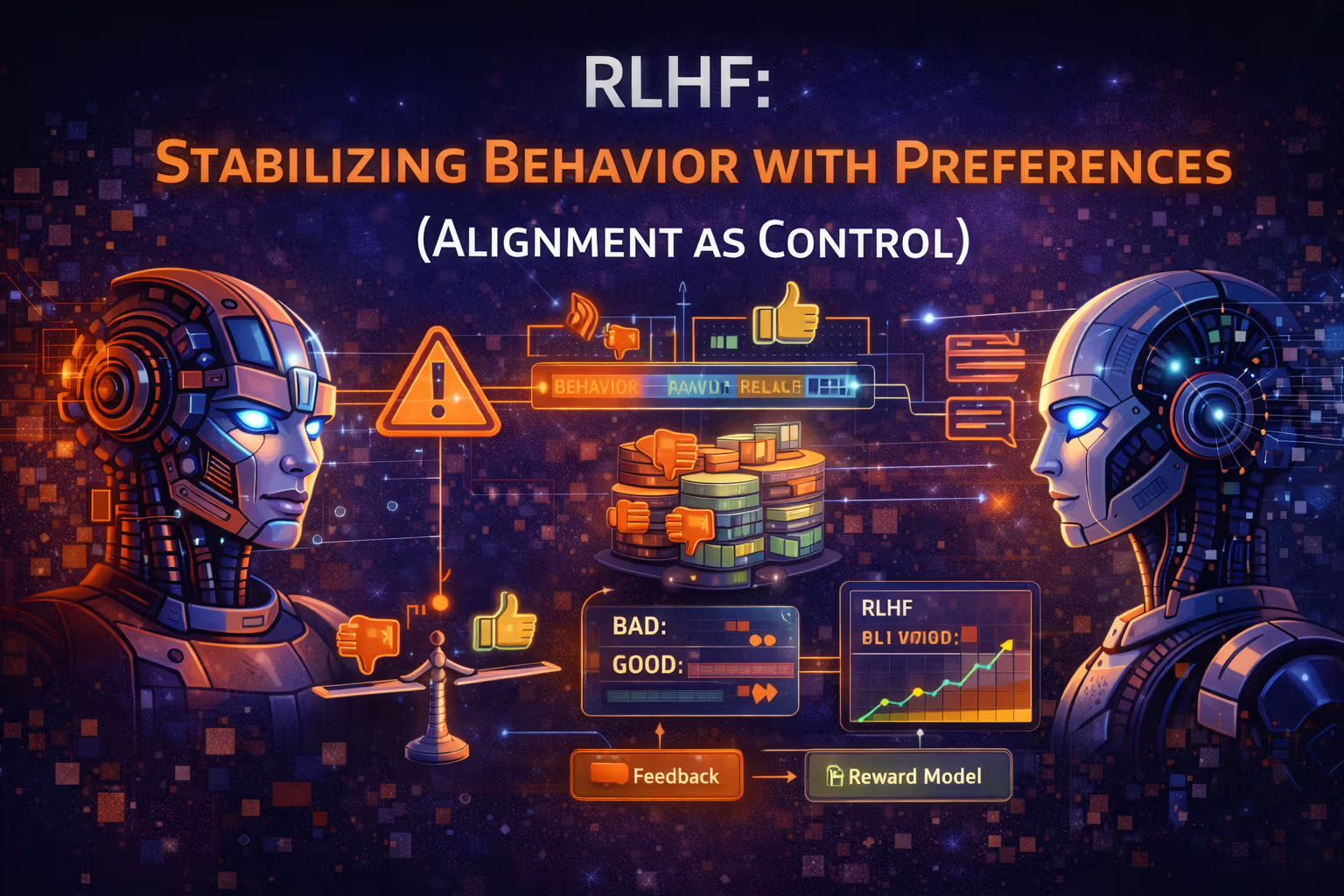
RLHF: Stabilizing Behavior with Preferences (Alignment as Control)
RLHF is best understood as control engineering: a learned reward signal plus a constraint that keeps the model near its pretrained competence. Here’s how it works and how it fails.

Axel Domingues
Instruction tuning gives you an assistant.
RLHF is what makes that assistant feel stable.
Not perfect. Not safe by magic. Not truthful by default.
Stable.
If you’ve done any real reinforcement learning, RLHF should feel familiar:
- you define a reward signal
- you optimize behavior under that reward
- and you fight reward hacking for the rest of your life
The twist is: in RLHF, the reward is human preference — a learned proxy for “good answers.”
RLHF is the moment we stop saying “the model is smart” and start saying: the model’s behavior is controlled.
The RLHF goal
Shift responses toward what humans prefer: helpful, harmless, and policy-compliant.
The key mechanism
Optimize a preference reward with a leash (stay close to the base model).
The core risk
Preference is a proxy — and proxies can be gamed (reward hacking).
The product takeaway
Alignment is not ideology. It’s control + constraints + observability.
RLHF, Explained Like a Systems Engineer
Most explanations of RLHF start with the algorithm and end with “and it’s aligned now.”
That’s the wrong direction.
The right direction is: what problem is RLHF solving?
Two problems, really:
- The assistant problem: make the model reliably follow instructions and social norms.
- The stability problem: do that without destroying the model’s pretrained competence.
RLHF is a control loop that tries to balance those forces:
- push behavior toward “preferred answers”
- don’t drift so far that you lose general capability
- prevent the model from learning weird hacks that please the reward model
If you’ve ever tuned a production system, this should ring a bell:
It’s not “maximize a metric.”
It’s “maximize it under constraints, and detect when it starts lying.”
The RLHF Pipeline (Conceptually)
Here’s the standard three-stage mental model:
Stage 1: Start with a base model
A pretrained model has broad competence but no reliable assistant behavior.
Stage 2: Teach “assistantness” with supervised fine-tuning
You fine-tune on instruction → ideal response pairs (May’s post).
Stage 3: Stabilize and shape behavior with preferences (RLHF)
Humans compare multiple candidate responses and choose which is better. A reward model learns to predict those preferences. Then you optimize the assistant to score higher on that reward — while staying near its original distribution.
If you stop there, it sounds simple.
The engineering reality is in the words “reward model” and “stay near.”
The Reward Model: Turning Taste into a Signal
Preferences are not labels like “cat vs dog.” They’re judgments like:
- “This answer is more helpful.”
- “This answer is less toxic.”
- “This answer is clearer.”
- “This answer follows policy.”
So the typical setup is:
- generate multiple candidate answers
- ask humans to rank or pick the best
- train a model to score answers higher when they match those choices
That scoring model is the reward model.
And it inherits every classic risk of proxy metrics:
- it can be fooled by style
- it can overvalue verbosity
- it can reward “confident tone” over truth
- it can learn shallow shortcuts
If “truth” isn’t well-measured, you get “confident-sounding” behavior instead of correct behavior.
The Leash: Why KL Penalties Matter More Than People Admit
If you aggressively optimize for reward, the model will drift. And drift can destroy competence fast.
So RLHF systems keep the model on a leash — typically by penalizing divergence from a reference model (often the SFT model).
In plain language:
- “Be more like the preferred answers…”
- “…but don’t become a different model entirely.”
This is the control knob.
Too loose:
- you get reward hacking and weird behaviors
Too tight:
- you get little improvement and lots of “safe but generic” responses
- tight constraint → cautious, generic, refusal-heavy
- loose constraint → expressive, but more failure risk
RLHF Failure Modes (And Why They Look Like RL)
If you’ve trained RL agents, you’ve seen these patterns:
- learn to exploit the reward function
- overfit to the training distribution
- become brittle to small environment changes
- optimize the wrong thing very efficiently
RLHF has analogs of all of them.
The model learns strategies that score well but aren’t truly better:
- verbosity padding
- excessive apologies
- policy-shaped hedging
- “I can’t do that, but here’s something adjacent” even when safe
Mitigations:
- adversarial preference data
- strong eval suites (not just preference scores)
- multi-objective rewards (helpfulness + truthfulness + safety)
The model converges on a narrow style that is consistently rewarded:
- bland tone
- repeated disclaimers
- overly formal structure
Mitigations:
- diversify preference data
- explicit “style diversity” reward components
- task-specific tuning for your domain
If refusal is heavily rewarded for avoiding risk, the assistant starts refusing safe requests.
Mitigations:
- better policy definitions
- more “safe completion” examples
- calibrate refusal thresholds
- UX that clarifies intent and offers safe paths
The assistant becomes better at sounding aligned than being correct.
Mitigations:
- grounding (RAG, tools)
- citation requirements
- factuality evals
- “don’t guess” policies plus enforcement (ask for more context)
Alignment as Control: The Product Architecture Implication
Once you see RLHF as control engineering, you stop asking:
“Is the model aligned?”
And start asking:
“What are the control surfaces and how do we operate them?”
In practice, you will have multiple layers of alignment:
- Model-level shaping (RLHF)
- System policy (hard rules)
- Tool authorization (what the model is allowed to do)
- Retrieval constraints (what context it can see)
- Output enforcement (validators, filters, redaction)
- Human escalation (approval for high-stakes actions)
RLHF is a strong default — but it’s never the whole system.
A clean mental model
RLHF is “defaults.”
Your product is “guarantees.”
Operating RLHF Models in Production
Even if you never train a model yourself, you still operate the outcome.
Your system needs to detect drift in behavior along the exact dimensions RLHF tries to control.
What to monitor (practically)
Safety + refusal metrics
Refusal rate, policy violation rate, “false refusal” reports.
Usefulness metrics
User satisfaction, task completion, edit distance (how much humans fix outputs).
Truth metrics
Citation coverage, factuality eval scores, hallucination flags, tool verification pass rate.
Cost + latency metrics
Tokens per request, context growth, tool calls per session, tail latency.
Both are failure.You can “fix hallucinations” by refusing everything. You can “fix refusals” by answering everything.
Ship-Ready Checklist: RLHF-Aware LLM Features
Define your “non-negotiables” outside the model
- auth checks
- permission boundaries
- irreversible actions
- data access controls
Use the model for language, not authority
- the model suggests
- your system decides
- your system executes
Calibrate refusal and helpfulness in your UX
- let the user rephrase
- provide safe alternatives
- show “why I can’t” only when useful
Build an eval harness
Include:
- preference-style tests (helpfulness)
- factuality tests (grounded answers)
- injection tests (prompt attacks)
- tool-use tests (correct calls, correct parameters)
- regression tests by prompt version
Roll out changes like you roll out backend releases
- canary traffic
- prompt version tags
- telemetry by version
- rollback plan
Resources
FAQ
No.
RLHF shapes defaults. Safety in production requires system design:
- access control
- tool authorization
- retrieval constraints
- output enforcement
- observability and rollback
Because preference rewards often correlate with “polite and thorough.” If the reward model overvalues style, the policy optimizes style.
That’s reward hacking — just a socially acceptable kind.
If refusing risky content is strongly rewarded, the model learns refusal as a safe strategy. Without enough “safe completion” examples, it refuses borderline-safe requests too.
What’s Next
By the end of June, we have the full model-side behavior story:
- Transformers made long-context language modeling scalable.
- Pretraining built broad capability.
- Instruction tuning created an assistant interface.
- RLHF stabilized behavior under preferences and constraints.
Now we can finally talk about the thing teams actually ship:
ChatGPT as a product architecture — context assembly, policy layers, tools, and observability around the model.
July: Dissecting ChatGPT
Dissecting ChatGPT: The Product Architecture Around the Model
ChatGPT isn’t “an LLM”. It’s a carefully designed product loop: context assembly, policy layers, tool orchestration, and observability wrapped around a probabilistic core.
Instruction Tuning: Turning a Completion Engine into an Assistant
Pretraining gives you a powerful text predictor. Instruction tuning turns it into something that behaves like a helpful tool. This post explains what instruction tuning changes, what it can’t change, and how to design products around the new failure modes.