HTTP as a Distributed Systems API (Without the Buzzwords)
HTTP isn’t just “how browsers talk to servers.” It’s a mature distributed-systems contract with semantics for caching, retries, concurrency, intermediaries, and evolution. If you design APIs without those semantics, production will teach you them anyway.

Axel Domingues
Last month we talked about the web’s “compression algorithm”: how the industry keeps moving work between server → client → server again (SSR) → edge to satisfy new constraints.
This month is the substrate that makes every one of those eras possible:
HTTP.
Not as “requests and responses.”
As a distributed systems protocol that:
- runs through multiple intermediaries you don’t control
- can be cached, replayed, delayed, reordered, and partially observed
- will fail in ways that look like your bug, even when they aren’t
- and has a set of semantics that—when respected—make systems boringly reliable
If you ignore those semantics, you don’t get to avoid them.
You just get to learn them during an incident.
Give you a practical mental model and a set of checklists so you can design HTTP APIs that survive:
- real networks
- real clients
- real caches and proxies
- real rollouts
- real security constraints
HTTP, in one sentence
HTTP is a message protocol with semantics designed for an ecosystem of intermediaries.
That ecosystem matters.
Because your “client → server” diagram is almost never true in production.
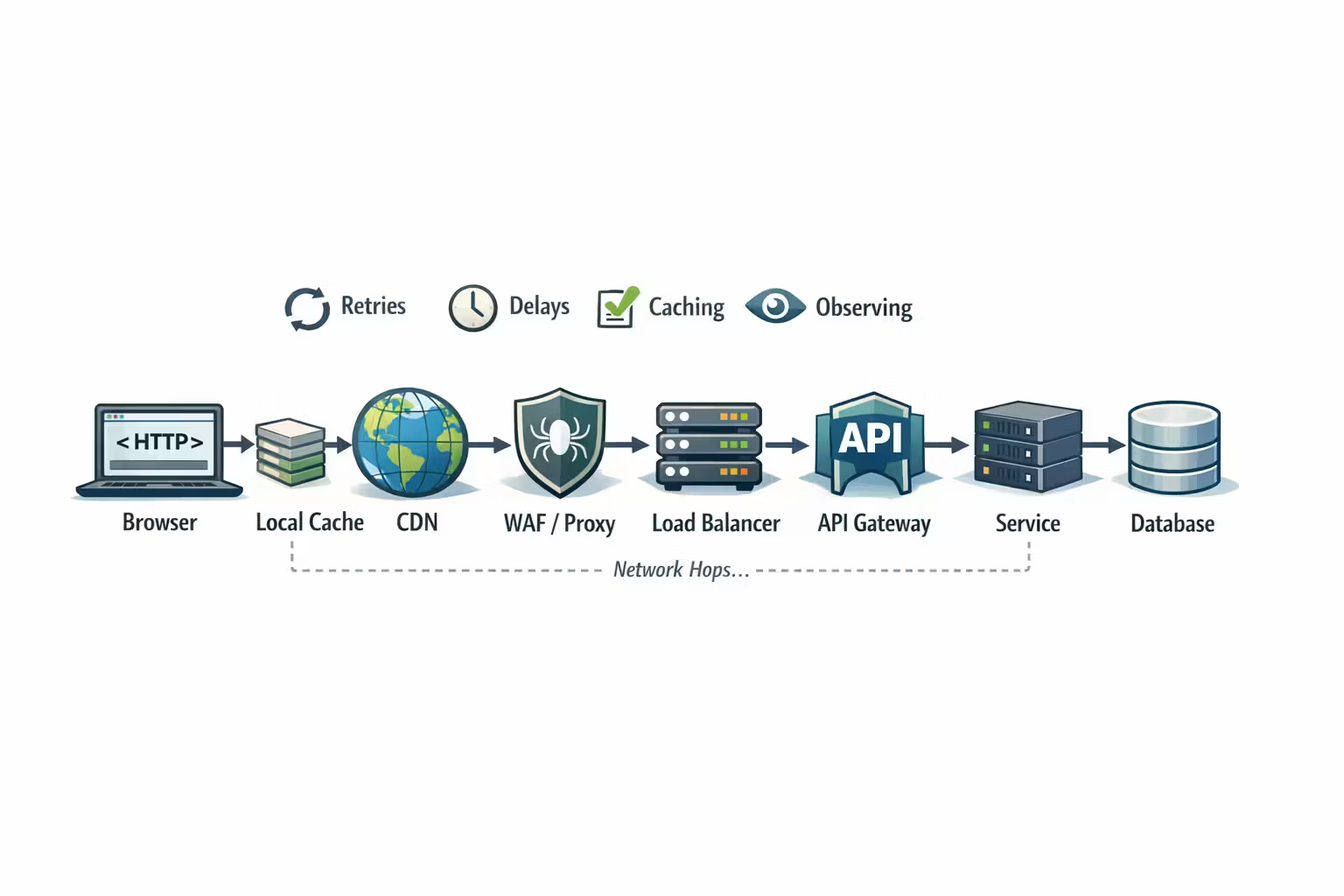
The mental model: the HTTP request graph
When you send a request, you don’t hit “the server.”
You traverse a graph.
- browser cache
- service worker (maybe)
- corporate proxy (maybe)
- CDN
- WAF / bot protection
- load balancer
- reverse proxy
- API gateway
- your service
- upstream services
- caches
- databases
Each hop can:
- change latency and timeouts
- cache responses
- block or rewrite headers
- retry or terminate connections
- apply rate limits
- record logs (or not)
So the right question isn’t:
“What does my server do when it receives a request?”
It’s:
“What semantics does my system promise when the request graph behaves like the real internet?”
Mini-glossary (the only words we’ll use)
- Safe method: an HTTP method that is intended to be read-only (no state change), e.g. GET.
- Idempotent method: repeating the same request produces the same state result (even if the response differs), e.g. PUT, DELETE (in intended semantics).
- Cacheable response: a response intermediaries are allowed to store and reuse under rules.
- Conditional request: a request that says “only send me the body if it changed” (e.g., using ETag).
- Deadline: a time budget for the whole operation, not just one hop.
- At-least-once delivery: the reality that a request may be processed more than once due to retries/timeouts.
If you’re thinking “this is distributed systems vocabulary,” yes.
That’s the point.
The four semantics HTTP gives you “for free” (if you respect them)
HTTP isn’t just bytes over TCP.
It gives you semantics that you can build systems on top of—if you stop fighting them.
Method semantics
Safety + idempotency determine what can be retried, cached, and replayed.
Caching semantics
Cache-Control, validators (ETag), and Vary let you scale reads without lying.
Status semantics
Status codes tell clients and intermediaries what happened and what to do next.
Content semantics
Representation, negotiation, and headers let you evolve contracts without breaking everyone.
In practice, teams mostly learn these semantics only after they shipped an API that violates them.
Let’s not do that.
1) Method semantics: the fastest way to avoid duplicate money
Here’s the rule architects keep in their pocket:
The retry rule
If an operation can be retried, it must be safe or idempotent (or have an idempotency key).
Why? Because timeouts aren’t “didn’t happen.”
Timeout means:
- the client didn’t get a response in time
- the server may still be processing
- the response may have been lost
- an intermediary may retry
So if you design an endpoint like this:
POST /charge-card
…and it’s not idempotent, you just wrote a payment duplication bug.
A practical method guide (that survives meetings)
Use for resource retrieval and queries.
Design expectations
- safe (no state change)
- should be idempotent
- may be cached (with correct headers)
Common mistakes
- using GET to trigger side effects (“track view”, “send email”)
- leaking sensitive data into URLs
Use when the server assigns identity or the action is non-idempotent by default.
Design expectations
- not idempotent unless you design it to be
- must be safe to retry with an idempotency key for important actions
Good patterns
POST /ordersto create a new orderPOST /orders/{id}/submitas a command (explicitly a state transition)
Use when the client knows the resource identity and sends the full desired state.
Design expectations
- idempotent (repeat should converge)
- good for “set this exactly” behavior
Common mistakes
- partial updates via PUT without documenting merge semantics
Use for partial updates when replacement is wasteful.
Design expectations
- may or may not be idempotent depending on patch semantics
- document whether patches are merge-based or operation-based
Common mistakes
- undocumented patch formats
- non-repeatable patches that break retries
Design expectations
- calling DELETE twice should not break anything
- response codes may differ (200/204 vs 404), but the state should converge
Common mistakes
- “soft delete” semantics that aren’t documented
- deletes that trigger cascading side effects without idempotency planning
We’re not choosing verbs for style.
We’re choosing semantics that define retry safety, caching, and operability.
2) Caching semantics: how you scale reads without inventing chaos
Caching is not an optimization.
Caching is a feature that:
- changes correctness
- changes cost
- changes failure modes
HTTP gives you a caching language. Use it.
The caching layers you actually have
Browser cache
Fastest path. But can be polluted by auth and shared devices if mishandled.
CDN / edge cache
Your biggest scalability lever for public content and stable resources.
Reverse proxy cache
Great for shielding origins, but needs strong cache key discipline.
Application cache
Redis/memory caches. Powerful, but now you own invalidation and coherence.
A safe default for caching posture
If you’re unsure, start with:
- Public content: cacheable, explicit TTL, validators, safe
Vary - Personalized/auth content:
Cache-Control: privateorno-storeuntil proven safe
It’s serving the wrong user’s data. That’s how performance incidents become security incidents.
Conditional requests (ETag) are the underrated superpower
Conditional requests let clients and CDNs ask:
“Has this changed?”
Without refetching the whole payload.
That’s how you reduce bandwidth and improve perceived speed while keeping correctness.
The practical win
ETags + 304 responses are a bandwidth and latency reducer that also improves stability under load.
- Decide: public vs private vs no-store for every response type.
- Define cache keys intentionally (URL + relevant headers via
Vary). - Avoid caching personalized responses at shared layers unless you can prove it’s safe.
- Prefer validators (ETag / Last-Modified) for frequently accessed resources.
- Be explicit about TTLs; “defaults” vary across intermediaries.
- Test your cache behavior in staging with real headers and real proxies/CDNs.
3) Status semantics: a contract between you and the ecosystem
Status codes aren’t for humans.
They’re signals to:
- clients
- SDKs
- proxies
- caches
- retriers
- observability tools
A few status patterns separate “clean systems” from “painful systems.”
2xx — success with meaning
Return 201 for creation, 202 for accepted async work, 204 for empty success.
4xx — client action required
Use 400/401/403/404/409/422 intentionally to communicate what to fix.
5xx — server fault (and retriable signals)
Differentiate “try again later” vs “we’re broken” with your error policy.
429 — throttling
Rate limits need contracts (headers, retries, budgets), not surprise failures.
The two status codes that unlock production systems
- 202 Accepted: “We accepted the request, work continues asynchronously.”
This is how you avoid holding connections open for long workflows. - 409 Conflict: “Your request is valid, but conflicts with current state.”
This is how you avoid silent overwrites and race-condition chaos.
If clients can’t distinguish:
- invalid request
- unauthorized
- conflict
- temporary failure
- permanent failure
4) Timeouts, retries, and the lie of “network errors”
HTTP failures are not binary.
They’re ambiguous.
The production truth
- The client times out.
- The server might still finish.
- The client retries.
- The server processes twice.
- You get a “random” duplicate.
- Everyone blames the database.
This is why method semantics + idempotency are architecture concerns.
The “retry budget” pattern
Retries should be designed like spending money:
- you have a budget
- you have rules
- you stop before you bankrupt the system
Retry design rule
Retries must have a limit, backoff, and jitter—or they become a denial-of-service you wrote yourself.
Step 1 — Set deadlines, not just timeouts
A single hop timeout is not enough.
Define a deadline for the whole request path (client → edge → origin → upstreams). Every layer must honor it.
Step 2 — Retry only when you can prove it’s safe
- Safe/idempotent methods can retry (GET/PUT/DELETE by semantics)
- POST/PATCH must be designed for retries (idempotency keys)
- Never retry “unknown” failures blindly
Step 3 — Backoff + jitter
If thousands of clients retry on the same schedule, you create synchronized load spikes.
Backoff spreads load. Jitter prevents thundering herds.
Step 4 — Observe the retry rate
Retry rate is an SLO smell. If it climbs, you’re masking a deeper reliability issue.
When a dependency slows down:
- clients retry
- traffic multiplies
- dependency slows down more
- the system collapses
Design your API like an ecosystem, not an endpoint
Now we combine the pieces into a practical design posture.
The architecture posture
Design HTTP APIs assuming intermediaries exist, clients retry, caches cache, and failures are ambiguous.
A production-grade HTTP API checklist
Semantics
- Methods chosen for safety/idempotency, not “style”.
- Idempotency keys for actions that must not duplicate.
- Conflict handling (409) for concurrent updates.
Caching
- Explicit cache policy for every response type.
- Public vs private vs no-store is intentional.
- Validators (ETag) used for high-traffic resources.
Varyis explicit and safe.
Errors
- Error bodies are structured and stable.
- 4xx codes guide corrective client behavior.
- 5xx codes indicate retriable vs non-retriable failure policy.
Resilience
- Deadlines enforced.
- Retries have budgets + backoff + jitter.
- Rate limiting is contractual (429 + headers if you use them).
Security
- Auth/private responses are not accidentally cached publicly.
- Sensitive data is not placed in URLs.
- TLS everywhere; security headers in place.
The failure modes you’ll see in production (and what they usually mean)
These are the ones I keep seeing across teams and companies.
Typical root cause
- POST actions not protected by idempotency keys
- client retries after timeout
Fix
- idempotency keys + server-side dedupe
- move long work behind 202 + async processing
Typical root cause
- caching personalized content in shared caches
- missing or incorrect
Varybehavior
Fix
private/no-storewhere needed- strict cache keys and explicit
Vary - separate public and authenticated origins/routes
Typical root cause
- intermediaries rewriting headers
- CORS / cookies behaving differently
- missing timeouts / different defaults
Fix
- test through realistic proxies/CDN in staging
- explicit headers, explicit timeouts, explicit policies
Typical root cause
- retry storms
- no budgets, no backoff, synchronized clients
Fix
- retry budgets, backoff+jitter
- circuit breakers and load shedding where appropriate
The takeaway: HTTP is already the contract you need
A lot of “microservices architecture” debates happen because teams skip fundamentals.
But HTTP already solved many system-level concerns at the protocol level:
- caching
- intermediaries
- semantics for safe retries
- signals via status codes
- evolvable representation patterns
When you respect HTTP semantics, your system becomes easier to:
- scale
- debug
- evolve
- and operate
When you ignore them, you’ll re-invent them—badly—inside application code.
February takeaway
HTTP is not “transport.” It’s distributed systems semantics that you either use intentionally or learn painfully.
Resources
MDN — HTTP Overview
A pragmatic, developer-friendly guide to methods, headers, caching, and status codes.
HTTP Semantics (RFC 7231)
The canonical semantics: methods, status codes, negotiation—useful when you need “the source of truth”.
FAQ
Not really.
This is about HTTP semantics—which REST uses, but which also apply to “RPC-ish” APIs.
You can build a pragmatic API style and still benefit from:
- idempotency rules
- caching rules
- status code signals
- deadlines and retry safety
No.
But you do need consistency and clarity—especially for:
- 401 vs 403
- 404 vs 409
- 429 and retry behavior
- 202 for async work
Status codes are less about purity and more about client behavior under failure.
Treat ambiguity as normal.
Assume:
- requests can be retried
- responses can be cached
- intermediaries exist
- timeouts don’t mean “didn’t happen”
Then design your operations so repeating them doesn’t break the world.
What’s Next
HTTP is the contract.
Next month we talk about the runtime that consumes it:
Browser Reality
Because once you understand HTTP semantics, your next most common production failures are no longer “API bugs.”
They’re timing and scheduling bugs—in the browser.
Browser Reality: The Event Loop, Rendering, and Why UX Bugs Look Like Backend Bugs
The browser is a constrained runtime with a scheduling problem: one main thread, many responsibilities, and users who notice missed frames. This post gives you the mental model to debug “random” UX failures as deterministic timing and contention issues.
The Web's "Compression Algorithm": Static → Web 2.0 → SPA → SSR/Edge
The web didn’t evolve because developers got bored. It evolved because latency, state, and economics kept forcing us to move responsibility between server, client, and edge. This post gives you the mental model and the checklist to choose the right rendering architecture in 2021+