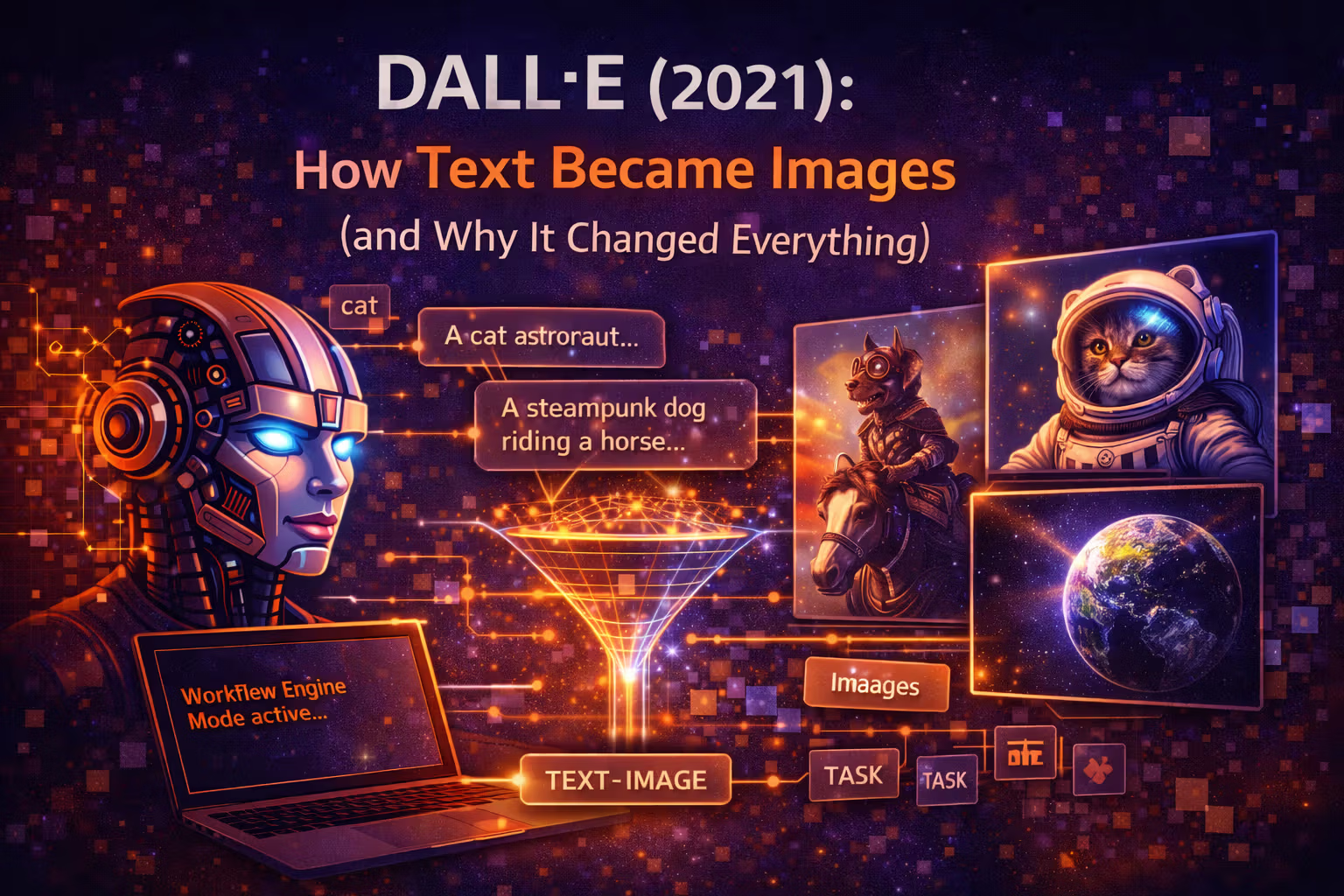
DALL·E: How Text Became Images (and Why It Changed Everything)
DALL·E wasn’t “just a cool generator.” It turned language into a control surface for visual distributions — and forced product teams to treat image creation like a probabilistic runtime with safety, latency, and cost constraints.

Axel Domingues
If ChatGPT made it obvious that language can be an interface, DALL·E made something bigger obvious:
language can be a control surface for an entire probability distribution.
Not a menu. Not a template. Not a form.
A sentence — a few tokens — can steer a model into producing an image that never existed before, in a style that never existed exactly like that, composed out of concepts that were never paired in training.
That’s why DALL·E matters even if you never ship image generation:
It’s the first mainstream proof that “prompting” is not a gimmick. It’s a new kind of software interface: natural language → probabilistic program → artifact.
And the moment you accept that, the architecture questions change:
- What is the “truth boundary” for generated media?
- How do you make outputs reproducible enough for production workflows?
- How do you prevent a generator from becoming a liability (safety, policy, IP, abuse)?
- How do you design latency/cost so it can actually ship?
This month is about the mental model and the product architecture — not the math.
The goal this month
Build a production-grade mental model for text-to-image: what the model is doing, why prompting works, and what breaks in real products.
The stance
Treat image generation as a probabilistic runtime: policy, safety, observability, cost, and reproducibility are part of the system.
The “aha”
DALL·E didn’t just generate pictures.
It made language a UI for visual distributions.
The practical outcome
A checklist for shipping: prompt contracts, moderation gates, caching, async jobs, storage, audits, and evaluation.
The mental shift: from “image editor” to “distribution steering”
Before DALL·E, most image software felt like this:
- start from an existing image
- apply deterministic operations (filters, layers, masks)
- get predictable output
DALL·E made image creation feel like this instead:
- write intent in language
- the system samples a distribution
- you curate from candidates
- you iterate by describing differences
That workflow is fundamentally different.
It looks a lot closer to:
- search
- compilation
- sampling
- human-in-the-loop selection
Which is why the right analogy is not “Photoshop.”
The right analogy is a probabilistic compiler for visual intent.
DALL·E is not “an image tool.”
It’s an interface that turns language into control signals for a generator.
What DALL·E (2021) actually did, in plain engineering terms
DALL·E is easiest to understand as a pipeline with three ideas:
- Make images representable as tokens
- Learn a joint model of text tokens + image tokens
- Sample image tokens conditioned on the text
No need for equations. Think in data structures.
1) Images became “a sequence” (tokenization for pixels)
The key unlock is to stop thinking of an image as “a grid of pixels” and start thinking of it as:
a compressible latent representation that can be expressed as a finite vocabulary
DALL·E used a discrete image representation so it could treat image generation as “next-token prediction,” just like language.
That’s the bridge:
- language models predict the next token
- DALL·E predicts the next image token (conditioned on text tokens)
2) Joint modeling: text and image share a common sequence space
Once you have tokens for both modalities, you can do the most powerful trick in modern ML:
train on a massive pile of paired examples.
Think:
- captions ↔ images
- alt text ↔ images
- messy internet data at scale
The model learns correlations like:
- “a red cube” implies a certain shape and shading distribution
- “in the style of…” implies composition and texture priors
- “on a beach at sunset” implies lighting and palette priors
3) Sampling: generation is search through a probability landscape
At inference time you do not “compute the image.” You sample from a distribution.
This matters because:
- there is no single “correct” image for a prompt
- diversity is a feature, not a bug
- your UI must support exploration and refinement
Text-to-image is stochastic by nature.
Your product must embrace that — with seeds, variants, and a selection loop.
Why text control works at all
Most people treat prompting as magic until it fails.
But there’s a simple mental model that survives the hype:
The prompt is a latent constraint, not a command
A prompt doesn’t “tell the model what to do.”
It biases the sampling distribution.
- Certain concepts become more probable
- Certain compositions become more probable
- Certain styles become more probable
And because the model has learned a huge latent manifold of visual structure, those biases can be surprisingly precise.
The model doesn’t understand — it correlates
This is the same lesson as hallucinations in language models:
- the model is not reasoning about truth
- it is sampling patterns consistent with training data
So prompts that are underspecified produce outputs that are “plausible by training priors,” not “faithful to your intent.”
That’s why:
- small prompt changes can drastically alter outputs
- negative constraints (“no text”, “no watermark”) are brittle
- compositional instructions can partially fail
The model is navigating a probability surface, not executing logic.
The “product loop” DALL·E introduced
DALL·E didn’t just introduce a model.
It introduced a new interaction loop:
- describe
- sample
- select
- refine
- repeat
That loop is the product.
And it’s why image generators feel magical when the UX supports the loop.
Describe
Natural language becomes the primary UI.
Users express intent, not parameters.
Sample
The system generates candidates, not “the answer.”
Diversity is the first feature.
Select
The user becomes the critic.
Curation is part of generation.
Refine
Iteration teaches the model what you mean (indirectly).
Not through training — through prompt steering.
Architecture: text-to-image as a service, not a demo
If you ship image generation, you’ll discover quickly:
The model is not the hard part.
The system around the model is the hard part.
Here’s the reference architecture I keep coming back to:
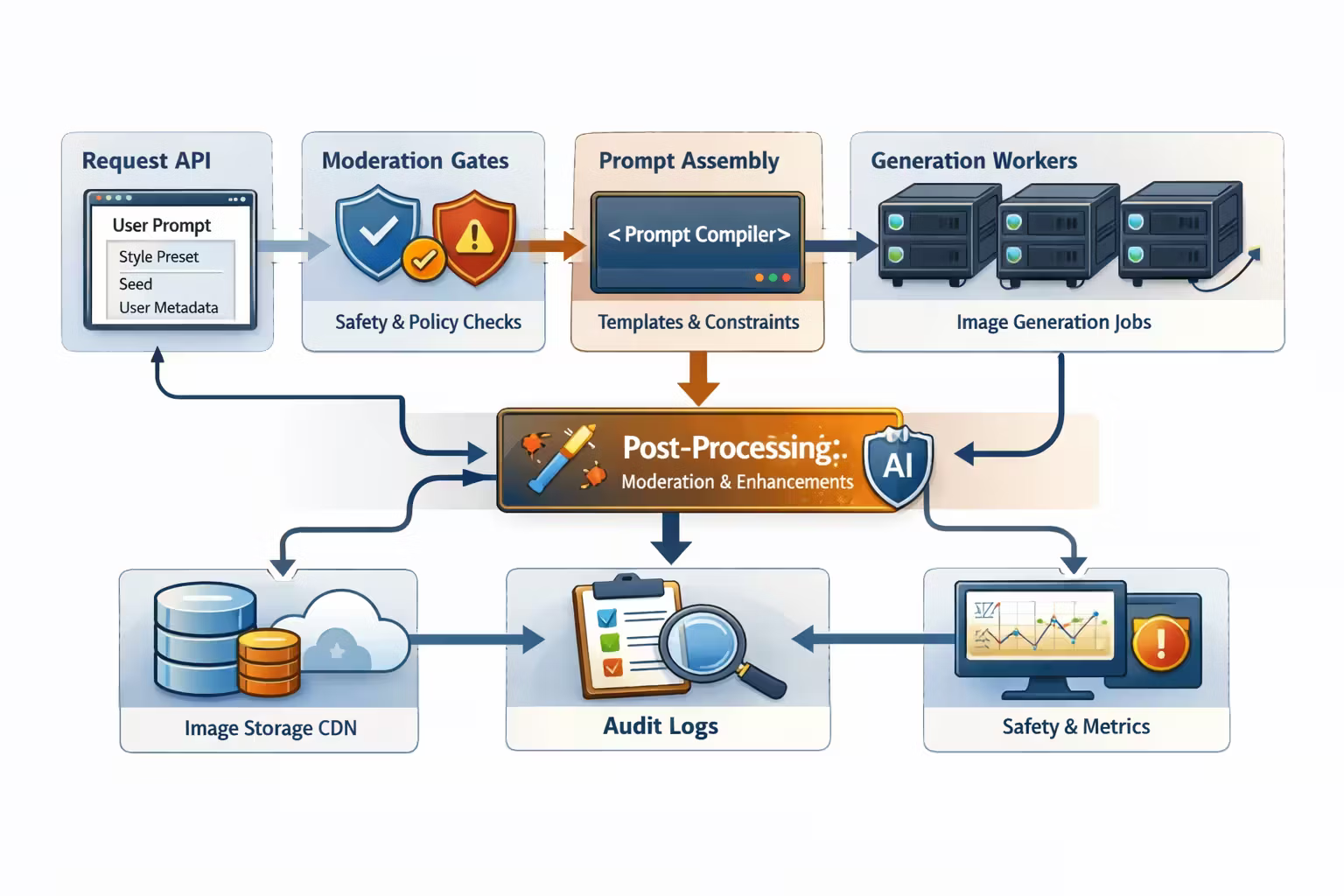
The pipeline at a glance
Accept the request (and define the contract)
A generation request is not “a prompt string.” It’s a contract:
- prompt text
- optional style preset (curated vocabulary)
- seed / reproducibility settings
- output size / count
- safety mode / user tier limits
- metadata (who, where, why)
Run input safety and policy checks
Before you spend GPU money:
- abuse detection / rate limits
- prompt moderation (disallowed content)
- policy transformations (strip unsafe patterns, enforce safe mode)
Assemble the final prompt (prompt compiler)
Treat prompt assembly as code:
- templates + system constraints
- style tokens
- negative constraints (carefully)
- user context (if any)
Dispatch a job (async by default)
Generation is expensive and can take seconds. Do it like any other long-running job:
- enqueue work
- return a job id
- stream progress or poll
Generate (workers with bounded concurrency)
Your “GPU workers” are a scarce pool:
- concurrency limits
- backpressure
- per-tenant quotas
- retries with idempotency
Post-process outputs
Common steps:
- run output moderation
- watermarking / metadata
- upscaling / variations
- thumbnail generation
Store and serve
Images are artifacts:
- object storage
- CDN
- signed URLs
- retention policies
- audit trails (who generated what)
The uncomfortable truth: “prompting” is an API design problem
Most teams start with a textbox.
That scales poorly.
Because language is underspecified, and your product needs:
- predictability
- controllability
- policy enforcement
- reproducibility
So you end up building what I call a prompt compiler.
The prompt compiler pattern
Instead of accepting raw prompts, accept intent + constraints:
subject(what)context(where/when)style(a controlled vocabulary)camera/lightingpresets (optional)constraints(no text, no watermark, safe mode)seed(reproducibility)
Then compile it into the string you actually send.
Give them a bounded, composable vocabulary: presets, toggles, and structured fields — with language as the glue.
Failure modes you should expect (and design for)
Text-to-image “breaks” in consistent ways.
Not because the model is evil. Because sampling from learned correlations has sharp edges.
Symptom: outputs look generic or drift toward stereotypes.
Why: the model falls back to high-probability priors.
Mitigation: add structured fields (subject/context/style), provide guided prompt scaffolds, and show examples.
Symptom: “a blue cube on a red sphere” becomes “two blue shapes.”
Why: composition is hard; the model approximates constraints.
Mitigation: iterative UI (variations), region editing (if available), and “constraint-aware” prompt templates.
Symptom: unwanted garbled text appears.
Why: training data includes watermarks, posters, memes; the model learns “text as texture.”
Mitigation: post-processing filters, stricter templates, and user education: “avoid requesting logos unless needed.”
Symptom: the model ignores your style and produces a popular aesthetic.
Why: dominant styles have strong priors.
Mitigation: curated style tokens, reference images (where supported), and stronger “style first” prompt assembly.
Symptom: disallowed content slips through or is requested indirectly.
Why: adversarial prompts, ambiguity, and context tricks.
Mitigation: input + output moderation, policy layers, rate limits, abuse monitoring, and auditability.
You design around stochastic failure with constraints, moderation, and workflows.
Reproducibility: the difference between toy and tool
In production, you will hear a sentence that kills demos:
“Can we get the same one again?”
So treat reproducibility as a first-class product feature:
- store the exact prompt used (after compilation)
- store the seed (where supported)
- store model/version identifiers
- store safety settings and post-processing steps
And expose it in the UI:
- “re-run”
- “generate variations”
- “use as base”
Because users don’t want a vibe.
They want a workflow.
Cost and latency: the physics you can’t ignore
Image generation is expensive. Not “cloud expensive.” physics expensive.
So you need architecture discipline:
The knobs you actually have
- batching: group requests if your worker stack supports it
- caching: cache the result for repeated job ids / same request signatures
- quotas: per-user and per-tenant limits
- async UX: job-based flows, not blocking HTTP
- progressive delivery: thumbnails first, upscale later
- tiering: different speed/quality by plan
Don’t block HTTP
Treat generation as a job.
A synchronous request path is a denial-of-service invitation.
Tier the experience
“Fast draft” vs “final render” is a business model and a reliability strategy.
Safety is not a filter — it’s a system
A lot of teams think of safety as:
“run moderation on the prompt.”
That’s insufficient.
Safety in generative media is a multi-stage control system:
- input checks (prompt moderation)
- policy transformations (safe mode constraints)
- output checks (image moderation)
- rate limits and abuse patterns
- audit logs for compliance
- user reporting loops
And — crucially — human review paths for edge cases.
If you’re a tech lead, your question should be:
“Where is the control plane for this capability?”
Because the model is not where governance lives.
What DALL·E changed (beyond images)
DALL·E is a case study in a broader architecture truth:
When a model can generate artifacts, software becomes orchestration.
The product value shifts from:
- “we have a model” to
- “we have a workflow that makes the model useful and safe”
That’s the same arc we’ve been tracing all year:
- July: ChatGPT is a product architecture around a model
- August: hallucinations are probabilistic failures, not moral defects
- September: RAG is grounding + evaluation, not vibes
- October: tool use turns models into workflow engines
- November: images prove that language can steer entirely different modalities
And the next step is obvious:
When you combine generation + a great iteration loop, you get products that feel like magic.
That’s where Midjourney enters.
Resources
DALL·E — Zero-Shot Text-to-Image Generation
The original DALL·E research write-up: the “text + image tokens” framing that made the whole thing click.
CLIP — Language-Image Pretraining
A key companion idea: learning aligned representations of images and text at scale — foundational for making “text understands image” feel real.
FAQ
Because the prompt is a probabilistic constraint, not a program.
Some constraints are weakly represented in training data, some concepts conflict, and the model often satisfies the dominant cues first (style, composition priors, common objects).
That’s why a refinement loop (variations, edits, seeds) is a core product feature.
Treating it like a synchronous API call.
Generation is expensive, spiky, and failure-prone. If you don’t design it as an async job system with quotas, retries, and auditability, you’ll get reliability incidents and runaway cost.
Don’t rely on raw prompts.
Build a prompt compiler: structured fields + curated style vocabulary + constraints → compiled prompt string.
Users still feel like they’re “prompting,” but you’ve bounded the space enough to deliver consistent behavior.
What’s Next
DALL·E proved a capability.
But Midjourney proved something even more product-critical:
a generator can feel like a creative partner if the iteration loop is fast, legible, and addictive.
Next month:
Midjourney and the Product Loop.
We’ll dissect how UX, community, and feedback loops turn a probabilistic sampler into a product people can’t stop using.
Midjourney and the Product Loop: Why Some Generators Feel Magical
Diffusion models made image generation possible. Midjourney made it feel addictive. The difference wasn’t just the model — it was the product loop: fast iteration, visible search, and UI as a steering system for probability.
Tool Use and Agents: When the Model Becomes a Workflow Engine
Tool use is not “prompting better” — it’s turning an LLM into a controlled orchestrator of deterministic systems. This month is about the architecture, safety boundaries, and eval discipline that make agents shippable.