Tabular RL - When Value Iteration Feels Like Cheating
Tabular RL is the last time reinforcement learning feels clean. Values become literal tables, planning becomes explicit, and the “aha” moments arrive fast.

Axel Domingues
February was brutally honest.
Bandits forced me to face the simplest RL truth:
you can’t learn without paying an exploration tax.
But bandits also have an escape hatch:
There’s no state. No dynamics. No long-term consequences.
So March is where RL starts to feel like reinforcement learning in the way people mean it:
- actions change the state you end up in
- rewards can be delayed
- good behavior requires planning across multiple steps
This is the month where value functions stop being abstract, and become something I can literally print out and inspect.
And honestly?
The first time I ran value iteration it felt like cheating.
The problem shape
What an MDP is, in plain English — and why structure makes planning possible.
Why it feels like cheating
Value iteration isn’t trial-and-error.
It’s solving a world when the rules are known.
What “value” really means
State value, action value, and the intuition behind advantage-like thinking.
The first real forks
Monte Carlo vs TD.
SARSA vs Q-learning.
Where learning philosophy starts to matter.
The “MDP” Moment: When the Problem Finally Has Shape
In January, the RL loop felt like an interface.
In February, it felt like uncertainty.
In March, it finally felt like a structured problem.
The structure is simple to describe:
- there are states you can be in
- there are actions you can take
- actions move you to new states (often with randomness)
- rewards show up along the way
- the goal is to learn behavior that produces good long-term outcomes
This structure is what makes “planning” possible.
And it’s also what makes the next year of Deep RL make sense:
Deep RL is mostly “tabular RL, but the table is too big to store.”
Values are tables. Policies are tables. Transitions are tables.
It’s RL at human scale.
Why Value Iteration Felt Like Cheating
I expected learning to feel like training:
- trial and error
- gradual improvement
- noisy curves
But value iteration feels like this instead:
- define the rules of the world
- compute what “good” means everywhere
- instantly extract the right behavior
It feels less like learning and more like compiling.
And that’s exactly the point:
Value iteration is not “learning from experience.”
It’s solving the environment when you already know its dynamics.
That helped me build a clean mental separation:
Planning
You know the environment’s rules.
You compute the best behavior directly.
Learning
You don’t know the rules.
You must discover good behavior through interaction.
Most of the time in real RL, we’re in the second bucket.
But starting with the first bucket made everything else less mysterious.
The Three Ways “Value” Showed Up This Month
The word “value” is overloaded.
March is where I finally stopped treating it as a vague concept.
Here’s how it showed up clearly:
- State value: “How good is it to be here?”
- Action value: “How good is it to do this here?”
- Advantage-like thinking (even if I didn’t call it that yet): “Is this action better than my baseline expectation?”
Once I saw values as simple scores attached to states and actions, RL became much easier to reason about.
The Core Loop I Kept Repeating Mentally
This was the mental loop that clicked again and again:
A state is only meaningful through its futures
A state isn’t “good” or “bad” by itself. It’s good or bad because of what it tends to lead to.
Value is how you bring the future into the present
Value is your compressed belief about downstream consequences.
A policy is just a choice rule over actions
Given your current beliefs (values), choose the action that leads to the best future on average.
Learning is improving beliefs so the choice rule improves
If values are wrong, the policy will be wrong — even if the agent is “trying.”
That’s it.
Everything else this month felt like different ways of making that loop work under constraints.
The Environment That Made It Real: FrozenLake
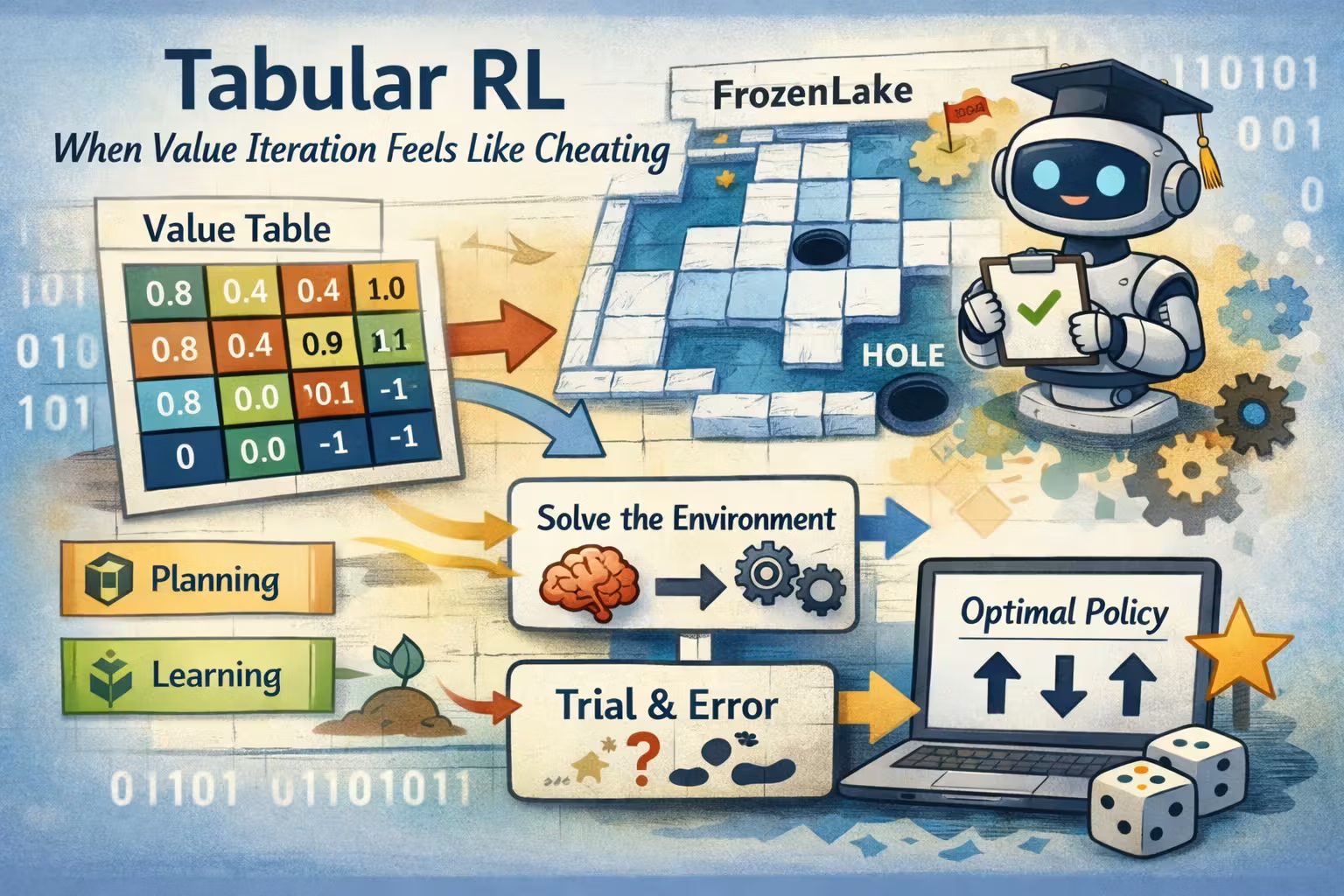
FrozenLake is deceptively simple:
- it looks like a tiny grid world
- there’s a goal state
- there are holes you fall into
- you want to reach the goal
But it also adds the first real “welcome to RL” detail:
slipperiness.
You try to move up, and the world says, “maybe.”
That one detail was enough to teach me two things:
- the best action is not always the one that looks best locally
- learning needs to handle uncertainty in transitions, not just reward noise
FrozenLake is small enough to reason about…
…but not so clean that it becomes fake.
- a table of state values: do “near-hole” states look worse?
- a policy-as-arrows view: do arrows point away from holes?
- where randomness matters: do “safe-looking” moves still have risk?
- termination handling: do hole states and goal state end episodes correctly?
Monte Carlo vs Temporal Difference: The First Real Fork in the Road
This was the big conceptual fork:
Monte Carlo (MC) thinking
“You learn by seeing full outcomes.”
- you run an episode
- you observe what happened
- you update your estimates based on the total outcome
This feels intuitive… and slow.
Temporal Difference (TD) thinking
“You learn while things are still unfolding.”
- you update based on partial progress
- you bootstrap from your current value estimates
This feels less intuitive… but it feels like the beginning of modern RL.
This month I started to understand TD as a powerful engineering tradeoff:
Temporal Difference is messy but fast.
And the “mess” is exactly what later becomes instability in Deep RL.
- episodes are short and meaningful
- you can afford to wait for outcomes
- you want simple, less bootstrapped reasoning
MC feels “honest” because it waits for reality to finish speaking.
- episodes are long
- you need faster learning signals
- you want to reuse partial experience
TD is an engineering trade: earlier updates, but now your estimates can chase their own errors.
SARSA vs Q-learning: Where On-Policy Became Concrete
I’d heard “on-policy” and “off-policy” in January.
But it was still abstract.
March made it concrete in the simplest way:
- SARSA learns about the behavior you actually follow
- Q-learning learns about a best-case future behavior, even if you’re not behaving that way yet
That distinction matters because it changes what you consider “truth” during learning.
- SARSA: “I want to evaluate the world under the behavior I’m actually executing.”
- Q-learning: “I want to evaluate the world under the best behavior I wish I were executing.”
I’m not going to pretend I mastered this in March.
But I did feel the difference:
- SARSA feels cautious and honest
- Q-learning feels ambitious and sometimes overconfident
And suddenly a lot of later Deep RL design choices make more sense.
What Actually Broke (My Debugging Notes)
Even in tabular RL, I still hit real breakage.
Just… in simpler forms.
Here are the most common failure modes I ran into mentally:
- confusing “more updates” with “better learning”
- forgetting that exploration changes what data you see
- mixing up episode termination handling (again!)
- assuming deterministic transitions when the env is stochastic
- evaluating with exploration still on (and blaming the algorithm)
You think you’re evaluating the learned policy, but you’re still injecting randomness through exploration.
This month reinforced a theme from January:
If you don’t control the interface, you don’t control the story.
The Most Important “Aha”: Values Are Debuggable
This is the part that made March feel like a gift.
In deep learning, if training is failing, you often stare at curves and guess.
In tabular RL, you can inspect the world:
- you can print a value table and see if it makes sense
- you can visualize a policy as arrows on a grid
- you can see where the agent thinks it’s safe vs dangerous
- you can see whether the agent’s beliefs match the environment
It’s the last time RL feels this transparent.
And I’m grateful for it.
The Mental Model I’m Taking Into Deep RL
This month gave me a map I want to carry forward:
The “table in my head” mental model
Deep RL is still trying to learn values and policies.
The only reason it looks different is because the “table” doesn’t fit in memory — so we approximate it with a model.
If I can’t explain what a deep agent is doing in tabular terms, I probably don’t understand it yet.
What’s Next
March made RL feel solvable.
But it also revealed the cliff I’m walking toward:
Tabular RL works because the state space is small enough to store beliefs as a table.
Real problems don’t fit in tables.
So next month I’m stepping into the uncomfortable middle ground:
function approximation.
Not deep networks yet — but the moment we replace a table with a model.
And if the pattern from 2017 holds…
that’s the moment stability starts to wobble.
FAQ
Because it’s closer to “solving” than “learning.”
If you know the environment dynamics, value iteration computes what good behavior looks like everywhere, without needing trial-and-error experience.
Monte Carlo updates from full outcomes after an episode finishes.
Temporal Difference updates during the episode by bootstrapping from current estimates. TD feels less clean, but it’s the foundation for most modern RL methods.
That values and policies are not mysterious.
Deep RL is still learning the same objects — it’s just forced to approximate them because the “table” is too big.
Function Approximation - The Day RL Stopped Being Stable
Tabular RL felt clean because you could see the truth in a table. The moment I replaced the table with a model, RL stopped being a neat algorithm and became a fragile system.
Bandits - The First Honest RL Problem
Bandits strip RL down to one tension—explore vs exploit—so I can stop confusing luck with learning and start building real intuition.