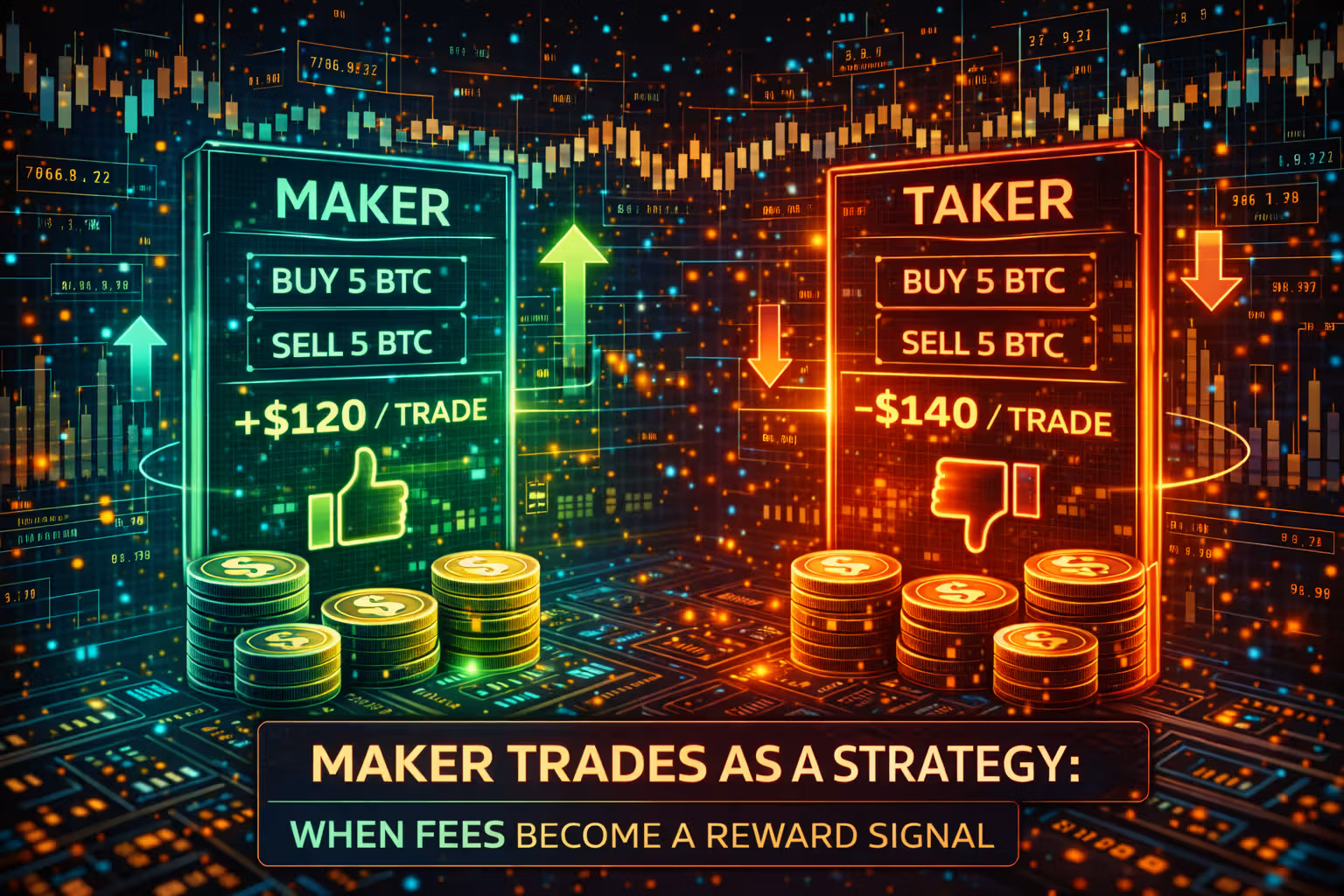
Maker Trades as a Strategy: When Fees Become a Reward Signal
In September 2020, I stop trying to be fast and start trying to be executable. The surprising result: in maker-style trading, fees aren’t a footnote — they can be the whole edge.

Axel Domingues
By September 2020 I had two painful truths on my desk:
- My agents were getting a "bull personality" because both training and validation were biased toward a bull regime. The backtests were impressive and also… not honest.
- Outages were real. If BitMEX gives you a 503 in the exact minute you "need" to trade, your strategy is not a strategy — it’s a fragile assumption.
So I started asking a different question:
What does a policy look like when execution is the constraint?
That question is what pushed me into maker-style behavior.
Maker vs taker: the hidden reward signal
On BitMEX, the market structure matters:
- Taker trades pay fees.
- Maker trades can receive rebates.
That sounds like a footnote until you run a high-churn strategy and notice that fees can dominate the entire PnL curve.
This is the exact kind of thing a pure price-only reward misses. If your reward is only "did price go my way", you train agents that:
- chase momentum,
- flip constantly,
- and fall apart when the exchange is stressed.
But if maker rebates exist, the world changes:
- placing good liquidity becomes a skill,
- the spread becomes a micro-reward,
- and "do nothing" becomes a valid action when the tape is toxic.
The bot already knew the rule: post-only or die
Before I tried to teach this to an agent, the real execution loop (“Chappie”) was already telling me what was safe.
In BitmexPythonChappie/BitMEXBotClient.py, orders are placed with BitMEX’s post-only instruction:
execInst='ParticipateDoNotInitiate'
That single flag encodes an entire philosophy:
- If the order would cross the spread and take liquidity, don’t place it.
- If you can’t be maker, be patient.
Turning fees into learning: the maker-shaped reward
The core idea of this month was simple:
Make the reward reflect what the live system is allowed to do.
If the bot is constrained to maker-style execution, the agent’s reward should learn that same constraint.
Here’s the reward spec I converged toward (v0):
Reward components (v0)
- PnL term (directional)
- Reward for favorable price movement while holding.
- Penalize adverse movement (but not so hard that the agent panic-flips).
- Fee / rebate term (execution-aware)
- Maker rebate is a positive add-on when a trade is executed as maker.
- Taker fee is a negative add-on when execution slips into taker.
The environment hint: fees were already first-class
One reason this clicked fast is that parts of my environment code already treated maker/taker as first-class parameters.
For example, in the HFT environment prototype (bitmex-hft-gym/.../bitmex_hft_env.py) the fee terms are explicit:
maker_fee_pct = 0.025taker_fee_pct = -0.075
Even if the HFT environment become a failure story, this part was a good artifact: it forced me to write down the fact that execution type changes reward.
Maker behavior is not "more trades" — it’s better trades
If you tell an agent "maker rebates are good" without guardrails, it will try to spin in circles.
So the learning goal became:
- low churn
- high-quality placements
- survive outages and bad fills
In practice, the "maker strategy" started to look like:
- place a limit near the bid/ask,
- wait,
- roll only when necessary,
- avoid urgent market-taking entirely.
That last point matters because it connects directly to the BitMEX reality:
- a taker strategy needs timing,
- timing fails under 503s,
- maker behavior tolerates delay because it’s designed around patience.
Fee-aware reporting: the moment I believed it
To avoid self-delusion, I added a fee-aware breakdown in the execution reporting.
The key line (conceptually) is:
- total fees contribution =
num_trades * abs(maker_fee_pct) * 2
Why * 2?
- one maker rebate on entry,
- one maker rebate on exit.
And then I started getting logs like this:
Short rolled over - prince (8695.500000) timestamp (2019-06-15 00:00:26.172225+00:00)
Long rolled over - prince (8674.000000) timestamp (2019-06-15 00:34:39.171643+00:00)
Long rolled over - prince (8666.000000) timestamp (2019-06-15 00:51:50.171991+00:00)
...
Short rolled over - prince (9047.500000) timestamp (2019-11-10 16:29:55.170885+00:00)
Short rolled over - prince (9012.000000) timestamp (2019-11-10 16:46:24.171960+00:00)
...
Total trades: 2777
Max open count: 10
Max drawdown: -18.157810
Total summed profit precentage: -80.688532
Total fees precentage: 138.850000
Total fees & profit precentage: 58.161468
This was the “oh” moment:
- purely on trade PnL, the strategy lost ~80% over the slow bear drift,
- but on maker rebates it generated ~138%,
- netting ~58% total.
And that wasn’t with perfect execution or magical alpha — it was simply what the microstructure made possible.
Spread capture vs adverse selection: the real maker tradeoff
Maker behavior is not free money. It’s a different risk profile:
- Spread capture: get paid for providing liquidity.
- Adverse selection: get filled right before price moves against you.
So reward shaping had to teach the agent to prefer:
- calm moments,
- good placement,
- low frequency,
…and to fear:
- placing into spikes,
- constantly rolling orders,
- getting trapped holding inventory in a one-way tape.
That’s also where my “bull personality” paranoia helped: maker rebates are a stabilizer, but they can also hide directional weakness if you don’t measure them separately.
Why this mattered for the next step: management-style environments
The maker-strategy idea exposed the next missing piece:
- Inventory matters.
At this point, a lot of my setups were still “entry-ish”:
- relatively coarse decisions,
- fixed sizing assumptions,
- and a focus on “should I be long or short”.
Maker trading forced me to admit that the real problem is position management:
- How long do I keep inventory?
- When do I reduce risk?
- How do I avoid churn while still adapting?
Which is exactly why the next article exists.
Repo pointers
Repository — bitmex-deeprl-research
The full project: environments, training loops, and the live “Chappie” execution client.
BitMEXBotClient (post-only execution)
Where the live constraint shows up: execInst='ParticipateDoNotInitiate' (maker-only intent).
FAQ
It can be, if you ignore fill realism. The point of this month wasn’t "rebates are free money" — it was: rebates are a real term in the reward, so the environment must model when you actually earn them.
Because taker-style strategies often depend on precise timing. Maker-style policies can tolerate delay: you place, wait, and accept that sometimes the best action is to do nothing.
I stopped treating costs as bookkeeping and started treating them as behavioral incentives. Reward shaping isn’t just about getting learning to converge — it’s about teaching the agent what reality will actually pay for.
What’s next
bitmex-management-gym: Position Sizing
Maker rebates made the strategy survivable.
Management is what makes it responsible.
bitmex-management-gym: Position Sizing and the First Risk-Aware Agent
After months of "all-in" agents with bull personalities, I rebuilt the environment to teach risk: stackable positions, time-awareness, and penalties that prevent reward-hacking.
Deep Silos in RL: Architecture as Stability (and the First LSTM Variant)
August 2020 - After the first live pain and the bull-personality problem, I stopped tuning "algorithms" and started tuning the network contract. Deep Silos beat flat MLPs, and the LSTM variant overfit fast.