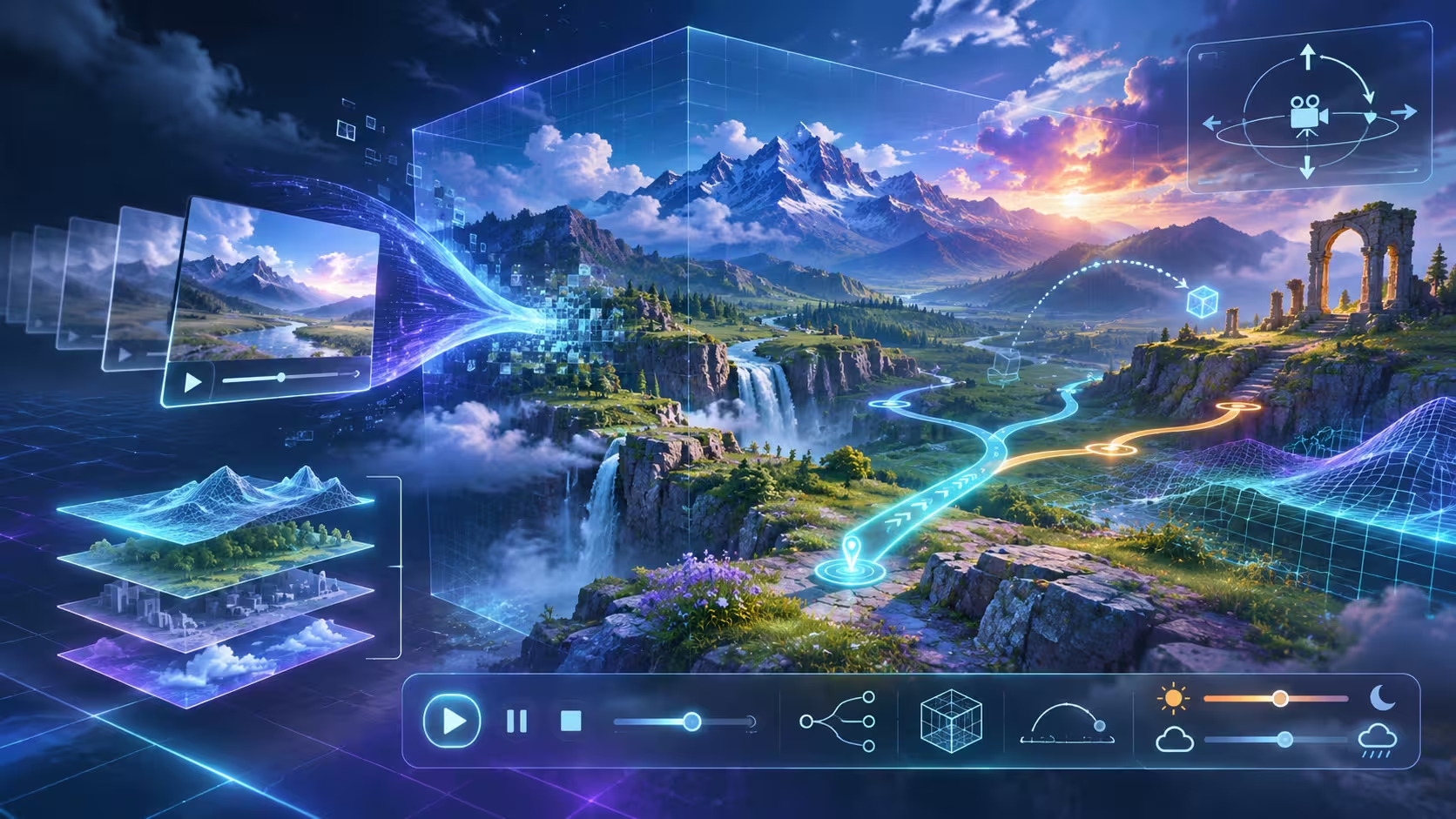
Genie 4: When AI Stops Generating Videos and Starts Simulating Worlds
Genie 4 turns generative video into an interactive world that responds to actions, edits, and events. Here is the engineering architecture behind action-conditioned simulation, Gemini-guided world generation, physical consistency, and the evaluation problems that matter for robotics and RL.

Axel Domingues
October’s AI story is a different kind of generative model.
We have spent years watching models produce increasingly convincing images and videos. The output gets better, the motion gets smoother, and the generated clip becomes harder to distinguish from footage.
But a video still has an important limitation:
It happens whether or not you do anything.
You can watch a generated person open a door. You cannot necessarily decide to leave the door shut, walk around the building, return five minutes later, and expect the world to remember where you left everything.
That is the problem Google DeepMind's Genie 4 is pushing toward: interactive world simulation.
Announced on October 27, 2026, Genie 4 generates audiovisual environments that can be navigated and changed in real time. Users can steer the camera and scene, introduce characters or weather changes with natural language, and observe an evolving world rather than a precomputed clip. DeepMind also describes Gemini models working alongside Genie to help plan and maintain coherent events. Source: Google DeepMind's Genie 4 announcement.
The architecture question is more interesting than the demo:
What changes when the model must simulate what happens because of an action, rather than merely generate what happens next?
That question connects generative media to causal modeling, reinforcement learning, robotics, real-time systems, and the old engineering problem of defining what counts as correct.
What changed
The user is no longer just a viewer. Actions and prompts steer the next state of a generated world.
The technical challenge
A world must preserve objects, space, history, and cause and effect as interaction continues.
The research opportunity
World models could produce diverse training and evaluation environments for embodied agents.
The reality check
Photorealism is not a physics guarantee. Plausible worlds can still teach false lessons.
The distinction that matters: video versus world simulation
A conventional generative-video request looks like this:
Prompt / reference image
          |
          v
    Video generator
          |
          v
   Finished video clip
          |
          v
        Watch
The model may generate frames sequentially and may accept conditioning signals. But the product contract is usually a finished artifact: a clip you can replay, edit, or regenerate.
An interactive world model has a different contract:
Initial world description
          |
          v
    World generation
          |
          v
  Observation at time t  <--------------------------+
          |                                         |
          v                                         |
 User / agent action                                |
          |                                         |
          v                                         |
 Action-conditioned world update                    |
          |                                         |
          v                                         |
 New observation + audio + evolving world context --+
The important loop is observe → act → simulate → observe.
An interactive system must produce a next observation that responds to the action, remains compatible with the relevant history, and is ready quickly enough for the interaction to continue.
That does not prove it contains a faithful physics engine. It means the system is trying to behave like an environment.
If I cannot ask that question, I may have a convincing video generator—but not a useful interactive simulator.
How we got here: Genie was already about action
Genie 4 did not invent interactive world generation overnight. The lineage is useful because it reveals what the research has been trying to unlock.
The original Genie research showed how to learn a generative interactive environment from unlabelled internet videos. Its published architecture included a spatiotemporal video tokenizer, an autoregressive dynamics model, and a learned latent-action model.
That last ingredient matters: the source videos did not need explicit button presses or robot control labels. The system learned a representation of actions from observed changes.
Genie 2 extended the idea to a broad range of explorable 3D environments, explicitly motivated by generating experiences for embodied-agent training and evaluation.
The research direction was becoming clear: not just make scenes, but make places agents can interact with.
DeepMind described Genie 3 generating environments navigable in real time, including a published demonstration specification of 24 frames per second, 720p, and coherence over short sessions.
This was an important shift toward interactive feedback, even though maintaining state over time remained difficult.
Genie 4 adds more realistic movement, native generated audio, live natural-language edits, and tighter integration with Gemini models for planning and continuity.
DeepMind describes it as a research preview for trusted testers, with broader Project Genie and developer access planned—not generally available to everyone at announcement.
The through-line is not "each version makes better video."
It is each version tries to make the generated experience more useful under interaction.
What Genie 4 actually announced
Before trying to reconstruct an architecture, separate reported capabilities from our engineering interpretation.
Live steering
Users can navigate and steer scenes, including changing weather, camera position, and characters using natural-language instructions.
Native sound
Genie 4 generates ambient sound, music, and interactive dialogue as part of the evolving experience.
Physical and human motion
DeepMind demonstrates more plausible collisions, aerodynamics, and human movement, while acknowledging remaining inaccuracies.
Gemini-guided events
Gemini 3.8 Flash is described as a guiding agent that observes frames, plans steps, checks progress, and adapts as the world changes.
There is another important detail: DeepMind describes Gemini Omni as helping anchor scenes in real-world appearance and behavior, and demonstrates a research experiment combining Gemini 4 Argon, Genie 4, and robotics-oriented tasks.
These are public descriptions of roles. They are not a complete disclosure of Genie 4's internal layers, training dataset, loss functions, memory representation, or inference implementation.
We can reason about the interfaces a world-model runtime needs without claiming to know how Genie 4's undisclosed internals are built.
The model is a predictive environment, not a database of objects
Here is the core intuition from model-based reinforcement learning.
A world model attempts to predict a future observation or internal state from some representation of the past and an action:
(previous observations, world context, chosen action)
                         |
                         v
               learned dynamics model
                         |
                         v
          next observation / next latent state
For an embodied agent, those actions might be:
- move left or forward
- rotate the camera
- grasp an object
- press a button
- open a door
For Genie 4, natural-language changes can also modify the experience: make it rain, introduce a person, or change the scene.
The difficult part is that a rendered frame is only a partial view of a world.
If a person walks behind a wall, a useful environment should retain enough information to make their later reappearance coherent. If a glass falls and breaks, returning to that location should not casually restore an intact glass unless the world has a reason to do so.
That property is often called object permanence or state persistence.
A world model can achieve some persistence with learned temporal representations; it does not necessarily maintain an explicit, queryable table of entities and coordinates.
That distinction becomes important the moment a robot or RL policy starts trusting the environment.
The hybrid architecture: a planner and a world generator
One of the most interesting parts of Genie 4 is the interaction with Gemini.
DeepMind describes Gemini 3.8 Flash watching generated frames, breaking goals into steps, assessing progress, and revising the plan when the world changes. This is a logical planning loop coupled to a sensory simulation loop.
Conceptually, an engineering architecture could separate those responsibilities as follows:
       User goal / event description
                    |
                    v
          +-------------------+
          | Planning layer    |  Gemini-style reasoning
          | - interpret goal  |
          | - choose events   |
          | - monitor frames  |
          +---------+---------+
                    | scene guidance
                    v
Actions ---> +-------------------+ ---> Video + audio
             | World generator   |
             | - evolving scene  |
             | - response to act |
             +---------+---------+
                       |
                       v
               Observations / checks
                       |
                       +----> planning feedback
This is an architectural interpretation of the published description, not a claim that Google exposes these exact internal components or APIs.
Why separate the two?
Because they answer different questions.
Planning and structure
What should happen next? Interpret goals, break down events, monitor progress, and adapt instructions.
Sensory realization
What does that look and sound like? Produce continuous visual and audio observations under user interaction.
This hybrid direction has a practical appeal: symbolic constraints are easier to inspect, while generative pixels can represent complex environments that are expensive to hand-author.
But the interface is also a failure boundary. A planner can request "the robot grabs the cup" while the renderer shows an apparently successful grab that never corresponded to a stable, physically meaningful object state.
A plan's success must not be inferred only from how convincing a frame looks.
The runtime contract I would build around a world model
Suppose we wanted to expose an interactive model to a robotics lab, game engine, or evaluation harness.
I would start with a small interface that makes state and actions explicit—even if the underlying model only exposes generated observations.
The following is a proposed application contract, not an actual Genie 4 SDK:
interface WorldSession {
  sessionId: string
  worldSpecVersion: string
  modelVersion: string
  createdAt: string
  limits: {
    maxDurationMs: number
    maxSteps: number
    maxActionsPerSecond: number
  }
}

type WorldAction =
  | { kind: 'move'; direction: 'forward' | 'back' | 'left' | 'right' }
  | { kind: 'camera'; yaw: number; pitch: number }
  | { kind: 'scene_edit'; instruction: string }
  | { kind: 'wait'; durationMs: number }

interface WorldStepResult {
  frameId: string
  videoFrameRef: string
  audioChunkRef?: string
  observedAtMs: number
  actionAccepted: boolean
  observedEvents: string[]
  warnings: string[]
}
Why bother with this much structure?
Because once the model is a runtime, we need answers to operational questions:
- Which action caused this frame?
- Was the instruction accepted or ignored?
- What is the maximum duration of the session?
- Did the model silently reset part of the scene?
- Can a failed session be reproduced?
- What did the agent actually observe when it selected its next action?
A production wrapper should log those events, even if the generator itself is probabilistic.
Real time is not just a frame-rate benchmark
For a pre-rendered video, generating a 30-second clip in two minutes might still be perfectly useful.
For an interactive world, that latency destroys the experience.
The runtime has to operate under a feedback budget:
Input collection
     + planning / guidance (when needed)
     + world-model inference
     + audio / video delivery
     + client rendering
     = action-to-observation latency
Three engineering concerns appear immediately.
1) Different loops have different clocks
Camera and navigation updates may need fast feedback. Higher-level planning can occur less frequently, especially when a change spans multiple steps.
Making every frame wait for an expensive reasoning pass would be a fragile design. A useful runtime should decouple high-frequency sensory generation from slower semantic guidance whenever possible.
2) Streaming requires backpressure
If the model generates observations faster than a client consumes them, the application needs a policy: buffer, skip, slow the generator, or degrade fidelity.
There is no universal answer. A creative preview and a robot controller have different tolerance for dropped observations.
3) Tail latency matters more than the headline
Average frame time may look excellent while occasional inference stalls make controls feel unreliable.
I would monitor action-to-observation p50/p95, missed deadlines, dropped audio/video segments, recovery time, and the percentage of interactions that produce a usable response.
The hardest research problem: a world that remembers
Imagine creating a generated laboratory:
- A robot moves a cup from the left side of the table to the right.
- The camera turns away.
- The user changes the lighting.
- The camera returns.
- The robot attempts to grasp the cup again.
A visually appealing system might still fail because:
- the cup returns to its old position
- a second cup appears
- the table changes dimensions
- the robot's gripper passes through the cup
- the scene remembers the look of the cup but not the action history
These are not merely aesthetic glitches.
They are state-model failures.
Does an object retain identity, location, and relevant attributes after leaving the field of view?
Test: move an object, occlude it, change the camera, and return.
Does navigation preserve layout, scale, orientation, and relative positions?
Test: traverse a loop and compare the starting area before and after the traversal.
Does the outcome follow from the action rather than merely resemble a likely next video frame?
Test: replay the same initial scenario with different actions and inspect the resulting differences.
Do small errors accumulate until the environment becomes incoherent?
Test: extend a scenario through repeated interactions and score drift against earlier facts.
Google explicitly lists visual drift, imperfect object permanence, spatial inaccuracies, text-rendering limits, and long-term consistency as ongoing research problems. The model page also describes a few minutes of continuous interaction, rather than extended sessions. Source: Genie 4 limitations.
The physics problem: believable is not correct
This is where my reinforcement-learning intuition becomes useful again.
We have to distinguish three claims:
Looks physical
A ball falls convincingly, water moves naturally, and people walk without obvious visual glitches.
Acts physical
Changing force, angle, mass, or contact produces appropriately different outcomes.
Measures physical
The environment exposes or can be checked against meaningful state, constraints, and quantitative ground truth.
Transfers physical
A policy trained or evaluated in the environment behaves reliably in a real or validated target system.
Genie 4 offers evidence of progress in the first two categories through demonstrations. It does not follow from that announcement that it satisfies the last two for arbitrary physical tasks.
That gap matters because traditional physics simulators expose explicit state, collision models, geometry, and reproducible reference behavior. A learned world generator may represent these relationships implicitly.
A useful August 2026 research survey, From Generation to Simulation, examines this difference and highlights formal physics, state feedback, and reproducible long-horizon behavior as continuing gaps.
The architectural conclusion:
Do not replace your physics oracle with a photorealistic observation generator until you have validated the quantities your application depends on.
Genie 4 and RL: the opportunity, and the trap
This is the part I find most exciting.
In classical reinforcement learning, an environment provides:
- observations
- actions
- transition dynamics
- rewards
- episode termination
A generative world model could potentially supply diverse observations and plausible interactive transitions without requiring a developer to build every scene by hand.
Think of a robot trained to navigate unfamiliar rooms.
Instead of manually constructing a small collection of rooms, a model could vary:
- layout and clutter
- lighting and materials
- visible distractors
- human motion
- weather or sound
- unexpected obstacles
That sounds like an extraordinary environment-generation tool.
But there is a trap.
A policy learns the simulator's mistakes
In RL, the agent does not care whether behavior looks realistic to a human. It optimizes the reward signal available to it.
If the world model consistently lets an object slide through a wall or recover from a collision that should be fatal, an optimizing policy may learn to exploit that behavior.
That is model exploitation, not intelligence.
It resembles the reward-hacking lesson: an agent will find the difference between the environment you wanted and the environment you actually built.
A model can improve the appearance of reality while preserving incorrect action consequences.
The right first use cases
Before relying on a generative world as the sole training environment for safety-critical control, I would use it for:
- scenario ideation: generate situations worth testing in a trusted simulator
- visual variation: diversify appearances around validated dynamics
- agent robustness testing: expose policies to novel observations and distractions
- human-in-the-loop prototyping: rapidly explore environments before committing to costly assets
For physical policy evaluation, pair generated worlds with explicit references, real-world trials, or independently validated dynamics.
Evaluation: how do you know the world is useful?
A beautiful demo answers: Can the model generate an impressive-looking experience?
An engineering evaluation must answer: Can my application depend on that experience?
I would organize a world-model evaluation suite into six buckets.
Control fidelity
Does a specified action produce the expected type of change, with acceptable delay?
Scene continuity
Do objects, layout, and identities survive camera movement, occlusion, and edits?
Physical plausibility
Do collisions, motion, gravity, and interactions respect task-relevant constraints?
Counterfactual behavior
When we change an action, does the consequence change in a causally meaningful way?
Runtime performance
What are action latency, missed deadlines, cost per session, and recovery behavior?
Downstream utility
Does training or testing in the world improve performance on a trusted task outside it?
An experiment I would run
Choose a simple physical scenario with a trusted reference—say, pushing a box across a floor.
Establish the reference
Use a conventional simulator or measured physical experiment with known object positions, velocities, materials, and collision boundaries.
Fix the initial conditions
Specify the initial scene, object identity, contact point, and camera position. Record any stochastic settings the tested system exposes; don't pretend a deterministic seed exists if it doesn't.
Test matched actions
Apply the same family of pushes to the reference and to the generative world. Vary direction, duration, and contact point.
Evaluate the outcomes
Compare trajectory, relative displacement, collisions, object persistence, and whether the user action was followed. If generated state is not directly queryable, label the resulting measurements as observation-derived estimates.
Stress the environment
Turn the camera away, alter lighting, introduce distractors, and repeat actions. Measure whether behavior changes for reasons unrelated to the physical task.
Repeat and report failures
Run multiple trials where possible. Report distributions and concrete failure cases, not a single curated clip.
The October 2026 paper WMEval: Evaluating Interactive World Models Grounded on Physical Simulations proposes a related direction: execute matched action sequences in generated worlds and Unity-based reference simulations, then evaluate physical-causal behavior in addition to visual appearance.
That paper is context for the evaluation method, not evidence that Genie 4 has passed it.
What I would build around a research-preview world model
If I were designing a platform around a Genie-like capability, I would not let agents connect directly to a raw generation endpoint.
I would give the world model an execution envelope.
                  World / task registry
                           |
                           v
                    Session manager
                           |
        +------------------+-------------------+
        |                  |                   |
   Action gateway     Guidance planner    Policy / limits
        |                  |                   |
        +------------------+-------------------+
                           |
                           v
                   World generator
                           |
                  Video / audio stream
                           |
                           v
                    Agent or user
                           |
                Observation + action log
                           |
             Evaluation / replay / alerts
The minimum production contracts
Create, start, pause if supported, stop, expire, and clean up sessions. Treat time limits as an explicit product constraint.
Accept only authorized inputs. Distinguish user edits from agent actions; apply rate limits and control permissions.
Attach session ID, action ID, model/version identifier where available, time, and transformation history to captured observations.
Handle generation stalls, inconsistent scenes, malformed edits, and audio/video synchronization failures. Fail closed for safety-critical downstream decisions.
Store inputs and outputs for comparison, but do not promise exact replay unless the provider guarantees deterministic generation under the same conditions.
Separate creative-preview quality targets from robotics or scientific-simulation quality targets. A cinematic scene should not automatically pass a physics-simulator acceptance test.
I would also instrument runtime cost, because interactive inference generates an ongoing stream rather than a bounded document or clip. That creates capacity and quota problems as sessions become longer and more concurrent.
Where world models might matter first
Not every application needs perfect physics or hours of consistency.
That is why the immediate opportunity may be broader than robotics alone.
Games and rapid prototyping
Generate explorable concepts quickly, test atmosphere and interaction, then move validated designs into conventional production tooling.
Film and previsualization
Let teams steer camera paths and scene ideas before spending time on detailed sets, animation, or shoots.
Robot scenario generation
Explore a diversity of situations and observations, while verifying task-critical dynamics against reliable references.
Interactive education
Build explorable historical or scientific demonstrations—with clear distinction between generated illustration and verified fact.
DeepMind explicitly identifies prototyping, robotics, creative experiences, and simulation as research or partner exploration areas. Source: Genie 4 announcement.
A generated world can become an excellent interface for exploring possibilities long before it becomes a certified source of physical truth.
The limitations are the research roadmap
At the October announcement, Genie 4 remained a restricted research preview.
The published limitations are unusually instructive:
- short sessions: continuous interaction lasts minutes, not arbitrary lengths
- state drift: visual detail and object permanence may change over time
- imperfect spatial fidelity: real-world places and complex interactions may not be represented accurately
- physical uncertainty: realistic-looking motion is not guaranteed to follow measured physical dynamics
- audio errors: generated sound and dialogue can be inaccurate
- text rendering: in-world lettering remains unreliable
The preview also includes safety restrictions and SynthID watermarking for generated audio and video, according to DeepMind.
It is a research advance in learned interactive environments. Whether it can serve as a trusted simulator depends on the task, the available state interfaces, and independent evaluation.
The interesting thing is that each limitation points directly to an architectural frontier: stronger persistent state, more reliable causal modeling, better integration of explicit constraints, and measurable uncertainty.
The bigger shift: from predicting content to predicting consequences
In 2016, classical ML taught me to demand honest inputs, objectives, and evaluation.
In 2017, deep learning taught me that representational power is useless when training dynamics collapse.
In 2018, reinforcement learning made the problem harder: a learner interacts with its environment, and wrong environment assumptions produce wrong behavior.
Genie 4 brings those concerns together in a new form.
We are no longer asking only whether a generative model can produce a convincing scene.
We are asking whether a learned environment can become an arena where actions produce coherent consequences—and whether an agent can safely learn from them.
That is a much more demanding definition of intelligence infrastructure.
October takeaway
Video generation predicts a convincing experience. World simulation must respond to interventions.
Genie 4 is exciting because it pushes toward an interactive world-model runtime with live steering, generated audio, and reasoning-guided events.
The engineering discipline is to keep one distinction sharp: a world that looks real is not necessarily a world whose dynamics you can trust.
Resources
Google DeepMind — Genie 4 announcement
Primary October 27 announcement, examples, Gemini integration, safety measures, release scope, and limitations.
Google DeepMind — Genie model page
Capability demonstrations and explicit limitations around coherence, spatial accuracy, session duration, and audio.
Google DeepMind — Genie 3
Previous generation's real-time interactive-world direction and published performance demonstration.
Genie — Generative Interactive Environments (2024)
The original research foundation: controllable worlds learned from unlabelled video and latent actions.
FAQ
No. The defining direction is interactive, action-conditioned generation. The user or agent changes what happens next instead of requesting only a completed clip. It still produces audiovisual content, but the runtime contract is different.
The public announcement does not disclose a complete internal implementation or establish a conventional engine as the authoritative dynamics layer. We should not infer a particular hidden simulator from photorealistic output.
DeepMind describes robotics and embodied-agent research as promising applications, including demonstrations that combine Gemini and Genie. The October release was a limited research preview. A robot-training pipeline would still need suitable action interfaces, task definitions, reward/termination contracts, and validation against trusted dynamics or physical trials.
An agent needs its actions to have lasting consequences. If an object resets after leaving the camera view, the agent is no longer interacting with a coherent environment. It is navigating changing imagery, which can corrupt planning, evaluation, and learning.
They could complement simulators substantially, especially for visual diversity and scenario creation. Replacing a validated physical simulator requires accurate action consequences, observable state, reproducibility, and trustworthy long-horizon behavior. Those remain open research challenges.
There is no single universal score. Measure downstream utility against a task-specific reference, supported by control fidelity, state consistency, physical plausibility, action latency, and failure analysis. A model that looks extraordinary but leads a policy to make worse decisions is not a better simulator for that policy.