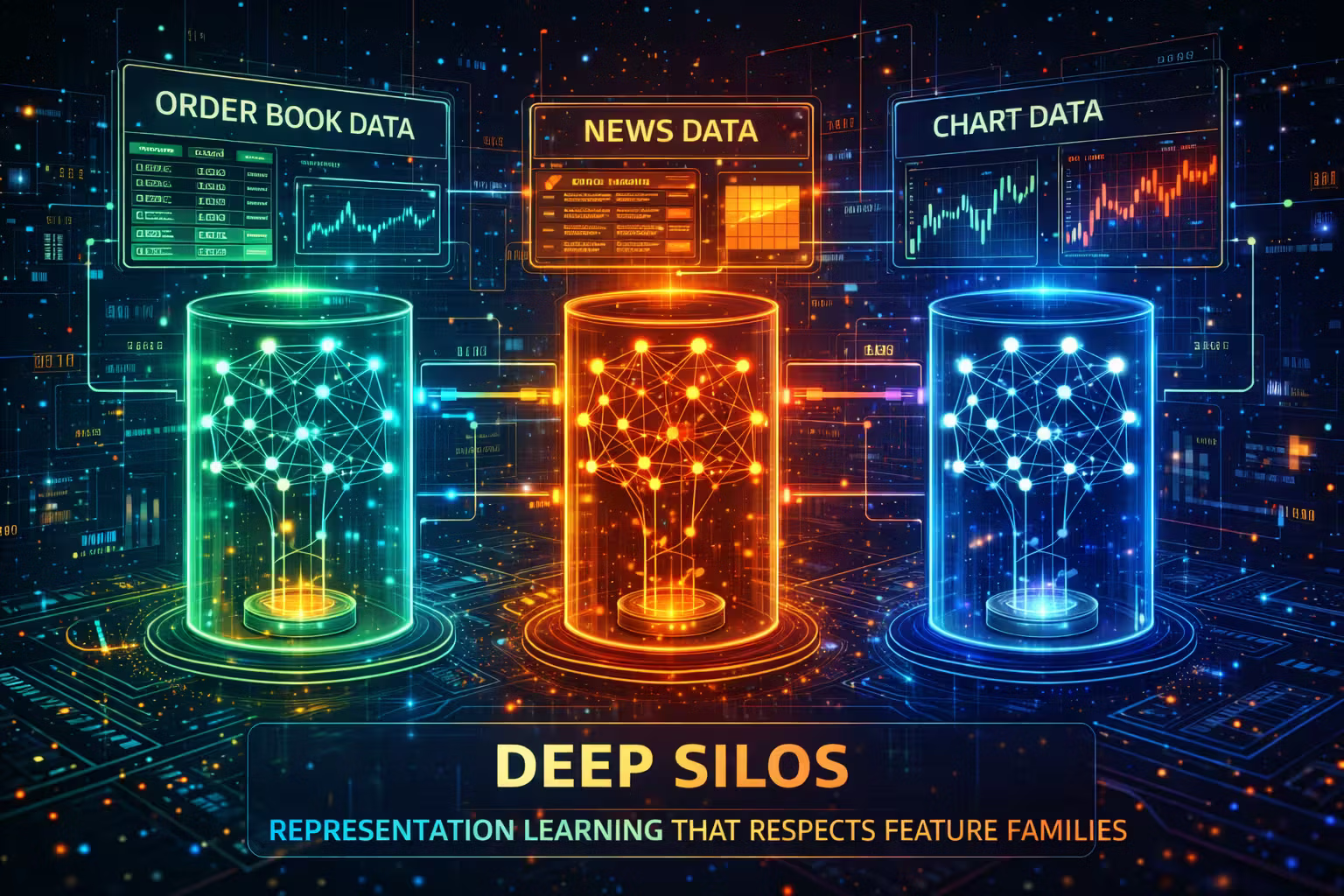
Deep Silos - Representation Learning That Respects Feature Families
My first serious attempt at making the model “see” microstructure features the way I designed them — grouped, compressed, and only then fused.

Axel Domingues
In August, I got my first real supervised “alpha” curves. They were… humbling.
Not because the model was useless — but because it was too easy to get a model that looked smart on the training set and weirdly fragile on validation.
This month I stop treating “add more layers” as the answer and start treating architecture as a way to encode how I believe the features should behave.
I’m calling the approach Deep Silos:
- group features by microstructure meaning (“feature families”)
- learn a compact representation per family
- only then fuse the representations into a shared network
This is the same mindset shift I had in deep RL: stability isn’t luck — it’s engineering.
The problem: my features are not one blob
By now my dataset is a pile of signals with very different “physics”:
- book shape (depth levels, bid/ask volumes)
- book flow (liquidity created/removed per side)
- trade pressure (buy/sell volume in windows)
- reference signals (index diff, funding-like context)
- “plumbing” features that exist mainly to sanity-check reality
If I feed all of that into one big MLP, the network is free to do this:
- grab whichever feature is temporarily predictive in the training slice
- memorize quirky interactions between unrelated families
- overfit on regime-specific artifacts (bullish months, low-vol periods)
- treat missingness and imputation patterns as signal
In other words: it can learn shortcuts.
And in microstructure, shortcuts are everywhere.
- a clock drift signature
- a missing-data pattern
- a schema default value
- a volume feed glitch
- a dataset split bug
The idea: feature families deserve their own representation
A “feature family” is a set of features that:
- come from the same measurement process
- share scale / statistical behavior
- should be interpreted together
So instead of a single network learning the representation from scratch, I force the structure:
- Silo networks: one small network per family
- Embeddings: each silo outputs a tiny vector (a learned summary)
- Fusion network: concatenated embeddings → shared layers → prediction
That’s it.
It’s not a fancy paper trick. It’s an inductive bias.
Repo anchors (what I actually built)
Step 1: define the silos (the “feature families” contract)
The core design choice is the silo list — what gets grouped together.
In alpha_detection/deep_silos.py I encode this directly as lists of feature names.
The file builds a SILOS_LIST and a FEATURES_NAMES_LIST. The silos are patterns like:
- order book “level i” groups
- bid and ask volume per depth level
- created/removed liquidity features (from May’s work)
- multi-window volume features
- other microstructure “families” that should be processed together
A simplified excerpt (structure only, not the full list):
# alpha_detection/deep_silos.py (excerpt)
SILOS_LIST = [
  ['level0', 'level1', 'level2', ...],
  ['ask_volume_level0', 'ask_volume_level1', ...],
  ['bid_volume_level0', 'bid_volume_level1', ...],
  ['ask_added_liquidity_level0', 'ask_removed_liquidity_level0', ...],
  ['buy_volume_1.500000', 'buy_volume_2.500000', ...],
  ...
]
The big win here is not that grouping is “correct”.
The win is: it’s explicit and it’s versionable.
If I change features, I have to change the silo contract too — and that forces me to think.
Step 2: learn a compact embedding per silo
Inside the deep_silos() network, each silo does this:
- select the silo’s features out of the full feature vector
- apply a small MLP
- output a tiny embedding (in my code: 2 units per silo)
- apply dropout during training
From the repo:
# alpha_detection/deep_silos.py (excerpt)
for feature_list in SILOS_LIST:
    silo_x = tf.gather(x, indices=cols, axis=1)
    out = mlp(silo_x, hidden_sizes=(10, 10), output_size=2, keep_prob=keep_prob)
    silos.append(out)
Two things matter here:
- Compression is a regularizer
If each silo gets only a tiny output, it can’t memorize everything. - Family-level invariances can form
The silo can learn patterns like “imbalance across levels” or “liquidity draining” inside the family.
Even though I’m not writing those formulas down, the architecture nudges the network to discover them.
Step 3: fuse embeddings + “other features” into a shared network
After the per-silo embeddings:
- concatenate embeddings
- optionally concatenate any remaining features not covered by silos
- apply shared dense layers
- output the prediction
Again, from the repo:
# alpha_detection/deep_silos.py (excerpt)
silos_concat = tf.concat(silos, axis=1)
x_concat = tf.concat([silos_concat, non_silo_features], axis=1)

out = tf.contrib.layers.fully_connected(x_concat, num_outputs=10)
out = tf.nn.dropout(out, keep_prob)
out = tf.contrib.layers.fully_connected(out, num_outputs=1, activation_fn=None)
This is the “fusion MLP”. It’s where cross-family interactions are allowed — but only after each family is summarized.
Training loop: what I log when I don’t trust myself
The training script is alpha_detection/train_alpha_model.py.
It’s classic TensorFlow-era code (placeholders + sessions), but the interesting part is the instrumentation discipline:
- mean/sigma computed from training only
- inf and NaN handled explicitly
- dropout controlled by
keep_prob - validation cost checked repeatedly
- predictions sanity-checked with threshold counters
The script contains a big display_results() function that prints:
- output mean/std/min/max
- label mean/std/min/max
- how many predictions exceed certain thresholds (0.25, 0.5, 1.0, etc.)
- what the true labels were when the model was confident
This looks crude… but it is exactly the kind of “manual dashboard” I need early:
- it catches exploding outputs
- it catches collapsed outputs (everything near 0)
- it reveals if “confidence” correlates with actual bigger moves
- it tells me if I’m just learning average behavior
What changed in my thinking
I used to think “feature engineering” ends when you build the feature columns.
Now I think:
Feature engineering continues into the model architecture.
Deep Silos is feature engineering with weights.
It’s me telling the network:
- “these features belong together”
- “summarize them first”
- “don’t mix everything too early”
- “earn the right to learn cross-interactions”
The deep-silos checklist (what I keep breaking)
Here’s the stuff I keep getting wrong — and the checks that save me:
Verify feature ordering is identical everywhere
If FEATURES_NAMES_LIST changes but the dataset column order doesn’t, the model silently trains on garbage.
- Compare dataset column names to
FEATURES_NAMES_LIST - Assert shapes and indices match
Confirm silos cover what you think they cover
A typo in a feature name makes a silo smaller than expected.
- Log the number of columns per silo
- Fail fast if a silo is missing columns
Normalize on training only
If I compute mean/sigma across train+valid I leak information.
- mean/sigma from training slice only
- reuse for valid/test
- store them as artifacts
Treat NaN/inf as pipeline bugs first
Replacing NaNs with 0 is a pragmatic band-aid, not a solution.
- count NaNs per feature
- track NaN rate over time
- inspect where they originate
Watch validation early, not at the end
With microstructure, overfitting can happen fast.
- plot train vs valid cost per epoch
- stop when valid cost worsens consistently
Common failure modes (symptom → likely cause → first check)
- Validation improves then collapses → overfitting to regime/microstructure artifact → compare by time slice, not random shuffle
- Outputs explode (very large values) → normalization bug or NaN/inf propagation → print feature stats after normalization
- Outputs collapse near 0 → learning rate too low or label scale mismatch → print label distribution and baseline predictor
- Model “predicts” mostly during missing-data moments → imputation pattern leakage → plot predictions vs missingness counters
- Training is unstable across runs → small dataset + non-stationary market → fix seeds and log dataset hashes
- Silo embeddings don’t help at all → silo grouping is wrong or too small → try bigger embedding size (2 → 8) and re-evaluate
- Good MSE, bad “useful” predictions → optimizing wrong objective → inspect threshold hit rates and later map to trading decisions
Field notes (what surprised me)
- “More structure” can outperform “more capacity” even with the same data.
- Some feature families are simply unreliable (volume can lie more than I expected).
- The most dangerous bugs are the silent ones: wrong column ordering, wrong normalization, wrong split.
- Deep Silos doesn’t magically make the model smart — but it makes failures easier to interpret.
Deliverables (what I can reproduce right now)
This month’s output isn’t a “production model”. It’s a reproducible experiment:
alpha_detection/deep_silos.py— the architecture definitionalpha_detection/train_alpha_model.py— training loop + diagnostics- Saved artifacts (local, for now):
- mean/sigma vectors used for normalization
- plots of training vs validation cost
- text dumps of “high-confidence” predictions with timestamps
Expected result (qualitative, no fake precision):
- training curve still improves quickly (it always does)
- validation curve is less jumpy than the naive MLP baseline
- “confident predictions” are rarer, but less random
- debugging becomes easier because I can isolate which silo contributes to instability
FAQ
I tried. Dropout and weight decay help, but they don’t encode meaning. Deep Silos is me saying “these features are related; these aren’t” — and forcing the network to respect that early.
I start from microstructure first: what features come from the same mechanism? Then I sanity-check by statistics (scale, missingness, correlation). If I can’t justify a grouping, I keep the features separate.
It’s a deliberate constraint. If it’s too small, I’ll raise it (2 → 4 → 8) and treat that like a controlled experiment. The point is to prevent the silo from becoming a full model on its own.
No. It reduces one type of overfitting (feature mixing shortcuts). Regime shift is still the bigger enemy — and maybe I’ll get punished by it later.
What’s next
Next month I take this model out of the quiet offline world and into something closer to a conversation with the market.
If the model is real, it should behave sensibly in real time:
- predictions should cluster around microstructure events that make sense
- confidence shouldn’t spike on data glitches
- and I should finally see whether the market is “speaking” in the features I engineered
I’m not expecting magic.
I’m expecting feedback — and probably pain.
Live Alpha Monitoring - When the Market Talks Back
I stop treating my alpha model like a notebook artifact and make it sit in the real BitMEX stream. The goal is not trading yet. It is seeing whether my features, normalization, and inference loop survive reality without quietly cheating.
Supervised Baselines - First Alpha Models, First Humbling Curves
I train my first alpha predictor on BitMEX order-book features, and learn why ‘it trains’ is not the same as ‘it works’.