
AI Compliance Becomes Runtime Architecture
After the EU AI Act started enforcing GPAI and transparency obligations, compliance stopped being a PDF exercise and became a production system. This post explains the architecture - model inventory, runtime policy gates, provenance, disclosures, audit logs, vendor evidence, and rollback.

Axel Domingues
August’s hot topic was not a new model.
It was a date.
2 August 2026.
That is when key EU AI Act obligations became enforceable in ways that matter to teams shipping AI systems: general-purpose AI model rules, transparency obligations, and enforcement machinery that turns “AI governance” from slideware into operating reality.
The important part is not “Europe made rules.”
The important part is this:
AI compliance is becoming runtime architecture.
Not a policy PDF. Not a spreadsheet. Not a quarterly checklist. Not a legal review that happens after product already shipped.
A runtime layer.
Because modern AI products are not one model in one place. They are systems:
- model routers
- RAG pipelines
- agents
- tool gateways
- generated media
- prompt templates
- user-specific context
- vendor APIs
- human approvals
- telemetry
- rollouts
- fallbacks
So if compliance requirements apply to the system, the system needs compliance controls inside the architecture.
It is the engineering lens: how to translate regulatory pressure into concrete systems — inventory, policy, evidence, logging, disclosure, monitoring, and rollback.
The trend
AI regulation moved from “future concern” to enforceable operational constraint.
The shift
Compliance becomes a runtime control plane, not a documentation side quest.
The core primitive
Every AI feature needs a traceable record: model, purpose, data class, policy, output, and action.
The thesis
If you cannot inventory, explain, disclose, audit, and revoke AI behavior, you cannot govern it.
The old compliance pattern is broken
The old pattern looked like this:
- product team builds feature
- legal / security asks questions
- someone fills a spreadsheet
- someone writes a policy document
- launch happens anyway
- months later, nobody knows what is actually running
That pattern was already weak for normal software.
For AI systems, it fails completely.
Why?
Because AI behavior is not static:
- model versions change
- prompts change
- retrieval corpora change
- tool permissions change
- routing policies change
- safety behavior changes
- user context changes
- generated outputs become part of downstream workflows
A PDF cannot track that.
A runtime can.
If the document says one thing and the router/tool gateway does another, production wins.
Compliance in one sentence
AI compliance, from an engineering perspective, is:
the ability to prove that an AI system was used for an allowed purpose, with allowed data, through an allowed model, under allowed controls, producing traceable outputs.
That sentence is deliberately operational.
It points to systems you can build:
- inventory
- classification
- routing
- logging
- disclosure
- provenance
- policy gates
- evidence packets
- access reviews
- incident response
The goal is not “perfect compliance.”
The goal is making compliance observable and enforceable.
Why GPAI changes the architecture
General-purpose AI models create a governance problem because they are not tied to one narrow use case.
The same model can be used for:
- customer support
- HR screening support
- code generation
- medical summarization
- marketing copy
- image generation
- legal drafting
- agentic tool use
- internal analytics
- cybersecurity triage
That flexibility is the product value.
It is also the compliance problem.
It is governed by where it is deployed, what data it sees, what decisions it influences, and what tools it can call.
So your compliance architecture cannot stop at “which model provider do we use?”
It needs to answer:
- which model is used in this workflow?
- what version?
- for what purpose?
- with what user-visible disclosure?
- with what data class?
- with what downstream effect?
- with what human review?
- with what audit trail?
That is runtime metadata.
Mini-glossary: the compliance words engineers need
A general-purpose AI model: a model capable of being integrated into many downstream systems and tasks, rather than a narrow model built for one fixed use case.
The actor that develops or places an AI model/system on the market. In platform terms, this may be the model lab, vendor, or system supplier depending on context.
The actor using an AI system in a real workflow. Many product teams are deployers even when they do not train the foundation model.
A requirement to inform people when they are interacting with AI or when content has been generated/manipulated by AI, depending on the system and context.
Metadata that helps answer where an output came from: model, prompt, sources, tools, editor, timestamp, and transformation history.
A structured record that lets reviewers reconstruct what happened: policy decision, model route, data class, output, tool calls, approvals, and evidence.
The architecture pattern: AI Compliance Control Plane
The component I would design for August 2026 is an AI Compliance Control Plane.
Not one giant monolith. Not a legal tool. A set of services and contracts that sit across the AI runtime.
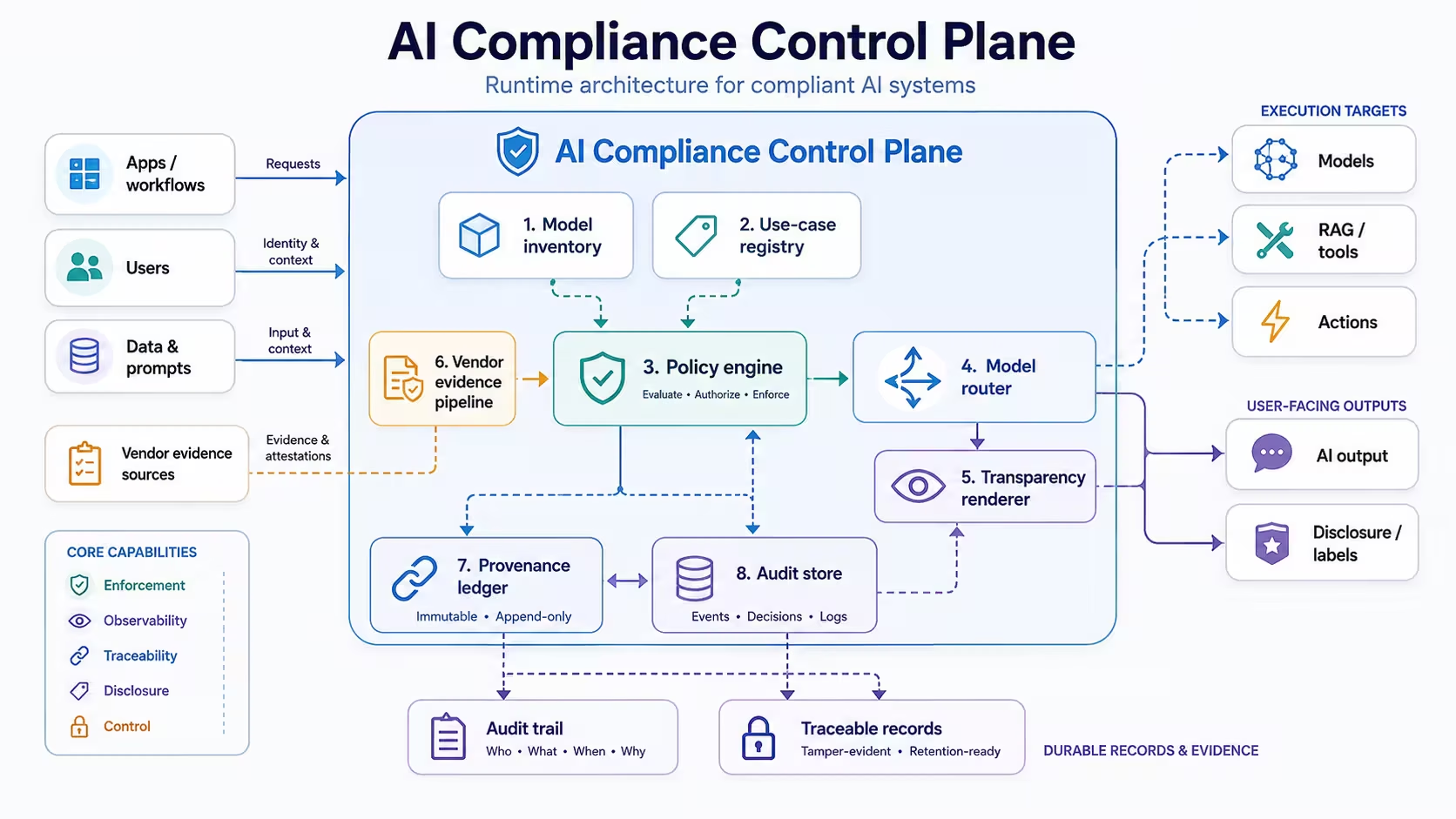
Model inventory
Which models exist, where they are used, what versions are active, and who owns each route.
Use-case registry
Which workflows use AI, for what purpose, with what risk tier and human oversight.
Policy engine
Runtime decisions: allow, deny, disclose, log, redact, require approval, or route differently.
Provenance ledger
A durable record of model route, prompt, data class, output, source evidence, and tool calls.
Transparency layer
User-facing disclosures, AI-generated content labels, metadata marking, and interaction notices.
Evidence pipeline
Vendor documentation, model cards, eval results, DPIA-style inputs, and internal review artifacts.
This is the runtime spine.
Everything else hangs off it.
The first table every company needs: AI system inventory
Before you can govern anything, you need to know what exists.
That sounds obvious.
It is not.
In real companies, AI appears through:
- SaaS features turned on by vendors
- embedded copilots
- marketing tools
- support tooling
- data analysis notebooks
- internal automations
- RAG prototypes
- coding agents
- shadow workflows
So the first engineering artifact is an inventory.
Minimum fields:
ai_system_id: support_reply_assistant
owner: customer_platform
business_purpose: draft support replies from approved knowledge base
user_facing: true
ai_disclosure_required: true
model_routes:
  - provider: openai
    model_alias: support-prod
    version_policy: pinned
data_classes:
  - customer_support_ticket
  - public_kb_article
tools:
  - kb_retrieve
  - draft_reply
  - ticket_read
  - ticket_comment_requires_human
risk_tier: transparency_sensitive
human_review: required_before_external_send
logs:
  provenance: enabled
  retention: 180_days
rollback:
  disable_feature_flag: support_ai_draft_enabled
This is not bureaucracy.
This is how you stop discovering production AI through incidents.
No inventory, no governance.
Risk tiering: route by use case, not vibes
One mistake teams make is trying to classify only the model.
That is not enough.
The same model can be low-risk in one workflow and high-risk in another.
Example:
- summarizing public release notes: low risk
- ranking job applicants: high risk
- drafting a medical explanation: regulated / sensitive
- generating marketing images: transparency-sensitive
- running a coding agent with write access: security-sensitive
So risk tiering belongs at the use-case level.
Low-risk assistive
Drafting, formatting, internal brainstorming, low-impact summarization.
Transparency-sensitive
Chatbots, generated content, synthetic media, user-facing AI interaction.
Decision-influencing
Workflows that affect people, eligibility, access, ranking, moderation, or prioritization.
Security-sensitive
Agents with tools, code access, secrets, deployment paths, or external side effects.
Each tier should map to controls:
- disclosure requirements
- logging level
- model allowlist
- human review
- tool restrictions
- retention policy
- eval requirements
- approval flow
April’s router chose between models.
August’s compliance router decides whether a model is allowed to run at all.
Transparency as a rendering problem
Transparency sounds like policy language.
In production, it is often a rendering problem.
The system needs to decide:
- should the user be told they are interacting with AI?
- should generated content be labelled?
- should metadata be embedded?
- should the disclosure be visible, machine-readable, or both?
- should the label survive export, screenshot, copy/paste, download, or API transfer?
That means transparency must live in the product layer and artifact pipeline.
When a user is interacting with an AI system, the UI may need a clear disclosure.
Engineering question:
- where is the disclosure rendered?
- is it present in chat, embedded widgets, emails, and mobile views?
- can downstream integrators remove it?
Generated or manipulated content may need labels.
Engineering question:
- is the label visible?
- is there metadata?
- does the label persist through export?
- how do edits change the label?
If content marking is required, it must be part of the generation pipeline.
Engineering question:
- what happens if marking fails?
- do we block export?
- do we fall back to visible labels?
- is failure logged as a compliance event?
Disclosures must be consistent across surfaces.
Engineering question:
- does web match mobile?
- does API output include required metadata?
- do generated files carry provenance?
- do embeds and shares preserve the disclosure?
It is a styling accident.
Provenance: auditability starts at generation time
You cannot reconstruct provenance after the fact.
You must capture it when the output is generated.
A useful provenance record includes:
- system ID
- user / tenant
- model provider
- model version or alias
- prompt template version
- input data classes
- retrieved sources
- tools called
- policy decisions
- output hash
- disclosure status
- human review status
- final action taken
Conceptually:
{
  "event_type": "ai_output_generated",
  "ai_system_id": "support_reply_assistant",
  "tenant_id": "acme-eu",
  "model_route": {
    "provider": "openai",
    "model_alias": "support-prod",
    "model_version": "pinned-2026-08-12"
  },
  "policy": {
    "risk_tier": "transparency_sensitive",
    "decision": "allow_with_disclosure",
    "human_review": "required_before_send"
  },
  "inputs": {
    "data_classes": ["support_ticket", "approved_kb"],
    "retrieval_sources": ["kb:billing-refunds:v12", "kb:account-access:v4"]
  },
  "output": {
    "hash": "sha256:...",
    "content_type": "draft_reply",
    "disclosure_applied": true
  }
}
The point is not the exact schema.
The point is the invariant:
every meaningful AI output should be traceable to the system, model, policy, context, and controls that produced it.
Runtime policy gates: compliance as code
The policy engine is where “we should not do that” becomes enforceable.
A compliance-aware runtime gate can decide:
- allow
- deny
- redact
- require disclosure
- require human review
- route to approved model
- disable tools
- block export
- log at higher detail
- escalate to compliance/security
Classify the request
Determine:
- use case
- data class
- user jurisdiction
- output type
- tool/action intent
- risk tier
Check model eligibility
Ask:
- is this provider allowed?
- is this model approved for the use case?
- does data residency apply?
- is the model version pinned or allowed to auto-upgrade?
Apply transparency rules
Decide:
- does the user need a disclosure?
- should the output be labelled?
- should metadata be embedded?
- should generated content export be blocked if marking fails?
Gate side effects
If the AI triggers tools:
- writes
- sends
- publishes
- exports
- modifies accounts
- changes records
…then compliance and security policies must be checked together.
Emit an audit packet
Record the decision before returning the output or executing the action.
Policies wired into routers, tool gateways, and renderers are controls.
Vendor governance: you need evidence from the model supply chain
Most companies do not train their own frontier models.
They depend on vendors.
So compliance architecture must include a vendor evidence pipeline.
The questions are predictable:
- which provider supplies the model?
- what documentation is available?
- what model/system cards exist?
- what transparency support is provided?
- what data-processing terms apply?
- what regions are supported?
- what logging / retention options exist?
- what safety evals and incident processes are documented?
- how are model updates announced?
- can versions be pinned or rolled back?
Provider evidence
Model documentation, eval summaries, data-processing terms, transparency support.
Version control
Pinned aliases, change logs, upgrade notices, rollback paths, deprecation windows.
Data controls
Retention, training opt-out, region, access controls, and logging settings.
Incident interface
How vendors report safety/security incidents, model regressions, and policy changes.
Model providers are moving systems. Your governance needs change detection.
AI-generated content: marking is a pipeline, not a checkbox
The transparency story became very visible in August because generated content labelling and watermarking moved from theory to implementation detail.
This matters because generated media flows through many surfaces:
- image editor
- document editor
- CMS
- social post tool
- email builder
- export service
- CDN
- archive
- analytics pipeline
A label that exists only at creation time may disappear later.
So the architecture needs a content lifecycle.
Mark at generation
Apply visible labels and/or metadata as required by policy.
Preserve through transformation
If the user crops, resizes, translates, compresses, or edits, decide whether provenance persists.
Preserve through export
Downloaded files, API responses, and CMS assets should carry required disclosure metadata where feasible.
Log marking failures
If metadata embedding fails, log it. For high-risk content, block export or require visible fallback labelling.
Support audit and user explanation
Users and reviewers should be able to ask:
- was this generated by AI?
- which system generated it?
- when?
- was it edited later?
It is an asset-management problem.
What to measure
Compliance needs dashboards too.
Not because dashboards solve compliance.
Because invisible compliance drift is how systems fail quietly.
Inventory coverage
Known AI systems vs discovered usage; owners assigned; stale entries; unknown model calls.
Policy decisions
Allowed, denied, redacted, disclosure-required, human-review-required, escalation events.
Transparency health
Disclosure render rate, marking success rate, export preservation, label removal attempts.
Audit readiness
Can you reconstruct model, data, sources, output, policy, approval, and action for sampled events?
A useful operational metric:
audit reconstruction success rate
Pick a random AI-generated output and ask:
- what system created this?
- which model/version?
- what prompt template?
- what data class?
- what sources?
- what policy decision?
- was disclosure applied?
- who approved it?
- what action followed?
If the answer is “we’re not sure,” you don’t have an audit trail.
You have logs.
There is a difference.
Failure modes I expect after the AI Act gets real
This is where engineering teams will feel the pain.
Symptom: teams use AI tools or APIs that are not in the official system inventory.
Fix: network discovery, vendor reviews, procurement controls, SDK wrappers, and periodic owner attestations.
Symptom: disclosure exists in the main web app but disappears in mobile, email, exports, embedded widgets, or API responses.
Fix: central transparency renderer and disclosure tests per surface.
Symptom: an output is challenged, but nobody knows which model version produced it.
Fix: pinned aliases, model-route logging, output hashes, and provider change notifications.
Symptom: logs show a request happened, but not the data class, policy decision, retrieved sources, or approval state.
Fix: structured provenance events, not plain text logs.
Symptom: images, audio, video, or text leave the system without required labels or metadata.
Fix: marking at generation, validation at export, and fallback visible labelling.
Symptom: every AI change waits on manual review because controls are not automated.
Fix: encode low-risk approvals into policy gates; reserve humans for high-risk and ambiguous cases.
The implementation blueprint
Here is the order I would build this in a real organization.
1) Create the AI system inventory
Start with a pragmatic registry:
- owner
- purpose
- model provider
- risk tier
- user-facing status
- tools/actions
- data classes
- rollout status
2) Force all model calls through approved adapters
No direct vendor SDK calls from random services.
Use a gateway/router that can log, classify, enforce budgets, and apply policy.
3) Add runtime classification
Classify:
- use case
- data class
- output type
- jurisdiction / region
- action intent
- risk tier
4) Add transparency rendering
Centralize user-facing disclosures and generated-content labelling.
Test across:
- web
- mobile
- API
- export
- CMS
- shared assets
5) Add provenance events
Emit structured events for model calls, retrieval, outputs, policy decisions, and actions.
6) Add vendor evidence tracking
Store provider documentation, versions, policy changes, model cards, eval reports, and contractual controls.
7) Add audit sampling
Regularly sample outputs and reconstruct the full chain.
Treat reconstruction failure as a production bug.
8) Add rollback and disable paths
Feature flags, model alias rollback, route disable, content export block, and tool-gateway shutdown.
centralize the path, structure the events, automate the obvious gates, and keep humans for the irreversible decisions.
How this connects to the rest of 2026
This month does not replace the earlier architecture lessons.
It depends on them.
- March taught that agents need identity and kill switches.
- April taught that model routing is an operational control plane.
- June taught that frontier model releases need staged governance.
- July taught that autonomous systems need containment and incident response.
- August turns those into compliance architecture.
The pattern is now obvious:
AI governance only works when it is wired into the runtime.
Not stapled onto the launch review.
August takeaway
Compliance is not the enemy of AI engineering.
Bad compliance is.
Good compliance is a system property:
- known inventory
- clear ownership
- executable policy
- traceable outputs
- explicit disclosures
- auditable evidence
- controlled rollout
- fast revocation
August takeaway
AI compliance has become runtime architecture.
The durable pattern is: inventory → classify → route → disclose → log → prove → review → rollback.
Resources
European Commission — AI Act enforcement starts
The Commission’s announcement that AI Act enforcement and new transparency requirements began from 2 August 2026.
AI Act Service Desk — enforcement timing
A clear FAQ on which enforcement powers and obligations apply from 2 August 2026.
European Commission — transparency guidelines
Guidelines for providers and deployers on transparency obligations for certain AI systems.
European Commission — GPAI provider guidelines
Guidance on the scope of obligations for providers of general-purpose AI models.
FAQ
No.
Engineers do not need to interpret every legal nuance alone.
But engineers do need to build systems that can:
- inventory AI usage
- enforce runtime policies
- apply disclosures
- preserve provenance
- produce audit evidence
- and disable risky behavior quickly
Legal defines obligations. Architecture makes them real.
Start with four pieces:
- AI system inventory
- model gateway/router
- structured provenance logs
- transparency/disclosure renderer
That alone gives you visibility, enforceability, and auditability.
Small teams need the lightweight version.
At minimum:
- know which AI systems exist
- route model calls through one path
- log model/version/output metadata
- disclose AI interaction where required
- keep a manual review path for high-impact workflows
The architecture can be simple. The discipline cannot be absent.
Treating compliance as documentation instead of runtime behavior.
If a policy is not connected to routing, logging, disclosure, and tool permissions, it will drift from production.
A model router chooses where a request runs.
A compliance control plane tells the router what is allowed:
- which model
- which vendor
- which region
- which tools
- which disclosure
- which logging level
- which human review state
They should be designed together.